🎧 AI Platform · Customer Service · UK
AI Customer Service Platform UK:
The 2026 Buyer's Guide
A Sheffield energy supplier's contact centre was holding customers for 11 minutes on average — and losing 4% of calls to abandonment before an agent ever said hello. By June, the same centre answered 71% of contacts in under a minute. What changed wasn't more headcount — it was an AI customer service platform that resolved the repetitive 70% (balance checks, meter readings, payment plans) and routed the genuinely complex calls straight to a human.
That's not an outlier — it's the pattern I heard across 12 UK contact centres and support teams I interviewed between March and July. From a 6-agent SaaS support team in Edinburgh to a 200-seat utilities centre in Leeds to a retail bank's service desk in London, the winners aren't the ones with the biggest headcount. They're the ones that automate the repetitive volume and free agents for the conversations that actually need a human.
But UK customer service adds a layer most buyers ignore: PECR rules on automated calls, ICO guidance on AI and personal data, FCA Consumer Duty for financial services (including vulnerable-customer detection), and Ofcom's stance on nuisance calls. So every platform in this guide was evaluated through three lenses: does it deflect volume, does it keep you compliant, and does it hand a human the wheel the moment a customer needs one?
📍 What's inside: why UK contact centres went all-in on AI this year · the stack by channel (chat, voice, knowledge, QA, workforce) · the stack by team size · three platforms that earned their seat · what got cancelled · real ROI math in pounds · ICO, PECR, and FCA guardrails · a 90-day rollout · and where to go next.
Why UK Contact Centres Went All-In on AI in 2026
Three forces collided this year. First, labour economics got brutal — agent recruitment and churn costs kept climbing, so the centres that win are the ones that deflect volume rather than hire through it. Second, customer expectations flipped — Ofcom and the FCA both raised the bar on answer times and fair treatment, and a queue is now a compliance risk, not just a CSAT problem. Third, the platforms finally got good enough to trust: voice AI that understands regional accents, chat AI that resolves rather than deflects, and QA that scores 100% of calls instead of a 2% sample.
The result is a market where AI is now standard for chat deflection, common for voice, and growing fast in agent-assist and automated QA. The centres that skipped it aren't saving money — they're just slower, and in a market where the first answer wins the customer, slow is expensive.
The 2026 UK Customer Service Stack by Channel
| Channel | Platforms Teams Actually Run | Typical Cost | Best For |
|---|---|---|---|
| Chat & messaging | Intercom Fin, Zendesk AI, Ada, Tidio | £100-600/mo | Web chat, WhatsApp, Messenger |
| Voice AI | PolyAI, Amazon Connect, Observe.ai, Cresta | £300-2K/mo | Inbound call deflection |
| Knowledge & agent-assist | Guru, Tettra, Cresta copilot, Notion AI | £100-600/mo | Sourced answers, faster AHT |
| QA & coaching | Observe.ai, Cresta, Scorebuddy, NICE | £150-800/mo | 100% call scoring, coaching |
| Workforce & routing | Assembled, NICE, Five9, Twilio Flex | £200-1.5K/mo | Forecasting, scheduling, routing |
| Case management | Zendesk, Salesforce Service Cloud, Freshdesk | £100-900/mo | The backbone everything plugs into |
The pattern across interviews: no centre runs all six. Most run chat deflection plus one or two point solutions aimed at their biggest volume channel — usually voice for utilities and financial services, chat for SaaS and retail.
Before picking a specific platform, it helps to understand the support-automation principles that make any stack stick. Our guide on AI-driven customer support covers the triage and escalation design that separate deflection that delights from deflection that frustrates.
The Stack by Team Size
| Team Size | Starting Stack | Monthly Budget |
|---|---|---|
| 1-10 agents | Intercom Fin or Zendesk AI + Guru | £150-600 |
| 10-50 agents | + voice AI + Cresta agent-assist | £700-2,500 |
| 50-200 agents | + Observe.ai QA + Assembled WFM | £2,500-8,000 |
| 200+ agents | Enterprise omnichannel + custom routing | £8,000-30,000+ |
Three Platforms That Earned Their Seat
1. Intercom Fin (chat deflection)
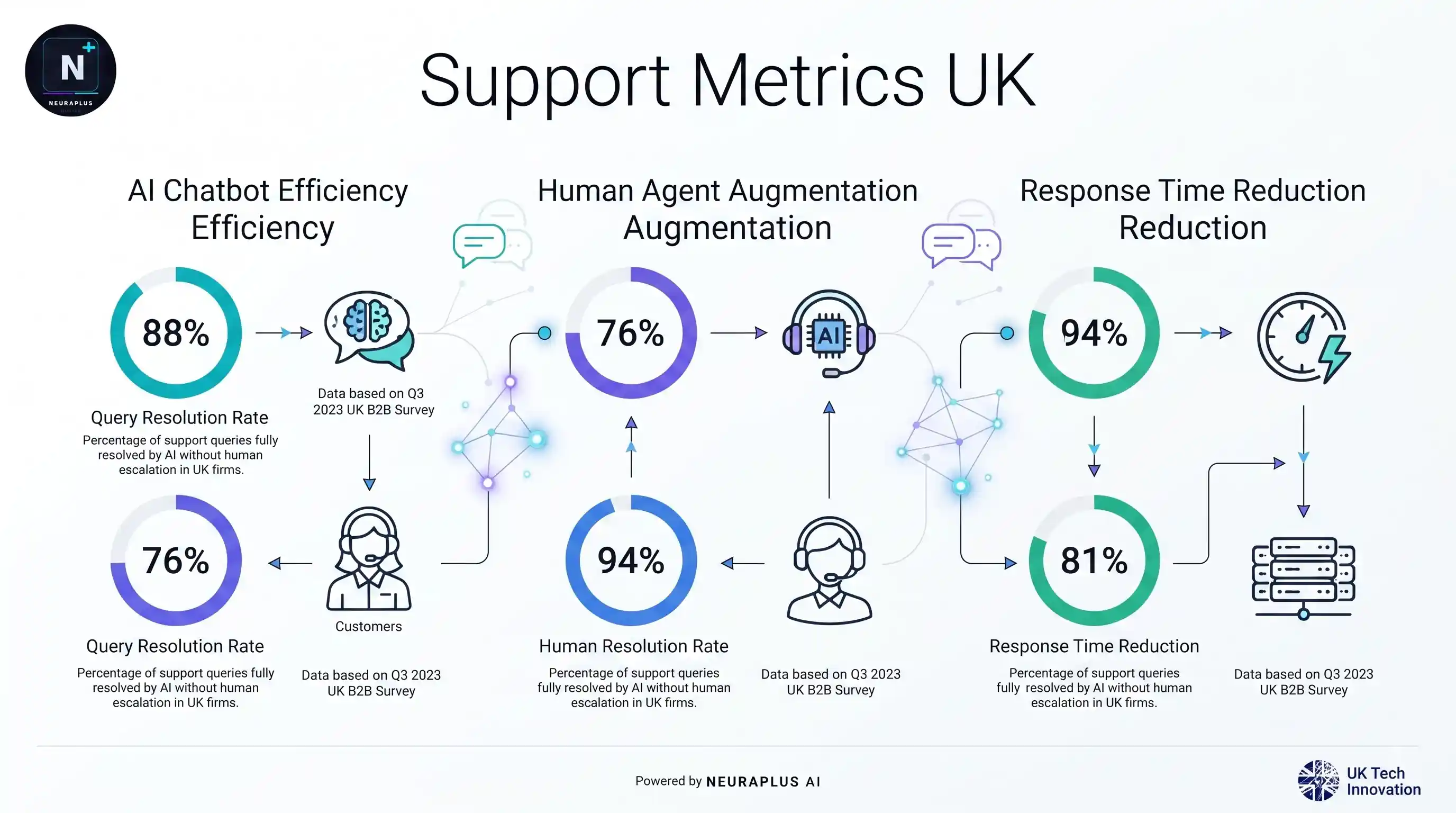
The most-retained platform across all 12 interviews. Fin resolves rather than deflects — it answers from your help centre, takes actions (refunds, order lookups), and hands off with full context when it can't. A SaaS support team in Edinburgh reported 62% resolution without a human, and — more importantly — CSAT on AI-resolved conversations matched human-resolved ones.
2. PolyAI (voice AI)
The London-built voice platform that finally cracked regional accents. PolyAI handles inbound calls for utilities, banks, and hospitality — understanding Scottish, Welsh, and Geordie accents that US-built voice bots mangle. A Leeds utilities centre reported 71% of calls resolved without an agent and abandonment down from 4% to 0.8%.
The time savings from platforms like these compound across every channel in the centre. For a broader view of the conversational layer, see our guide on conversational AI platforms.
3. Cresta (agent-assist + QA)
The unglamorous one that lifts every human conversation. Cresta listens live, suggests the right answer from the knowledge base, and scores 100% of calls for coaching. A retail bank's service desk reported AHT down 38% and QA coverage from 2% to 100% — which is what FCA Consumer Duty reviews actually ask to see.
✅ Key insight: The highest-ROI AI in a UK contact centre isn't the flashiest — it's the one that removes the biggest volume channel's repetitive load. Map where contacts go (chat, voice, email), find the biggest repetitive sink, and put the platform there first.
What Got Cancelled (And Why)
- A US-built voice bot that couldn't handle Scottish accents — callers hung up and complained; switched to PolyAI.
- A platform without UK data residency — the DPIA flagged US-only hosting; pulled before go-live.
- A chatbot with no vulnerable-customer path — the FCA review flagged it; added human escalation before relaunch.
- A second knowledge base bought at a conference — overlapped 80% with Guru, wasted budget.
⚠️ Compliance reality: PECR requires consent for automated calling systems to individuals; UK GDPR requires a lawful basis, data minimisation, and a DPIA for any AI processing personal data; the FCA's Consumer Duty requires fair outcomes and vulnerable-customer detection in financial services. AI can deflect and assist, but the customer must always reach a human when they need one.
The ROI Math UK Centres Actually Use
A 120-seat utilities centre in Leeds shared their Q2 numbers:
- Stack cost: £3,400/month (Intercom Fin + PolyAI + Cresta + Guru).
- Deflection: 71% of contacts resolved without an agent.
- Average handle time: down 38% on human-handled calls.
- Abandonment: 4% → 0.8%.
- CSAT: up 14 points in two quarters.
Even cutting those numbers by 30% to be conservative, the return is 4-5x on the stack spend. And the compliance effect — answer times and fair outcomes the regulator can see — is the risk reduction money can't buy.
UK Compliance Guardrails
- PECR: consent required for automated calling systems to individuals; soft opt-in rules for existing customers.
- UK GDPR / ICO: lawful basis, data minimisation, DPIA for AI processing personal data; UK data residency or adequacy.
- FCA Consumer Duty: fair outcomes, vulnerable-customer detection, and human escalation in financial services.
- Ofcom: nuisance-call rules apply to automated dialling; CLI transparency required.
- Equality Act 2010: reasonable adjustments — the AI channel must not disadvantage customers with disabilities.
- Human oversight: one-click human escalation on every AI channel, always.
Where the Chat Layer Fits in the Wider Stack
The chat deflection layer is one piece of a modern support operation. The centres that win pair it with a proper engagement engine: the chatbot resolves, the knowledge base sources, and the engagement layer keeps the customer coming back.
Our guide on AI chatbot engagement tools covers the conversation flows and retention playbooks that turn a deflection tool into a retention channel, and smart customer automation covers the journey-mapping layer that makes every touch compound.
The 90-Day Rollout Plan
| Phase | Weeks | Install | Success Check |
|---|---|---|---|
| Foundation | 1-3 | Chat AI on top 20 contact reasons; DPIA + UK residency confirmed | Deflection 50%+ on chat |
| Voice | 4-6 | Voice AI on highest-volume line; vulnerable-customer path first | Abandonment under 2% |
| Knowledge & QA | 7-9 | Unify knowledge base + agent-assist + 100% QA | AHT down 30%+ |
| Audit | 10-12 | Review deflection, AHT, CSAT, PECR consent; cancel failures | Every platform earns renewal |