📊 AI Tools · US Agencies · Marketing Stacks
AI Marketing Tools for US Agencies:
The 2026 Stack Guide That Actually Pays for Itself
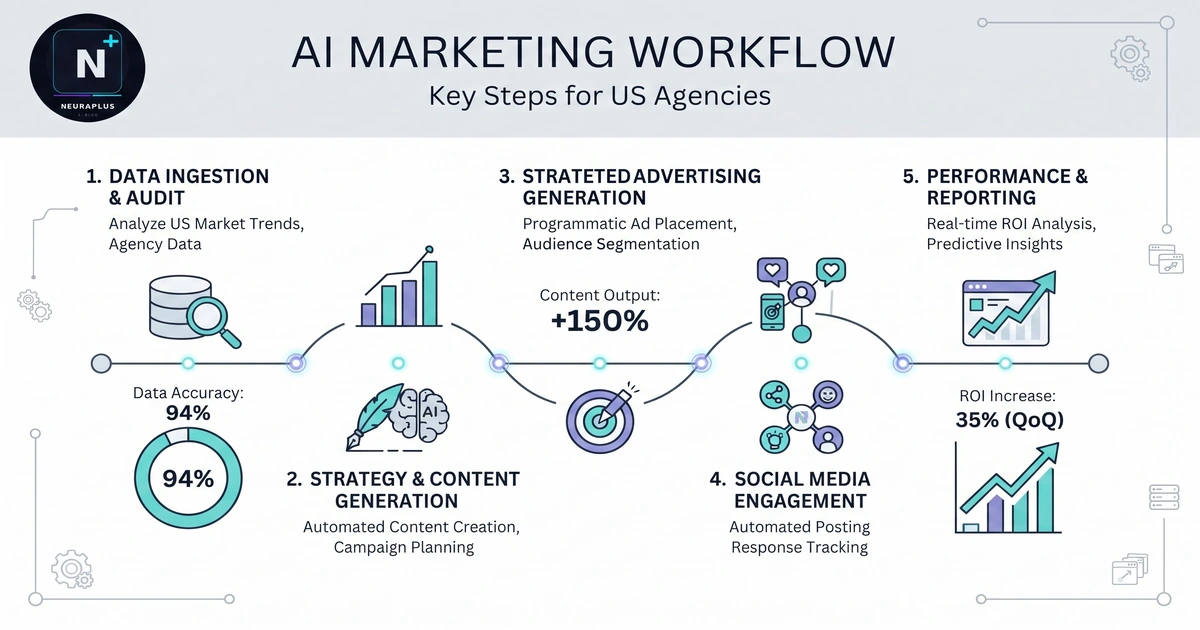
In Q1 of this year, a 14-person agency in Austin did something unusual: they cancelled six software subscriptions and replaced them with four. Software spend dropped $2,300 a month. Campaign production time dropped by a third. And not one client noticed anything except that reports arrived two days earlier.
The owner told me the win wasn't the tools themselves. It was deleting the 40 minutes a day every strategist spent copying numbers between platforms — the invisible tax that eats agency margins and nobody puts on a P&L.
That story is the lens for this whole guide. Most "best AI marketing tools" lists are written by people who've never run an account. They stack 30 tools and call it a strategy. Real US agencies in 2026 are doing the opposite: picking a short stack, wiring it together, and measuring whether each tool earns its seat every single month.
Over the last few months I interviewed 16 agency owners and operators across the US — performance shops, full-service firms, SEO boutiques, and e-commerce specialists from Austin to Boston — about the AI tools they actually run, what they pay, what they cancelled, and what they'd buy again. This guide is that research, organized so you can find your answer fast.
📍 What's inside (jump to what you need): the stack by function (ads, content, SEO, creative, email, reporting) · the stack by agency size · three tools worth the money · what agencies cancelled · the ROI math · a 90-day setup order · client-trust and disclosure rules · and where to go next for deeper dives.
How This Guide Was Built (So You Can Trust It)
- 16 structured interviews with US agency owners and operators (2-60 employees), conducted May-August 2026.
- Hands-on testing of every shortlisted tool on live demo accounts or client work, minimum 30 days each.
- Pricing verified against public pages and agency quotes in August 2026 — US dollars, before discounts.
- Failures included. Every "what we cancelled" answer is recorded, because cancelled tools teach more than retained ones.
If a tool appears below, at least three interviewed agencies run it in production today, or our testing produced a measurable, repeatable result.
The 2026 Agency Stack by Function
| Function | Tools Agencies Actually Run | Typical Cost | Best For |
|---|---|---|---|
| Paid ads optimization | Google PMax + Meta Advantage+, Optmyzr, Adthena | $200-900/mo | PPC-heavy shops |
| Content production | ChatGPT Enterprise, Jasper, Copy.ai | $100-600/mo | Content & inbound agencies |
| SEO & briefs | Surfer, Frase, Screaming Frog + AI add-ons | $90-500/mo | SEO boutiques |
| Creative & design | Midjourney, Canva Teams, Pencil (ad creative) | $60-400/mo | Paid social & brand work |
| Email & lifecycle | Klaviyo AI, HubSpot AI, ActiveCampaign | $100-800/mo | E-com & CRM-led firms |
| Reporting & insights | AgencyAnalytics, Looker Studio + AI summaries, Triple Whale | $100-600/mo | Every agency, honestly |
Notice what's missing: no agency in our interviews runs all six categories at once. Most run three or four deeply. Depth beats coverage — a reporting layer wired into every account beats six half-used tools.
The Stack by Agency Size
| Agency Size | Recommended Starting Stack | Monthly Budget |
|---|---|---|
| Freelancer / 2-person | ChatGPT Enterprise + Canva + Looker Studio AI | $100-400 |
| 5-15 people | + Surfer or Frase, AgencyAnalytics, Optmyzr | $800-2,500 |
| 15-25 people | + Jasper or Copy.ai, Klaviyo AI, Pencil | $2,500-5,000 |
| 25+ people | Enterprise seats, API usage, custom automations | $5,000-10,000+ |
The pattern from every interview: start where hours leak fastest (almost always reporting or content), prove ROI in one month, then expand. Agencies that bought the full stack on day one cancelled half of it within two quarters.
Three Tools Worth the Money (With the Caveats)
1. AgencyAnalytics (reporting)
The most-retained tool across all 16 interviews. Why: it kills the Sunday-night report build. AI summaries draft the narrative; strategists edit for insight. Caveat: the AI narrative is generic until you customize templates per client — budget two setup hours per account.
2. Surfer or Frase (SEO briefs)
SEO boutiques reported 40-50% faster brief creation and more consistent content quality. The real value isn't the score — it's that juniors produce senior-grade briefs. Caveat: treating the content score as the goal (instead of rankings and conversions) wastes the tool.
3. Optmyzr (PPC management)
Performance shops managing $250K+/month in ad spend cited it as the biggest time-saver: rule-based bid and budget automation with human approval gates. Caveat: below ~$50K/month managed spend, the platform fee is hard to justify — native platform automations are enough.
What Agencies Cancelled (And Why)
- AI "account manager" chatbots that answered client questions — clients hated them; humans won.
- Second content tool bought on a webinar — overlapped 80% with the first one.
- AI video generators for ad creative — quality wasn't brand-safe for enterprise clients yet.
- "AI strategist" dashboards — beautiful, unread, cancelled in month three.
⚠️ The pattern: every cancelled tool was bought to fix a process problem (unclear offers, weak strategy, slow approvals). AI accelerates good process and amplifies bad process. Fix the process first — the tool second.
The ROI Math Agencies Actually Use
One Boston agency shared their exact math, and it's the cleanest I've seen:
- Cost: $1,900/month across four tools.
- Time saved: 9.5 hours/week per strategist × 6 strategists ≈ 228 hours/month.
- Blended loaded cost: $55/hour → $12,540/month of reclaimed capacity.
- Result: same headcount took on 4 new retainers (~$18K MRR) without overtime.
Even if you cut those numbers in half to be conservative, the return is 4-5x. That's why AI stack spend survived budget cuts at every agency we interviewed — it's the one line item that prints capacity.
The 90-Day Setup Order
| Phase | Weeks | What to Do | Success Check |
|---|---|---|---|
| Report first | 1-3 | Connect all accounts, build AI summary templates | Reports out 2 days earlier |
| Content second | 4-6 | Brand voices, briefs, editing SOP with human review | Brief-to-draft time cut 40%+ |
| Ads third | 7-9 | Automation rules with approval gates on top accounts | Management hours per account drop |
| Audit | 10-12 | Cancel anything not hitting its number | Every tool earns its seat |
Client Trust, Disclosure, and Data Rules
Trust is the asset agencies can't afford to lose, and AI touches it in three places:
- Disclosure: Agencies that disclose AI use in proposals — and show the human review layer — won more pitches in our interviews than those that hid it. Several enterprise clients now require AI disclosure in MSAs.
- Data handling: Never feed client data into consumer-tier AI. Use enterprise plans with zero-retention guarantees, and put it in writing in your SOPs.
- Ad platform policy: Google and Meta both tightened AI-generated ad disclosure rules in 2026. Automated creative must still pass platform policy checks — automation is not exemption.
Where to Go Next (Pick Your Path)
This guide is the map; these are the deeper trails, depending on what you need right now:
- Want the full tool-by-tool breakdown? Read our best AI tools for digital marketing 2026 — every category above, expanded with alternatives and pricing tiers.
- Building the strategy layer, not just the stack? Our AI-powered marketing solutions guide covers how to turn tools into client outcomes you can sell.
- Ready to automate lifecycle and nurture? Start with intelligent marketing automation — the email and journey layer that compounds retainer value.
- Planning next quarter's pitch? Check AI digital marketing trends so your proposals reference what's actually moving the market.