📈 Content Marketing · US Strategy
Content Marketing Strategy USA 2026:
The 9-Step Framework That Actually Works
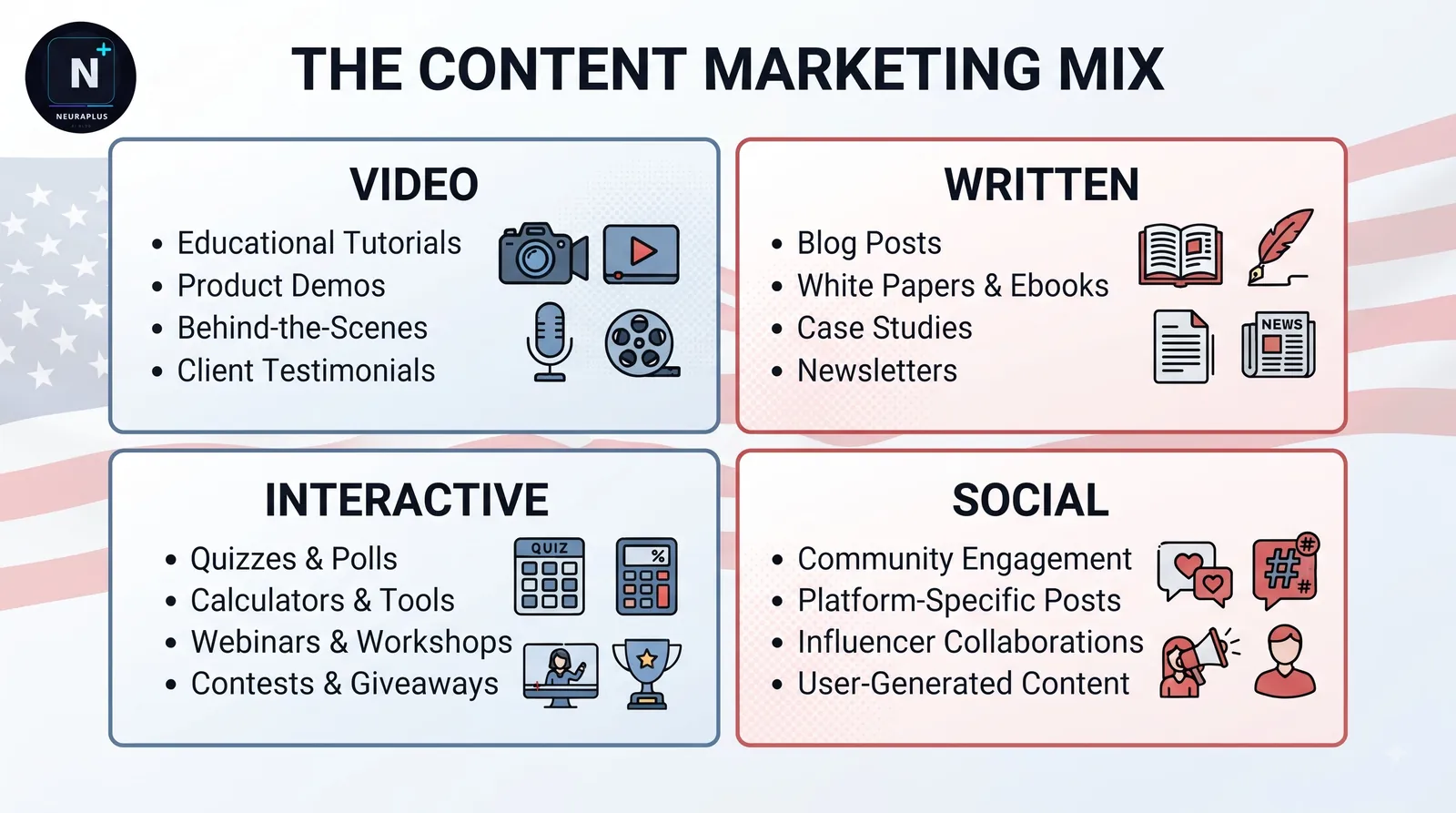
A DTC coffee brand in Portland published four blog posts a month for a year and got almost nothing. The problem wasn't effort — it was strategy. They published without keyword research, without topic clusters, without distribution. After rebuilding with a 9-step framework (personas, clusters, AI-assisted production, multi-channel distribution), organic traffic grew 412% in eight months and content now drives 46% of revenue. Content marketing works in the US — but only with a strategy.
Content marketing costs 62% less than outbound marketing and generates about 3x as many leads (DemandMetric). Companies that blog consistently get 67% more leads than those that don't. But in 2026's AI-saturated US market, publishing without a framework is publishing into a void. This guide is the complete 9-step framework we've applied across US client campaigns.
🇺 US Market Reality: US content marketing is the most competitive in the world. AI has flooded search with content, and Google's Helpful Content Update suppresses thin, expertise-free content. The winners in 2026 combine AI-assisted production with human expertise, topic cluster authority, and multi-channel distribution. Volume without strategy is now a liability.
US Content Marketing in 2026: The Numbers
- 62% cheaper: Content marketing costs 62% less than outbound and generates ~3x the leads (DemandMetric)
- 67% more leads: Companies that blog consistently outperform those that don't
- 25-30% of budget: Average share of US marketing budget allocated to content
- 70% of B2B buyers: Consume content before contacting sales
- AI Overviews: Appear on 40-60% of US informational queries — optimize to be cited
Step 1: Define Goals and KPIs
Every successful US content strategy starts with one primary goal: traffic (brand), leads (demand gen), or revenue (conversion). Then set 3-5 KPIs to measure it:
- Organic sessions: Total search-driven visits
- Keyword rankings: Top 3 / top 10 counts for target keywords
- Conversion rate: Visitors → leads / customers
- Cost per lead: Content cost ÷ leads generated
- Pipeline influenced: Revenue attributed to content (GA4 attribution)
⚠️ Avoid Vanity Metrics: Pageviews alone don't pay salaries. Track content-influenced pipeline in GA4 — the metric that justifies budget. A post with 500 visits that drives 5 demos beats a post with 50,000 visits that drives zero.
Step 2: Build Data-Backed Audience Personas
Guessed demographics ("Marketing Mary, 34, likes coffee") produce irrelevant content. Data-backed personas produce content that converts. Build them from:
- Customer interviews: 5-10 calls with current US customers — jobs-to-be-done, pain points, objections
- CRM data: Which segments close fastest and at highest value
- Search data: What your audience actually searches (Search Console + Semrush)
- Sales calls: Review Gong/Chorus recordings for recurring questions
Step 3: Keyword and Topic Research
Map keywords to funnel stages so content covers the entire buyer journey:
| Stage | Intent | Example (US) | Content Format |
|---|---|---|---|
| TOFU | Informational | "what is content marketing" | Guides, explainers |
| MOFU | Comparison | "best content marketing agencies USA" | Comparisons, lists |
| BOFU | Transactional | "content marketing service pricing" | Case studies, pricing pages |
Use Semrush or Ahrefs for US search volume and difficulty. Prioritize: high business value + winnable difficulty. See our best AI content strategy for SEO guide for the AI-assisted research workflow.
Step 4: Build Topic Clusters
Topic clusters replaced keyword-stuffed single pages as the dominant SEO model. One pillar page covers a core topic; 8-12 cluster articles cover subtopics; all interlinked. This builds topical authority — essential for competitive US keywords.
PILLAR: "Content Marketing Strategy USA" (this page)
  ├── Cluster: "B2B content marketing examples"
  ├── Cluster: "content marketing KPIs"
  ├── Cluster: "content distribution channels"
  ├── Cluster: "AI content writing tools"
  └── Cluster: "content marketing ROI calculator"
📖 Related Reading
AI Blog SEO Strategy 2026
The complete playbook for ranking AI-assisted blogs in US search — topic clusters, E-E-A-T, and AI Overview optimization.Read Article →
Step 5: Create AI-Assisted, Human-Verified Content
The winning formula in 2026: AI for research, outlines, and drafts + human expertise, original data, and expert review. Google's Helpful Content Update suppresses pure AI output without expertise — but rewards AI-assisted content with strong E-E-A-T.
- AI does: research synthesis, outlines, first drafts, meta tags, internal links
- Humans add: original data, expert quotes, first-hand experience, editorial judgment
- Always: author bios with credentials, publication + update dates, citations
✅ The E-E-A-T Rule: Every published piece must demonstrate Experience (first-hand), Expertise (credentials), Authoritativeness (citations, backlinks), and Trust (transparent authorship). AI accelerates production; humans provide the signals Google ranks.
Step 6: Optimize for Google + AI Overviews
Apply on-page SEO (title tags, schema, Core Web Vitals) and structure content for AI citations: question H2s, 40-60 word direct answers, tables, and FAQ schema. AI Overviews cite structured, authoritative sources — be one.
Step 7: Distribute Across Channels
Content without distribution is a tree falling in an empty forest. Repurpose every pillar across the channels where US buyers actually discover content:
| Channel | Best For | Format | US Audience |
|---|---|---|---|
| B2B discovery | Posts, carousels, newsletters | Decision-makers | |
| Highest conversion | Newsletters, sequences | Owned audience | |
| Short video | Reach | Reels, Shorts, TikTok | Younger demos |
| Podcast | Authority | Guest appearances | Commuters |
| YouTube | Search + depth | Tutorials, explainers | Researchers |
For the full channel-by-channel breakdown and 2026 trend data, see our AI digital marketing trends report.
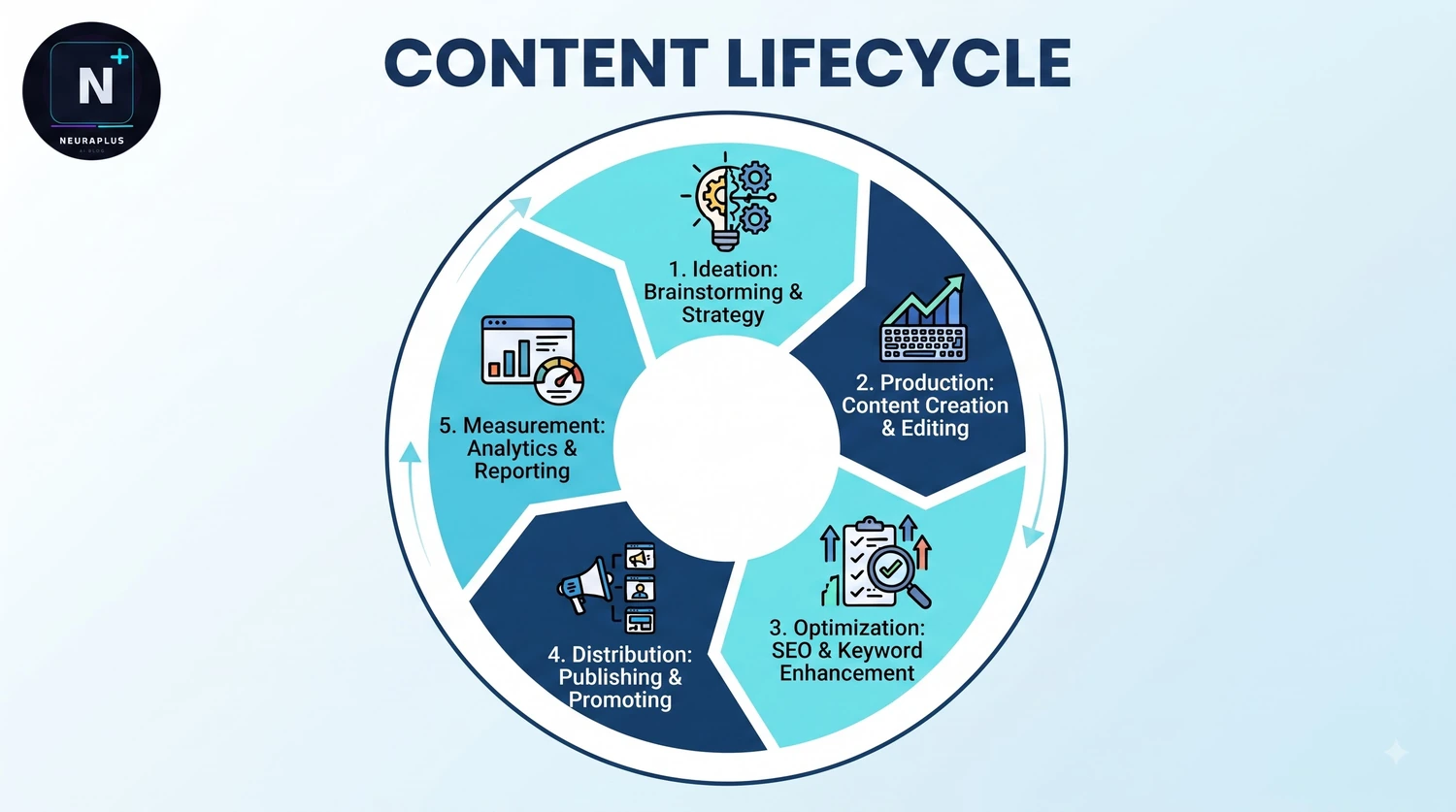
Step 8: Measure KPIs and Iterate
Review KPIs monthly in GA4 + Search Console. Double down on content driving pipeline; refresh or prune underperformers every 90 days. Content marketing compounds — but only if you actively manage the portfolio.
Step 9: Scale What Works with AI
Systematize winning formats with AI-assisted production while maintaining human editorial standards. Expand into adjacent topic clusters as authority compounds. US agencies are scaling this way now — see our guide to AI content writing tools for US agencies.
Content Marketing Tools for US Teams
Semrush From $139.95/mo
Why #1: Keyword research, topic clusters, content audit, SEO writing assistant, and distribution tracking in one platform. The complete US content strategy toolkit.
Surfer SEO From $89/mo
Why optimization: Real-time on-page scoring against top US ranking pages. Optimizes H2s, keywords, and length as you write.
Jasper From $49/mo
Why brand voice: Brand Voice training keeps AI output on-brand across a content team. Campaign workflows generate full content plans from a brief.
HubSpot Free CRM + paid hubs
Why lifecycle: Content + CRM + email + attribution in one. Connects content to revenue — the metric that justifies budget.
BuzzSumo From $199/mo
Why discovery: Finds the most-shared content in any US niche, identifies influencers, and tracks content performance across social.
Content Marketing Mistakes That Kill US Results
⚠️ Warning: These five mistakes waste most US content budgets. Avoid them all.
Mistake 1: Publishing without keyword research
The Fix: Every piece targets a mapped keyword with US volume and intent. No research = no search traffic.
Mistake 2: Volume over quality
The Fix: One comprehensive pillar + 10 clusters beats 30 shallow posts. Google rewards depth and authority.
Mistake 3: Pure AI content without expertise
The Fix: AI drafts + human expertise + original data. Helpful Content Update suppresses the rest.
Mistake 4: No distribution plan
The Fix: Every pillar gets repurposed to LinkedIn, email, and video before the next piece is written.
Mistake 5: Never pruning
The Fix: Audit quarterly. Refresh winners, merge thin posts, prune dead content. A lean, authoritative site outranks a bloated one.