🪙 Google Tools · Quick Decisions
Google Flip a Coin: Instant Heads or Tails Tool

Search "flip a coin" on Google and a coin shows up at the top of the page, waiting to be flipped. Tap it, watch it spin, and you get heads or tails. It's the fastest way to settle a small argument, pick who goes first, or break a tie when two options feel equally good and your brain won't choose.
How to use Google flip a coin
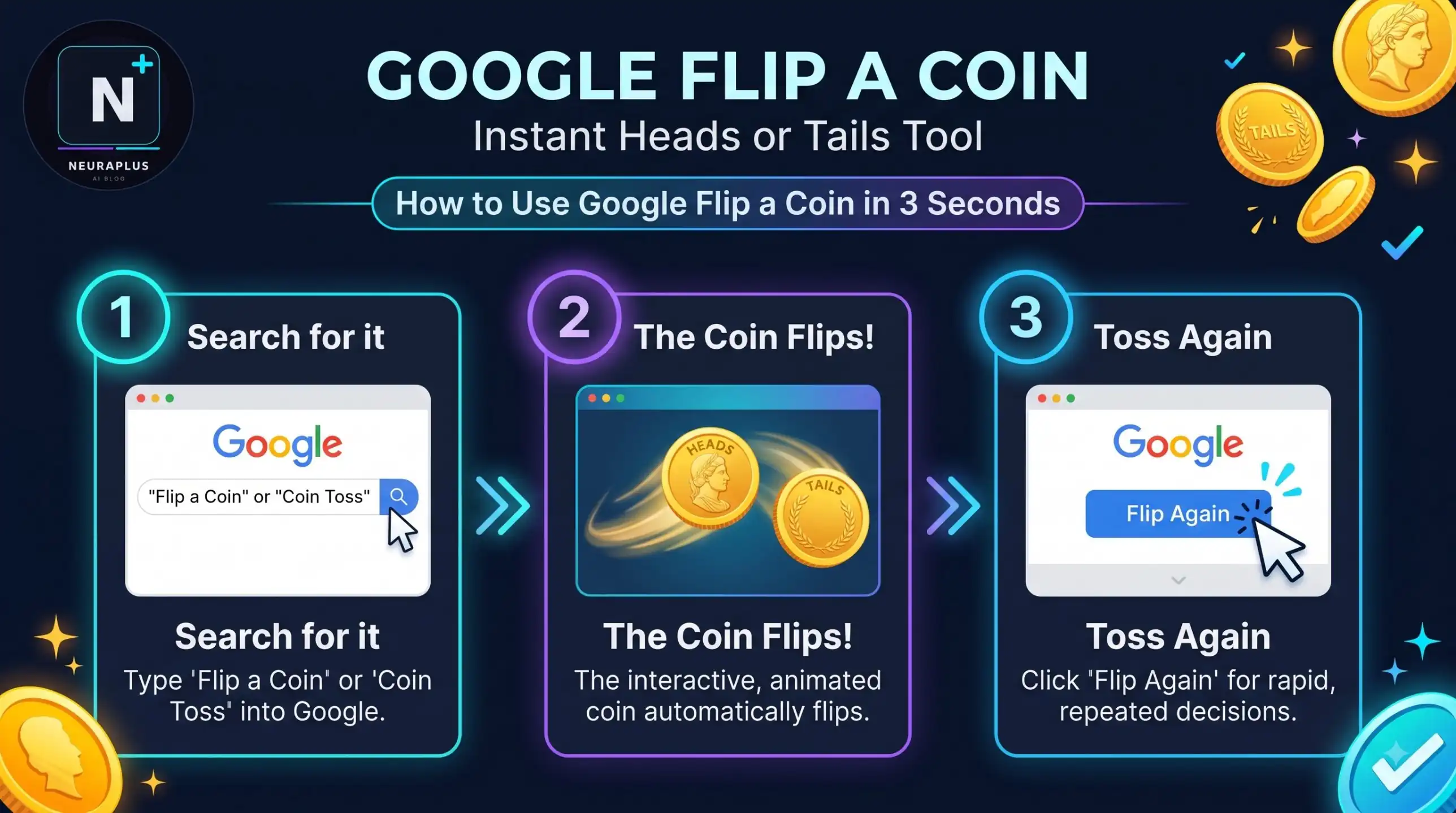
Go to Google and search "flip a coin." A coin widget appears above the regular results. Click or tap the coin, or the flip button if one is shown, and it spins and lands on heads or tails. To flip again, click once more. It works on phones, tablets and computers, with no download or sign-in.
- Open Google in your browser or the Google app.
- Search
flip a coin. - Click or tap the coin to flip it.
- Read the result: heads or tails.
- Flip again as many times as you like.
💡 If nothing appears: Check that you're searching on Google itself, and try the exact phrase again. A different wording like "coin toss" sometimes brings up a different layout.
How fair is a digital coin flip?
The widget uses a software random result, and for everyday choices it behaves like a fair coin: roughly 50 percent heads and 50 percent tails over many flips. There's no wobble, no edge landing and no thumb technique to worry about.
Real coins are a little more interesting. A well-known study of coin tossing by the mathematician Persi Diaconis and colleagues found that a real flipped coin tends to land on the same face it started with slightly more often than half the time, about 51 percent. That's a tiny bias, and you'd need thousands of flips to notice it, but it explains why some people insist that the starting side matters. A digital flip has no starting side, so the bias doesn't apply.
What are the odds of a streak?
Streaks feel unusual and are completely normal. Each flip has a 50 percent chance, regardless of what came before. The coin has no memory, which is the opposite of what the "gambler's fallacy" assumes.
| Event | Chance |
|---|---|
| Heads on one flip | 50% |
| Two heads in a row | 25% |
| Three heads in a row | 12.5% |
| Five heads in a row | 3.1% |
| Ten heads in a row | About 0.1% |
| At least one head in three flips | 87.5% |
| Exactly two heads in four flips | 37.5% |
🎯 Streaks are normal: So if someone flips five heads in a row and says the coin must be rigged, remind them that over a few hundred flips, runs like that appear all the time. The chance of a long streak somewhere in a long sequence is much higher than the chance of one at a specific moment.
When to use a coin flip, and when not to
Flipping a coin works best for low-stakes choices where the options are close: which movie, which restaurant, who takes the first turn, who does the dishes. It saves a lot of time, and the real benefit is often psychological. While the coin is in the air, many people find they're already hoping for one side, and that gut reaction tells them what they actually wanted.
For decisions with serious consequences, like a job offer, a move or a large purchase, a flip isn't a good method. Use a flip to break a tie between two options you've already vetted, not to skip the vetting.
| Situation | Good Fit for a Flip? | Why |
|---|---|---|
| Choosing a lunch spot | Yes | Low stakes, equal options |
| Deciding who serves first | Yes | Needs a quick fair answer |
| Picking between two similar gifts | Yes | Either one works |
| A career change | No | Needs real comparison |
| Splitting money or property | No | Needs agreement or a proper process |
| Breaking a stalemate after you've weighed both sides | Yes | Tiebreaker only |
Decisions with more than two options
A coin only gives you two outcomes. For larger decisions, you can chain flips. Flip once to choose between the first pair of options, then flip the winner against the next one. That gives the later options slightly less of a chance than the first ones, so it's not perfectly even for more than two choices.
If you want an even spread across several options, a die is cleaner. With four options, assign each a number and use the Google roll a dice tool, rerolling if you land on a number you haven't assigned. For two options, the coin is faster and simpler.
Coin flips in real life
Coin tosses decide kickoffs in many sports, and they've settled tied elections in some local races, which shows how much weight a simple, visible random act can carry. People trust a coin flip because it's easy to understand. That's also why a physical coin has a social advantage: everyone sees it land. A digital flip is convenient, but it isn't something you can prove to a skeptic across a table.
Quick ways to make flipping more fun
You can add a rule: best of three, best of five, or first to win two. You can give consequences, like loser picks the music. Kids enjoy making predictions before each flip and tracking how often they're right. And a classroom can chart results from fifty flips to see how close the split gets to 50 and 50.
If you want some other small Google surprises, try the barrel roll trick, where the whole results page spins. For a bigger tour of hidden features, check the Google easter eggs list for 2026 and the guide to cool things to type in Google.
Troubleshooting
| Problem | Cause | Fix |
|---|---|---|
| No coin appears | Search wording or layout | Search flip a coin again, exactly |
| Coin won't spin | Page didn't load fully | Reload the page |
| Result seems stuck | Browser glitch | Clear the tab, or reopen Google |
| Want to see more than two outcomes | A coin only has two sides | Use a die for more options |
| You doubt the randomness | Normal for short streaks | Flip more times and watch the split even out |
✅ Bottom line: Search flip a coin on Google for an instant, fair 50/50 decision tool — no downloads, no sign-in, no app. It's perfect for low-stakes ties and two-option choices. For anything with more than two options, use the dice widget instead. And if the flip reveals you were hoping for one side all along, that's the real answer.