🇺🇸 SEO · Keyword Research USA
How to Do Keyword Research for USA Market:
7-Step Framework + 12 Tools Tested (2026)
A DTC skincare brand in Austin was publishing three blog posts a week and getting almost zero organic traffic from the US. The problem wasn't content quality — it was keyword selection. They were targeting head terms like "skincare routine" (KD 84, 301,000 US searches/month) dominated by Allure, Healthline, and Sephora. After switching to a long-tail intent-based strategy (KD under 20, 200-2,000 US searches/month), they ranked page one for 47 keywords in five months and organic revenue grew 340%.
Keyword research for the USA market is fundamentally different from global research. The US has the highest search volumes, the fiercest competition, the heaviest AI Overview coverage, and the most zero-click searches of any market. This guide shows exactly how to do keyword research for the USA market in 2026 — a 7-step framework tested across 12 tools with real ranking results.
🇺 USA Market Reality: 68% of US searches now end without a click (zero-click). AI Overviews appear on 40-60% of informational queries. US keywords are 2-3x more competitive than global averages. The winners in 2026 target transactional and local intent, optimize to be cited inside AI Overviews, and build topical authority through long-tail clusters.
Why US Keyword Research Is Different
Before touching any tool, understand what makes the US market unique:
- Massive volume, brutal competition: The US generates the largest search volume globally, but head terms are dominated by authority sites (DR 80+). New sites must start long-tail.
- Zero-click dominance: 68% of US searches end without a click due to featured snippets, AI Overviews, and knowledge panels. Target queries where clicks still happen.
- AI Overview coverage: 40-60% of informational US queries show AI Overviews, cutting organic CTR by 30-50% on those queries.
- Local intent strength: "Near me" and local pack queries convert 3-5x higher than national queries for service businesses.
- Distinct seasonality: Black Friday, tax season, back-to-school, and holiday shopping create predictable volume spikes to plan content around.
- US English specifics: Spelling ("color" not "colour"), terminology ("sneakers" not "trainers"), and cultural references differ from UK/AU markets.
⚠️ Critical Rule: Always set your keyword research tool's location to United States. Global or default-location volume data will mislead your entire strategy — a keyword with 10,000 global searches may have only 2,000 US searches, and difficulty scores differ dramatically by region.
Step 1-2: Understand US Search Intent + Build Seed Keywords
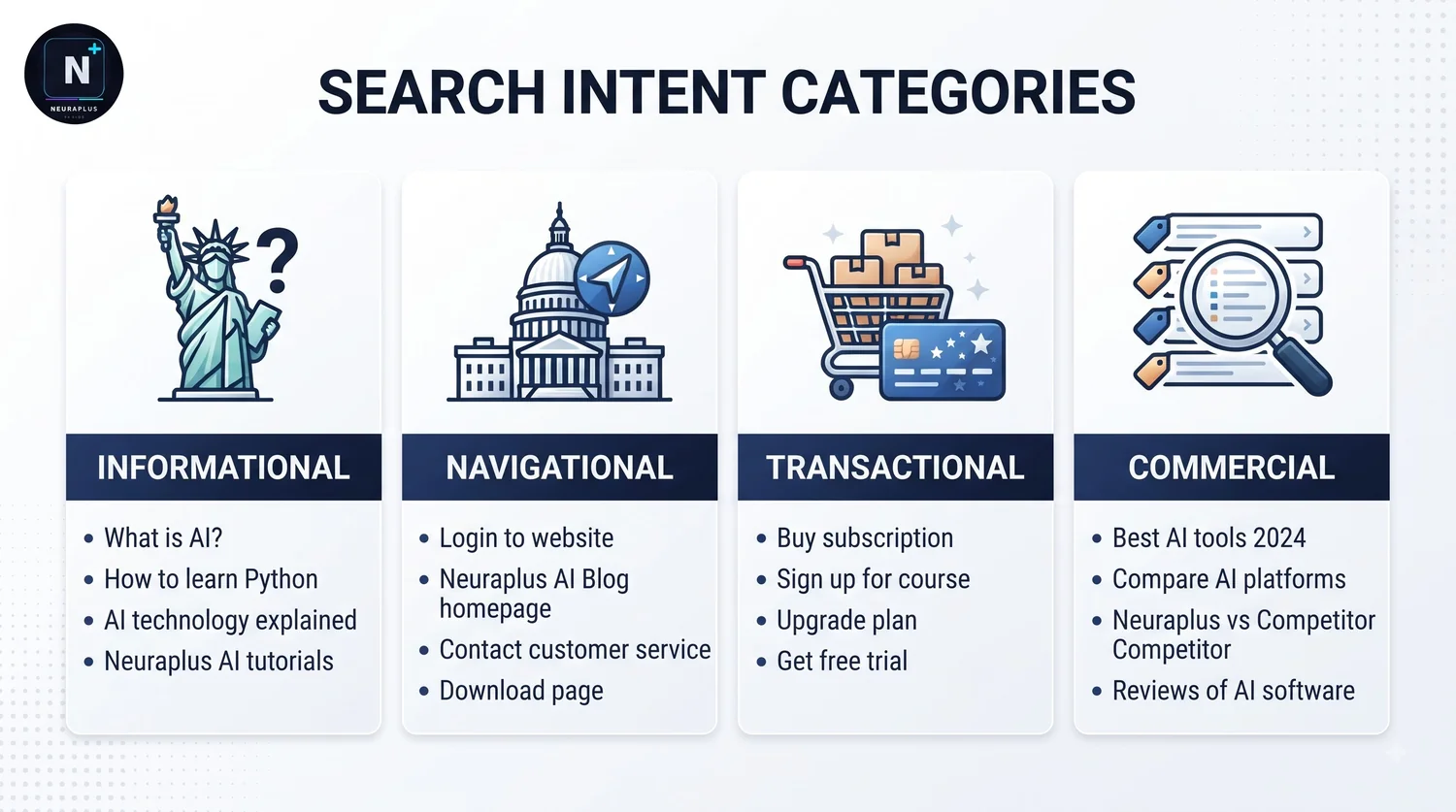
Every US keyword falls into one of four intent buckets. Google matches SERP layout to intent — if your content format doesn't match, you won't rank regardless of quality:
| Intent | Example (US) | SERP Layout | Content Format |
|---|---|---|---|
| Informational | "how to fix a leaky faucet" | AI Overview, Featured Snippet, PAA | Blog post / guide |
| Navigational | "neuraPulse blog" | Brand site | Brand pages |
| Commercial | "best CRM software 2026" | Listicles, comparison boxes | Comparison / listicle |
| Transactional | "buy standing desk USA" | Product pages, ads, shopping | Product / landing page |
Start with 10-20 seed keywords describing your core topics. Example for a US home-services brand: "leaky faucet," "water heater replacement," "emergency plumber," "drain cleaning." These seeds expand into hundreds of long-tail opportunities in step 3.
Step 3: The 12 Best Keyword Research Tools for USA (Tested)
Semrush From $139.95/mo
Why #1: Largest US keyword database (27B+ keywords), Keyword Magic Tool, Keyword Gap vs competitors, Keyword Difficulty scoring, and AI Overview tracking. The complete US keyword research platform used by most professional SEO teams.
Best for: Professional SEOs, agencies, and content teams needing the deepest US data.
Ahrefs From $129/mo
Why backlink leader: Best-in-class backlink index and Content Gap analysis. Keywords Explorer provides US-specific volume, KD, and click-through data. Essential for understanding why competitors rank and what it takes to beat them.
Best for: SEOs prioritizing link building and competitive analysis alongside keyword research.
Google Keyword Planner Free
Why best free: Google's own US search volume data — the source of truth. Free with a Google Ads account. Volume ranges are broad without ad spend, but it's the only tool with first-party US data. Combine with other tools for difficulty scores.
Best for: Everyone — the foundational free data source for US keyword research.
Keywords Everywhere From $10/mo credits
Why best value: Browser extension showing US volume, CPC, and difficulty directly in Google search results. Credit-based pricing means you only pay for what you research. Unbeatable value for solo marketers.
Best for: Solo marketers and bloggers wanting paid-grade data at $10-20/month.
Ubersuggest From $29/mo
Why budget choice: Neil Patel's tool offers US keyword ideas, difficulty scores, and content ideas at a fraction of Semrush pricing. Simpler interface ideal for beginners learning keyword research.
Best for: Beginners and small businesses wanting an affordable entry point.
LowFruits From $25/mo credits
Why low-competition finder: Specifically designed to find weak-SERP keywords where low-authority sites (forums, Reddit, thin content) currently rank — your easiest wins. Perfect for new US sites building initial authority.
Best for: New websites hunting low-difficulty US keywords to build early momentum.
AlsoAsked From $15/mo
Why question mining: Visualizes People Also Ask trees from US Google searches. Reveals the exact questions US searchers ask around your seed keywords — perfect for building FAQ sections and content outlines that win PAA boxes.
Best for: Content strategists building question-based content and FAQ schemas.
AnswerThePublic Freemium
Why visual questions: Generates question, preposition, and comparison wheels from US search data. Free tier offers limited daily searches. Excellent for discovering the full question universe around a topic.
Best for: Brainstorming content angles and long-tail question keywords.
Google Trends Free
Why seasonality: Free tool showing US interest over time, by state and metro area. Essential for planning seasonal content (Black Friday, tax season) and spotting rising queries before paid tools index them.
Best for: Validating trend direction and US regional interest before committing to content.
SE Ranking From $52/mo
Why mid-tier value: Full keyword research suite with US data, rank tracking, and competitor analysis at mid-tier pricing. Strong keyword difficulty accuracy and keyword grouping features.
Best for: Agencies and in-house teams wanting Semrush-grade features at lower cost.
Moz Keyword Explorer From $99/mo
Why priority scoring: Unique "Priority" score combining volume, difficulty, and organic CTR — helping you pick keywords that actually drive clicks, not just impressions. Strong US SERP analysis.
Best for: SEOs prioritizing click-through potential over raw volume.
Surfer SEO From $89/mo
Why content optimization: After research, Surfer analyzes top US SERP results and gives real-time on-page optimization scores. Bridges keyword research and content creation. See our best AI content strategy for SEO guide for the full workflow.
Best for: Optimizing content to rank once keywords are mapped.
📖 Related Reading
SEO for AI Websites 2026: Complete Guide
How to structure and optimize AI-powered websites to rank in US search — technical SEO, schema, and AI Overview optimization.Read Article →
Complete Comparison: All 12 Tools for USA Keyword Research
| Tool | Best For | US Data | Pricing | Free Tier |
|---|---|---|---|---|
| Semrush | All-in-one research | 27B+ keywords | From $139.95/mo | Limited |
| Ahrefs | Backlinks + content gap | Excellent | From $129/mo | Limited |
| Google Keyword Planner | First-party volume | Source of truth | Free | Yes |
| Keywords Everywhere | Browser research | Excellent | From $10/mo | Limited |
| Ubersuggest | Beginners | Good | From $29/mo | Limited |
| LowFruits | Low-competition | Good | From $25/mo | Limited |
| AlsoAsked | PAA question trees | Excellent | From $15/mo | Limited |
| AnswerThePublic | Question mining | Good | From $9/mo | Yes |
| Google Trends | Seasonality | Excellent | Free | Yes |
| SE Ranking | Mid-tier value | Good | From $52/mo | Trial |
| Moz | Priority scoring | Good | From $99/mo | Limited |
| Surfer SEO | Content optimization | Excellent | From $89/mo | Trial |
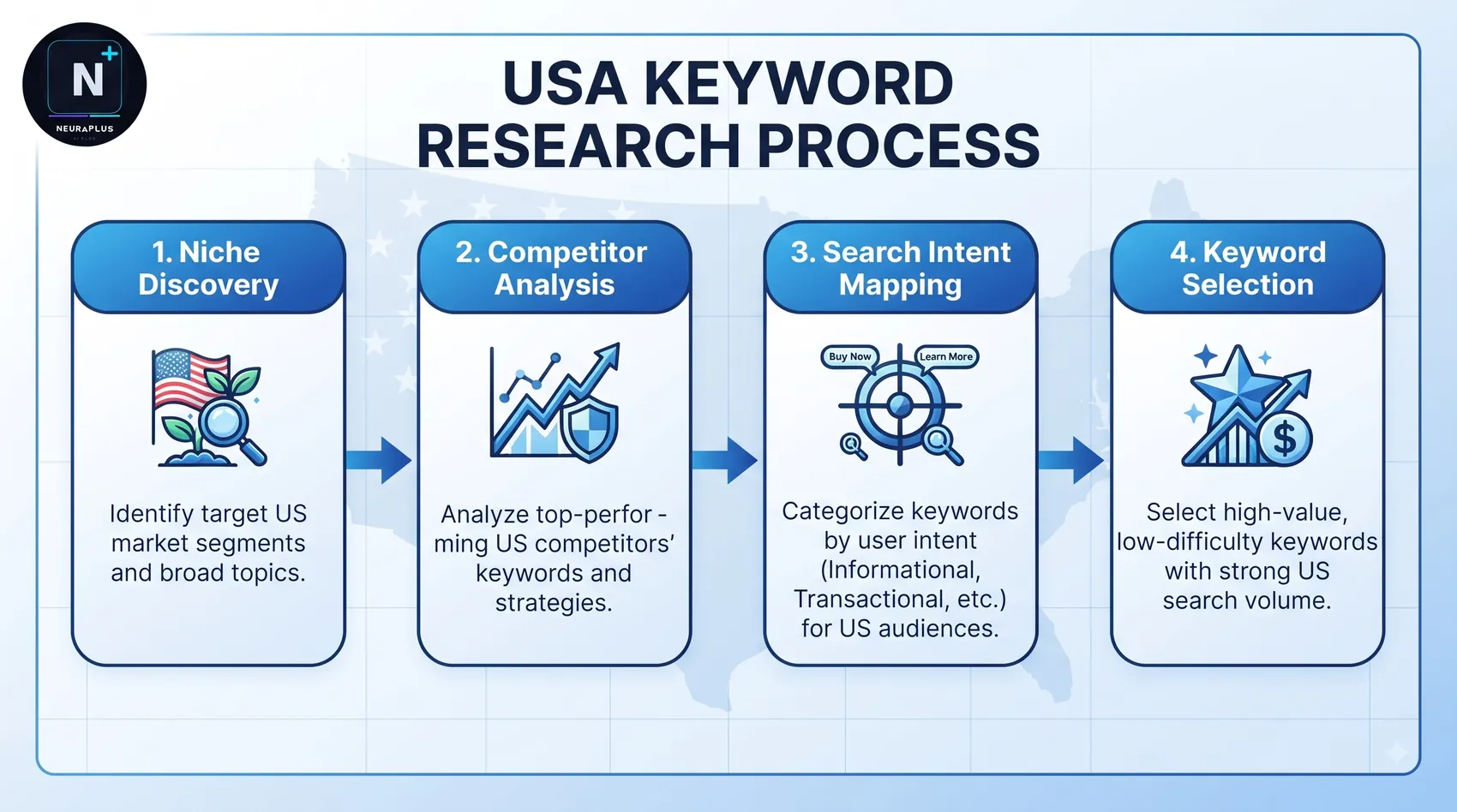
Steps 4-7: Intent Mapping, SERP Analysis, Prioritization, Mapping
Step 4: Map Search Intent
Classify every keyword into the four intent buckets. Then match content format: blog posts for informational, comparison pages for commercial, product pages for transactional. Never target a transactional keyword with a blog post.
Step 5: Analyze SERP Features + AI Overviews
Google the keyword (US location, logged out) and note which features appear. If an AI Overview dominates, decide: optimize to be cited inside it (structured answers, clear H2s, strong E-E-A-T) or pivot to a query type where clicks still happen.
Step 6: Prioritize by Difficulty, Volume, Value
Score each keyword: KD under 30 for new sites, US volume above 100/month, and business value 1-10. Multiply value × volume ÷ difficulty to rank your target list. Attack the highest scorers first.
Step 7: Map Keywords to Content + Track
Assign one primary keyword per page plus 5-15 semantic secondaries. Build topic clusters with internal linking. Track rankings weekly and refresh content every 90 days. See our AI blog SEO strategy 2026 guide for the clustering system.
📖 Related Reading
How to Rank an AI Blog on Google: 2026 Playbook
The complete ranking playbook for AI-generated content in US search — E-E-A-T signals, AI Overview optimization, and ranking timelines.Read Article →
Keyword Research in the AI Overviews Era
AI Overviews changed US keyword strategy permanently. Here's the 2026 playbook:
- Target non-AI-Overview queries: Transactional, local, and comparison queries show AI Overviews far less than pure informational queries.
- Optimize to be cited: AI Overviews cite sources with clear, structured answers. Use question H2s, 40-60 word direct answers, and schema markup.
- Chase the long tail: AI Overviews cover head queries; long-tail queries still deliver clicks and convert better.
- Track AI visibility: Semrush and Ahrefs now track AI Overview citations. Track your citation rate alongside rankings.
- Build E-E-A-T: AI Overviews cite authoritative sources. Author bios, expert credentials, and original data increase citation probability.
Common USA Keyword Research Mistakes
⚠️ Warning: These five mistakes waste months of content effort in the US market. Avoid them all.
Mistake 1: Using global volume instead of US volume
The Fix: Always filter to United States. Global data inflates volumes 3-5x and misrepresents difficulty.
Mistake 2: Targeting head terms with a new domain
The Fix: New sites (DR under 30) should target KD under 20. Build authority with 50-100 long-tail wins before attacking head terms.
Mistake 3: Ignoring search intent
The Fix: Check the US SERP before writing. If page one is all product pages, don't write a blog post for that keyword.
Mistake 4: Chasing volume over business value
The Fix: A 200-search/month keyword that converts at 5% beats a 10,000-search keyword that converts at 0.1%. Score by value, not volume.
Mistake 5: Publishing without tracking
The Fix: Connect Search Console + Semrush/Ahrefs before publishing. Without tracking you can't learn which keywords work.
ROI: What US Keyword Research Delivers
- New blog (0-12 months): 40-60 long-tail keywords ranked page one → 5,000-20,000 US organic visits/month.
- Established site: 200+ keywords ranked → 50,000-200,000 US visits/month → $10,000-100,000/month equivalent ad value.
- E-commerce: Transactional keyword rankings convert at 2-5% → direct revenue attribution.
Organic traffic from well-researched US keywords compounds over time — unlike paid ads, the asset appreciates. A disciplined 7-step process repeated monthly is the highest-ROI marketing activity available in 2026.