📍 Local SEO · Small Business · NeuraPulse
Local SEO Tips for US Businesses:
What Actually Moves the Needle in 2026
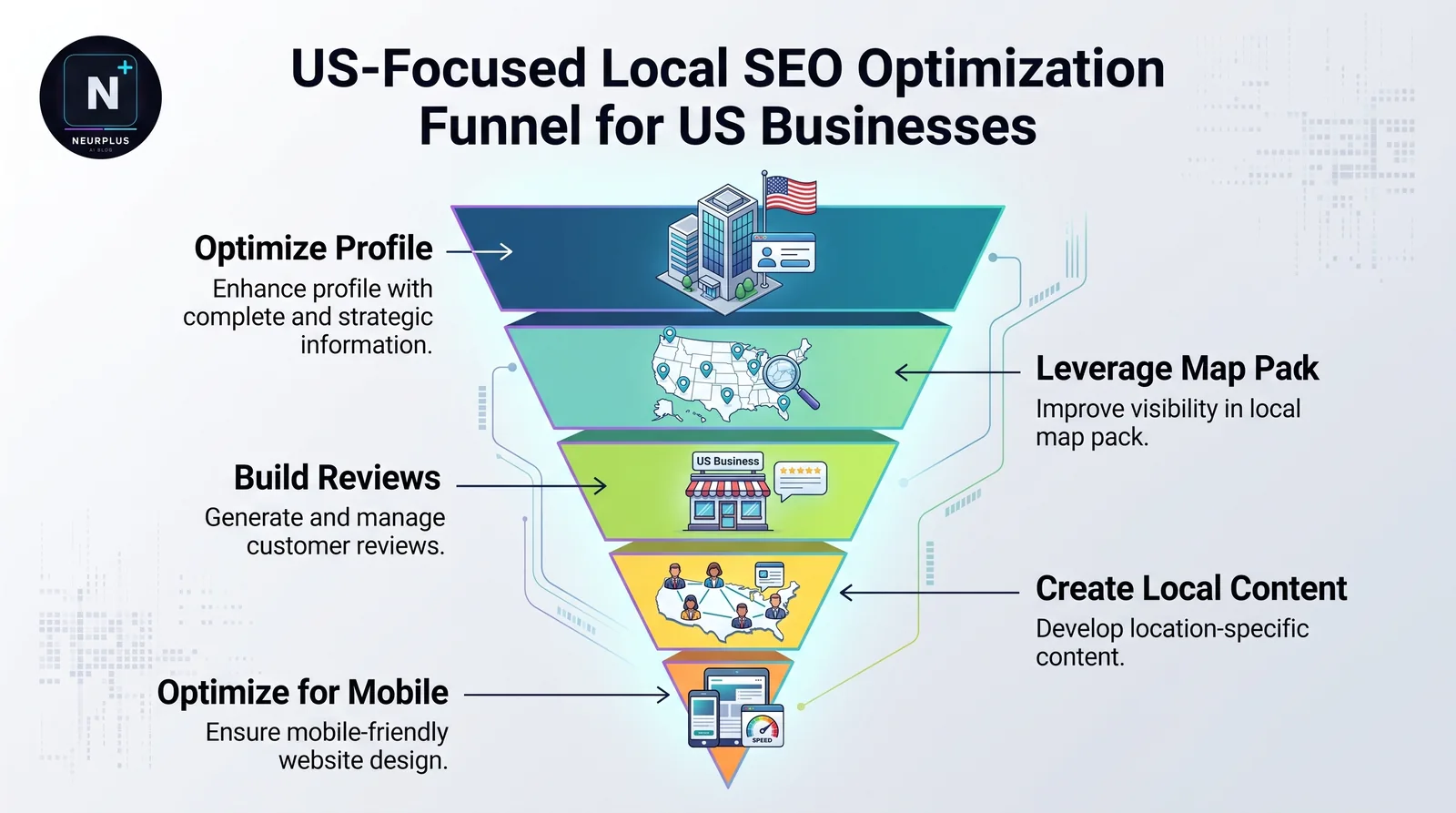
A dentist in Ohio once told me she'd spent three years assuming her website just wasn't "modern enough" to show up on Google. Her site looked fine. What was actually broken was her Google Business Profile — an old address from a location she'd moved out of two years earlier, no photos, and a phone number that rang a disconnected line. Nobody had told her local SEO wasn't about the website at all, at least not primarily. It's about a much smaller, much more overlooked set of signals that most small business owners never think to check.
💡 In plain terms: Local SEO is the set of practices that help a business show up when someone searches for something "near me" or in a specific city — think the map pack at the top of Google results, not just the regular organic listings below it.
Start With Your Google Business Profile, Not Your Website
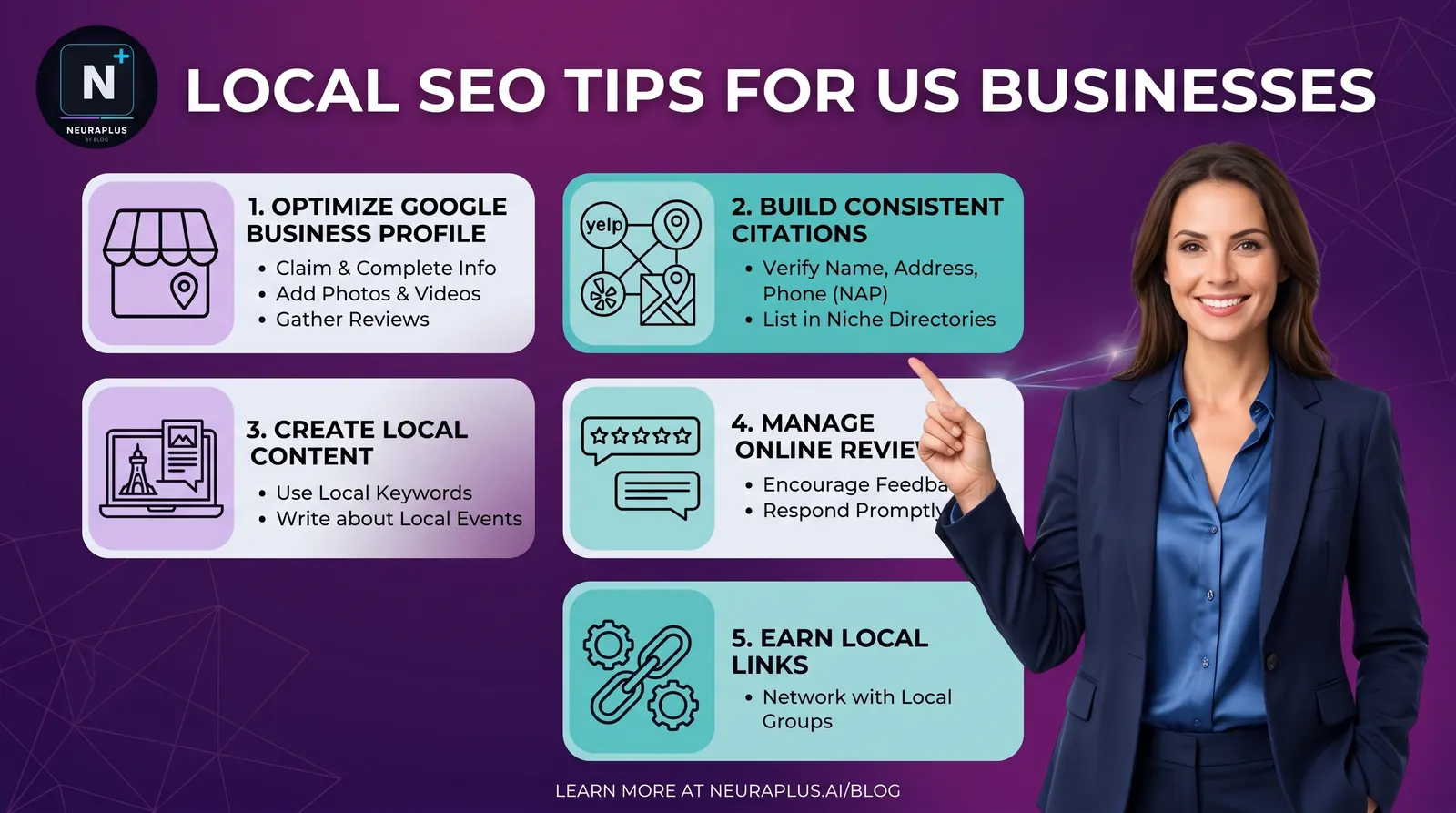
If there's one tip that outweighs everything else in this article, it's this: your Google Business Profile (formerly Google My Business) carries more direct weight for local visibility than almost anything on your actual website. It's the listing that shows up with your hours, photos, reviews, and directions link whenever someone searches for a business like yours nearby. And it's shockingly often left half-finished — wrong categories, missing service areas, stock photos instead of real ones, or worse, duplicate listings competing against each other.
Go through your profile line by line. Confirm the primary category actually matches what you do (a "general contractor" and a "roofing contractor" get shown for very different searches). Add real photos of your actual location, team, and work — not stock imagery. Fill in every attribute Google offers, from payment types to accessibility features. None of this takes more than an afternoon, and for most small businesses it's the single highest-leverage hour they can spend on marketing all year.
Get Your NAP Consistent Everywhere
| Element | Why It Matters | Where to Check |
|---|---|---|
| 1 | Name | Same legal/branded name everywhere, no keyword stuffing |
| 2 | Address | Exact match across directories, no old locations lingering |
| 3 | Phone | One primary number, consistently formatted |
NAP stands for Name, Address, and Phone number, and inconsistency here is one of the most common — and most fixable — local SEO problems out there. If Yelp lists your old suite number, Facebook has an outdated phone line, and your website footer has yet a third variation, search engines start losing confidence in which version is correct. Run a search of your business name across Yelp, Apple Maps, Bing Places, Facebook, and any industry-specific directories, and clean up every mismatch you find. It's tedious work, but it's foundational.
Reviews Aren't Optional Anymore
Both the number and the freshness of reviews factor directly into local ranking, and customers notice the quality of your responses just as much as search engines notice the quantity. A business with 40 reviews and a thoughtful reply to every one — including the negative ones — tends to outperform a business with 200 reviews that's never responded to a single comment. Build a simple habit: ask every satisfied customer directly for a review, right after the job is done or the visit wraps up, when the experience is freshest.
️ A common mistake: Never offer discounts or incentives in exchange for reviews — it violates most platforms' terms of service and can get a listing suspended. Ask for honest feedback, and make it as easy as possible with a direct review link.
Build Location-Specific Content, Not Generic Pages
If your business serves multiple cities or neighborhoods, a single generic "About Us" page won't earn visibility for each of those areas individually. Search engines want to see genuine, distinct content tied to each location — real photos from that market, mentions of nearby landmarks, and details specific to that service area rather than a copy-pasted template with the city name swapped out.
If you genuinely only serve one location, don't force multiple location pages just to look bigger. Google is fairly good at spotting thin, duplicated content built for that purpose, and it can hurt more than help.
Local SEO Doesn't Live in a Silo
One thing we see constantly with small business clients: local SEO gets treated as a separate, isolated task, disconnected from everything else the business is doing operationally. In reality, the businesses that perform best locally tend to be the ones running efficiently overall — replying to reviews promptly, keeping hours accurate during holidays, updating their site when services change.
✅ The honest version: Local SEO rewards businesses that are genuinely well-run and responsive far more than it rewards clever tricks. Most of what moves the needle is unglamorous maintenance work, done consistently.
Local Search Is Changing With AI, Not Disappearing
A fair question small business owners ask us now: does any of this still matter when people are asking ChatGPT or Google's AI Overviews "best coffee shop near me" instead of typing it into a search bar? The honest answer is that it matters just as much, because those AI systems are still pulling from the exact same underlying data — Google Business Profile details, review volume and sentiment, citation consistency — that traditional local SEO has always been built on.