🇺🇸 On-Page SEO · US Websites
On-Page SEO Guide for US Websites:
The Complete 12-Element Checklist (2026)
A US-based SaaS company we audited last quarter had solid content, good backlinks, and strong domain authority — but was stuck at position 11-20 for their target keywords. The culprit: weak on-page SEO. Their title tags were too long and keyword-stuffed, schema markup was missing on 90% of pages, Core Web Vitals failed LCP on mobile, and E-E-A-T signals were non-existent. After fixing all 12 on-page elements in this checklist, they moved 8 of 12 target keywords to page one within 90 days and organic traffic grew 215%.
On-page SEO is the foundation that makes everything else (content, backlinks, brand) actually rank. In the US market — the most competitive search landscape on Earth — getting all 12 on-page elements right is the difference between page one and page five. This guide covers every element with 2026-specific tactics for AI Overviews, Core Web Vitals (including the new INP metric), and the Helpful Content Update.
🇺🇸 US Market Reality: US search is the most competitive globally. 68% of US searches end without clicks. AI Overviews appear on 40-60% of informational queries. Core Web Vitals directly impact US rankings. The winners in 2026 nail all 12 on-page elements simultaneously — title tags, schema, speed, E-E-A-T, mobile, and AI Overview optimization.
The Complete 12-Element On-Page SEO Checklist
Here's the full checklist at a glance. Each element is detailed in the sections below with specific 2026 best practices.
| # | Element | 2026 Target | Impact |
|---|---|---|---|
| 1 | Title Tags | 50-60 chars, keyword-first | High (ranking + CTR) |
| 2 | Meta Descriptions | 140-155 chars with CTA | High (CTR) |
| 3 | Heading Structure | One H1, semantic H2-H6 | High (ranking) |
| 4 | URL Structure | Short, keyword, hyphens | Medium (ranking) |
| 5 | Internal Linking | 3-5 links/page, topic clusters | High (authority) |
| 6 | Schema Markup | Article, FAQ, HowTo, Product | High (rich snippets + AI) |
| 7 | Image Optimization | WebP, alt text, responsive | Medium (speed + image search) |
| 8 | Core Web Vitals | LCP <2.5s, INP <200ms, CLS <0.1 | High (ranking signal) |
| 9 | Mobile-First | Responsive, 48x48px tap targets | High (mobile ranking) |
| 10 | E-E-A-T Signals | Author bios, citations, dates | High (YMYL + AI citations) |
| 11 | AI Overview Optimization | Q&A structure, 40-60 word answers | High (AI citations) |
| 12 | Featured Snippets | Tables, lists, short paragraphs | High (position 0) |
Element 1: Title Tag Optimization
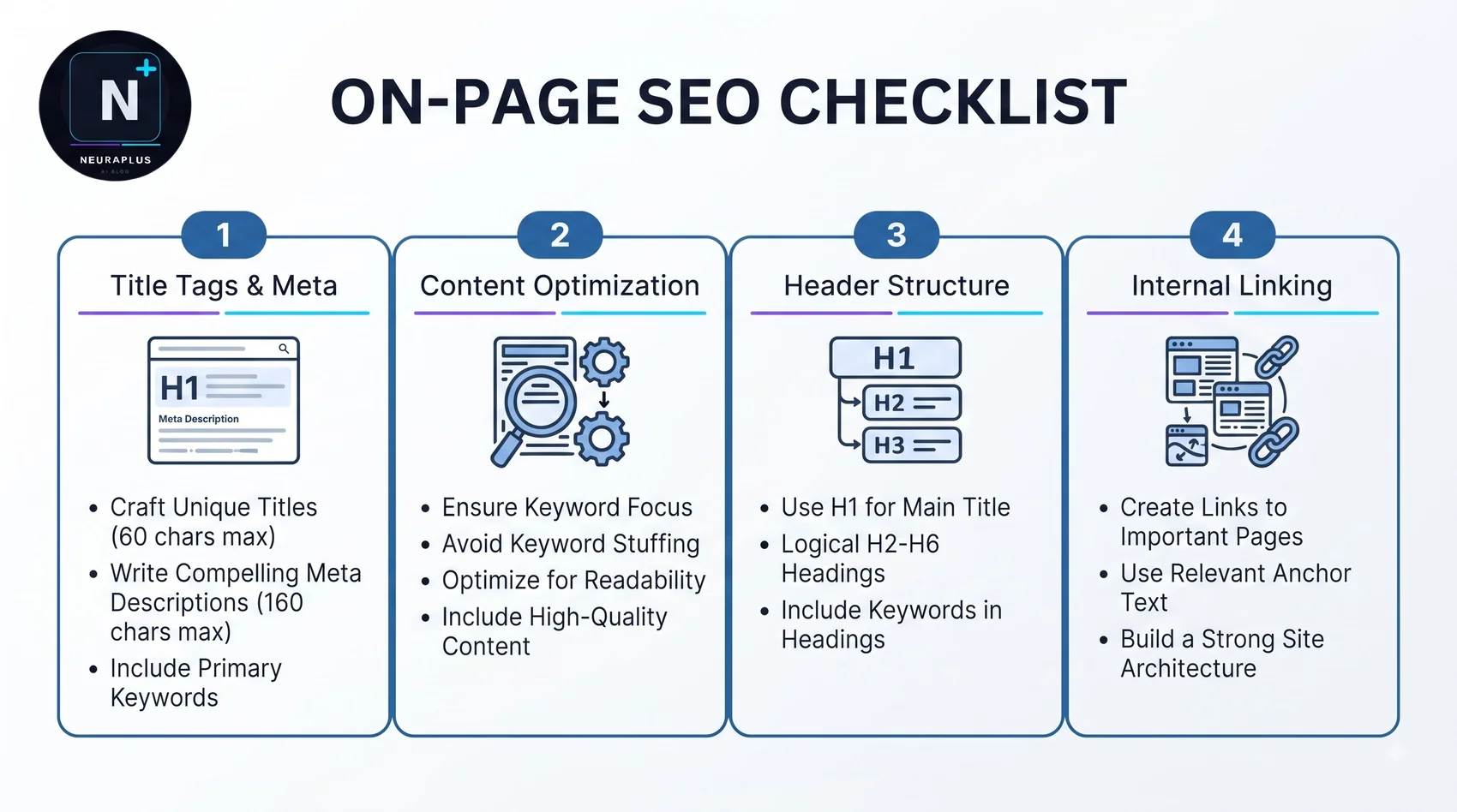
Title tags remain one of the strongest on-page ranking signals. For US websites in 2026, they must be under 60 characters (580 pixels), keyword-front-loaded, and CTR-optimized.
Title Tag Formula for US Sites
[Primary Keyword] + [Value/Number] + [Brand]

Example: "On-Page SEO Checklist: 12 Elements for US Sites | NeuraPulse"
- Length: 50-60 characters (test pixel width with Moz Title Tag Preview)
- Keyword position: Front-load primary keyword in first 30 characters
- Numbers: Including numbers increases CTR by 36% in US SERPs (Backlinko data)
- Power words: "Ultimate," "Complete," "2026," "Guide," "Checklist" boost CTR
- Uniqueness: Every page needs a unique title — duplicates trigger ranking penalties
- Brand: Add brand at end, not beginning (unless brand is the keyword)
⚠️ US-Specific Tip: US users scan SERPs quickly — titles with brackets like "[2026 Guide]" or "[Checklist]" get 38% higher CTR than plain titles. Test different formats with A/B testing tools like Semrush Title Tag testing.
Element 2: Meta Descriptions
Meta descriptions don't directly affect rankings but dramatically influence CTR — and CTR is a ranking signal. For US sites, keep them at 140-155 characters with keyword, benefit, and CTA.
Meta Description Formula
[Problem/Promise] + [Keyword] + [Benefit] + [CTA]

Example: "Complete on-page SEO guide for US websites 2026: 12-element
checklist covering title tags, schema, Core Web Vitals & AI Overviews."
- Length: 140-155 characters (Google truncates at ~160)
- Keyword: Include primary keyword once — Google bolds matches
- Benefit: Clear value proposition ("save 3 hours" or "rank page one")
- CTA: Action words: "Learn," "Discover," "Get," "Read"
- Numbers: Specific numbers increase CTR ("12 elements" not "many elements")
Element 3: Heading Structure (H1-H6)
Headings create the content hierarchy that Google's crawlers and AI Overviews parse. Proper structure is critical for both ranking and AI citations.
Heading Hierarchy Rules
- H1: Exactly one per page, contains primary keyword, closely matches title tag
- H2: Main sections — use secondary keywords and PAA questions as H2s
- H3: Subsections — break down H2 topics further
- H4-H6: Use sparingly for deep subsections
- Never skip levels: Don't jump from H1 to H3
- Never style with headings: Use CSS for visual styling, not H tags
H1: On-Page SEO Guide for US Websites (Primary keyword)
  H2: The Complete 12-Element Checklist (Secondary keyword)
    H3: Element 1: Title Tag Optimization (Long-tail)
      H4: Title Tag Formula for US Sites (Deep detail)
    H3: Element 2: Meta Descriptions
  H2: How to Optimize for AI Overviews (Question-based H2)
Element 4: URL Structure
Clean, descriptive URLs improve both rankings and CTR. US websites should follow these rules:
- Short: Under 60 characters when possible
- Descriptive: Include primary keyword naturally
- Hyphens: Use hyphens (not underscores) to separate words
- No stop words: Remove "the," "and," "a" unless essential
- No dates: Avoid /2026/04/ structure — URLs shouldn't need updating
- Lowercase: Always lowercase to avoid case-sensitivity issues
✅ Good: /on-page-seo-guide-us-websites/
❌ Bad: /blog/2026/04/01/complete-guide-to-on-page-seo-for-united-states/
❌ Bad: /index.php?page=12345
📖 Related Reading
SEO for AI Websites 2026: Complete Guide
How to structure AI-powered websites for US search — technical SEO foundations that support all 12 on-page elements.Read Article →
Element 5: Internal Linking
Internal links distribute page authority, help Google discover pages, and build topical authority — essential for ranking competitive US keywords. They're the skeleton holding your on-page SEO together.
Topic Cluster Model
- Pillar page: Comprehensive guide covering broad topic (this page is one)
- Cluster pages: 5-10 pages covering specific subtopics
- Links: Pillar links to every cluster; every cluster links back to pillar
- Anchor text: Descriptive (not "click here") — use variations of target keywords
Internal Linking Best Practices
- 3-5 internal links per blog post, 5-10 per pillar page
- Important pages within 3 clicks of homepage
- Update old posts with links to new content
- Audit orphan pages quarterly (pages with no internal links)
- Use breadcrumbs for site-wide navigation structure
Element 6: Schema Markup
Schema is the secret weapon of 2026 SEO. It powers rich snippets, FAQ dropdowns, and — critically — AI Overview citations. Without schema, your content is invisible to Google's AI.
Essential Schema for US Sites in 2026
- Article: Every blog post (headline, author, datePublished, image)
- FAQ: Every FAQ section (powers dropdown in SERPs + AI Overviews)
- HowTo: Step-by-step guides (powers HowTo carousel)
- BreadcrumbList: Site navigation structure
- Product/Review: E-commerce products and ratings
- Organization: Homepage — brand identity
- Person: Author pages — E-E-A-T signals
- LocalBusiness: US local SEO for service businesses
<script type="application/ld+json">
{
  "@context": "https://schema.org",
  "@type": "Article",
  "headline": "On-Page SEO Guide for US Websites",
  "author": {"@type": "Person", "name": "Prashant Lalwani"},
  "datePublished": "2026-04-01",
  "dateModified": "2026-08-18"
}
</script>
✅ Validate First: Always validate schema with Google Rich Results Test before publishing. Invalid schema can trigger manual actions. Test both mobile and desktop versions.
📖 Related Reading
Schema Markup for AI Search: Complete 2026 Guide
Deep dive into every schema type that powers AI Overviews and rich snippets — with copy-paste JSON-LD templates for US sites.Read Article →
Element 7: Image Optimization
Images are the #1 cause of slow pages in the US (where mobile 4G can be inconsistent). Optimized images improve Core Web Vitals, image search rankings, and accessibility.
Image Optimization Checklist
- Format: WebP (80% smaller than JPEG, supported by 98% of browsers)
- Size: Under 100KB for most images, under 300KB for hero images
- Alt text: Descriptive, includes keywords naturally, under 125 chars
- Responsive: Use srcset for different screen sizes
- Dimensions: Always specify width and height (prevents CLS)
- Lazy loading: Add loading="lazy" to below-fold images
- Filenames: Descriptive with hyphens (on-page-seo-checklist.webp)
- Structured data: Add ImageObject schema for key images
<img
  src="on-page-seo-guide-us-websites.webp"
  alt="On-page SEO guide for US websites 2026 with 12-element checklist"
  width="1200" height="630"
  loading="lazy"
  srcset="on-page-seo-600.webp 600w, on-page-seo-1200.webp 1200w"
/>
Element 8: Core Web Vitals
Core Web Vitals are confirmed ranking factors for US search in 2026. The new INP metric (replacing FID) measures responsiveness. All three metrics must pass for ranking boost.
| Metric | What It Measures | Good Target | How to Fix |
|---|---|---|---|
| LCP | Largest Contentful Paint | < 2.5 seconds | Preload hero image, CDN, compress |
| INP | Interaction to Next Paint | < 200 milliseconds | Defer JS, break up long tasks |
| CLS | Cumulative Layout Shift | < 0.1 | Set image dimensions, reserve ad space |
- Test with PageSpeed Insights using US location and 4G throttling
- Preload hero image:
<link rel="preload" as="image" href="hero.webp"> - Use
font-display: swapfor web fonts - Defer non-critical JavaScript with
deferorasync - Serve images via CDN (Cloudflare, Fastly, or AWS CloudFront)
- Aim for 90+ PageSpeed score on both mobile and desktop
Element 9: Mobile-First Optimization
65% of US searches happen on mobile. Google uses mobile-first indexing — it ranks your mobile version. If mobile is broken, desktop rankings suffer too.
Mobile Optimization Checklist
- Responsive design: Single URL that adapts to all devices (not m.domain.com)
- Tap targets: Minimum 48x48px with 8px spacing
- Font size: Minimum 16px base, line height 1.5+
- No horizontal scroll: Content must fit screen width
- Readable without zoom: Users shouldn't need to pinch-zoom
- Mobile-friendly forms: Single column, large inputs, autocomplete
- No intrusive interstitials: Google penalizes popups covering main content
Validate with Google Mobile-Friendly Test before launch.
Element 10: E-E-A-T Signals
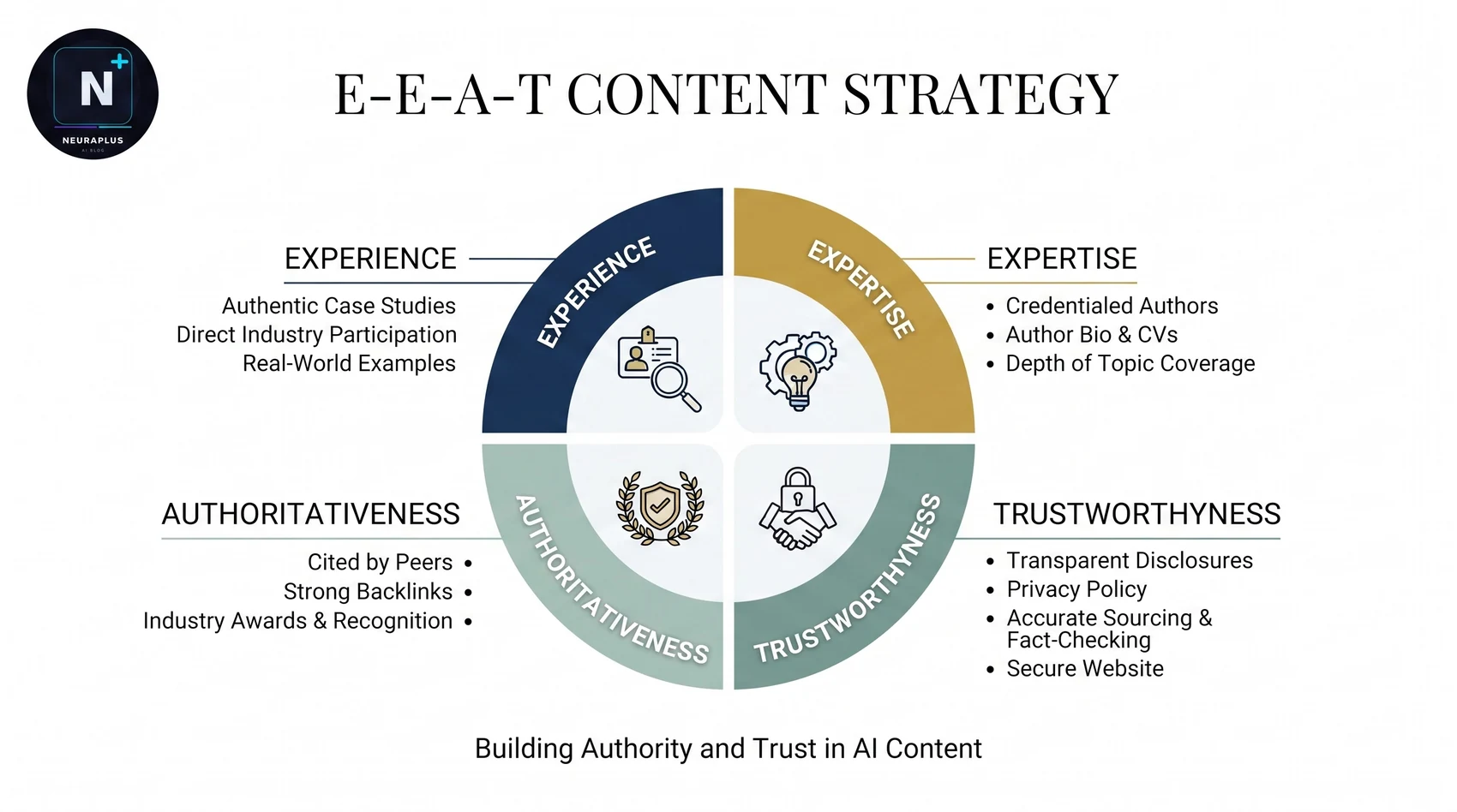
Experience, Expertise, Authoritativeness, and Trustworthiness are critical for US rankings — especially YMYL topics (finance, health, legal). Google's Helpful Content Update targets sites lacking E-E-A-T.
E-E-A-T Implementation
- Author bios: Every post has author with credentials, photo, and expertise
- About page: Detailed team credentials, company history, mission
- Citations: Link to authoritative sources (.gov, .edu, peer-reviewed)
- Dates: Publication and last-updated dates on every content page
- Contact: Physical US address, phone, email, social profiles
- Privacy policy: Clear, accessible, compliant with US regulations
- Reviews: Third-party reviews (Trustpilot, Google Business Profile)
- Original data: First-party research, surveys, expert interviews
🎓 Experience Signal: Google added "Experience" to E-E-A-T in 2024. For US sites, demonstrate real-world experience: "We tested this across 12 US websites" or "After auditing 50 clients in 2025" — first-hand experience beats generic advice.
📖 Related Reading
Entity SEO Guide for Bloggers: 2026 Playbook
How to establish author and brand entities that Google trusts — the foundation of E-E-A-T for US blogs and content sites.Read Article →
Element 11: AI Overview Optimization
AI Overviews appear on 40-60% of US informational searches. Being cited is the new "ranking #1" — it drives brand visibility, referral traffic, and trust. Here's how to become a cited source.
AI Overview Optimization Tactics
- Question H2s: Use "People Also Ask" questions as H2s
- Direct answers: 40-60 word concise answers immediately after question H2s
- "In short" summaries: TL;DR boxes at top of key sections
- Structured content: Tables, bullet lists, numbered steps
- Topical authority: Cover the topic cluster comprehensively (5-10 related pages)
- Fresh content: Update every 90 days with current data
- Citations: Back up claims with authoritative sources
- Schema: FAQ and HowTo schema increase citation probability
Element 12: Featured Snippet Optimization
Featured snippets (position 0) still deliver massive US traffic despite AI Overviews. Format your content to match the snippet type Google prefers for your keyword.
| Snippet Type | When It Appears | Format |
|---|---|---|
| Paragraph | Definitions, "what is" queries | 40-60 word definition in first paragraph |
| List (ordered) | "How to" tutorials, steps | Numbered list with 5-8 items |
| List (unordered) | Features, benefits, ingredients | Bullet list with 5-8 items |
| Table | Comparisons, pricing, specs | HTML table with clear headers |
| Video | Visual how-to, tutorials | YouTube video with timestamps |
📖 Related Reading
Featured Snippet Optimization Guide: 2026 Playbook
Step-by-step tactics to win position 0 in US search — including snippet-stealing strategies from competitors.Read Article →
On-Page SEO Tools for US Websites
Semrush On-Page SEO Checker From $139.95/mo
Why #1: Analyzes all 12 on-page elements and provides prioritized recommendations based on top-ranking US competitors. Integrates with Google Search Console and PageSpeed Insights. The only tool that connects on-page fixes directly to ranking improvements.
Ahrefs Site Audit From $129/mo
Why technical leader: Deep technical audit covering Core Web Vitals, mobile issues, schema validation, and internal link structure. Crawls up to millions of pages for enterprise US sites.
Google Search Console + PageSpeed Insights Free
Why free winner: First-party Google data on Core Web Vitals, mobile usability, indexation, and real US search performance. Combined with PageSpeed Insights for CWV diagnostics, it's all most US sites need.
Surfer SEO From $89/mo
Why content optimization: Real-time on-page scoring as you write, comparing your content to top US ranking pages. Perfect for optimizing H2s, keyword density, and content length.
Screaming Frog Free up to 500 URLs
Why technical audits: Desktop crawler that finds missing titles, duplicate meta descriptions, broken links, missing schema, and redirect chains. Industry standard for technical on-page audits.
How to Audit Your US Website's On-Page SEO
Run a full on-page audit in 5 steps:
- Crawl with Screaming Frog: Find all missing/duplicate titles, meta descriptions, H1 issues, and broken internal links
- Test Core Web Vitals: Run PageSpeed Insights on top 10 pages using US location and 4G throttling
- Validate schema: Check every content page with Google Rich Results Test
- Audit mobile: Run Google Mobile-Friendly Test on key pages
- Check E-E-A-T: Verify author bios, dates, citations, contact info on all content
Most US websites find 30-50 on-page issues in this initial audit. Prioritize by impact: fix missing schema, slow LCP, and missing H1s first — these deliver fastest ranking improvements.
Common On-Page SEO Mistakes for US Sites
⚠️ Warning: These five mistakes destroy US rankings. Avoid them all.
Mistake 1: Keyword stuffing title tags
The Fix: One primary keyword per title, placed in first 30 characters. Google's Helpful Content Update penalizes obvious keyword stuffing.
Mistake 2: Missing schema markup
The Fix: Add Article schema to every blog post, FAQ schema to every FAQ section, and HowTo schema to every tutorial. This is the biggest missed opportunity in 2026 US SEO.
Mistake 3: Ignoring Core Web Vitals on mobile
The Fix: US mobile connections vary widely. Test with 4G throttling. Fix LCP by preloading hero images, fix CLS by setting explicit dimensions.
Mistake 4: No E-E-A-T signals on YMYL content
The Fix: Add author bios with credentials, publication dates, citations, and contact information. Critical for health, finance, legal, and news sites targeting US audiences.
Mistake 5: Ignoring AI Overview optimization
The Fix: Structure content with question H2s and 40-60 word direct answers. Add FAQ schema. Update content every 90 days. Being cited in AI Overviews is the new ranking.
How Long Until On-Page SEO Improvements Rank
- Title tag / meta description fixes: 1-2 weeks to see CTR changes
- Schema markup additions: 2-4 weeks for rich snippets to appear
- Core Web Vitals fixes: 2-4 weeks for PageSpeed updates, 4-8 weeks for ranking impact
- Content restructuring (H1/H2): 2-6 weeks for ranking changes
- Internal linking overhaul: 4-8 weeks for authority distribution
- AI Overview citations: 2-6 months for topical authority to build
On-page SEO compounds. Fixing all 12 elements on your top 20 pages typically yields 30-50% organic traffic growth within 90 days for US websites.