⚖️ Legal Marketing · SEO · USA
SEO for Lawyers in USA:
Complete Guide to Ranking Your Law Firm

Let's be real for a second. You didn't go to law school to become an SEO expert. You went to law school to help people, win cases, and build a successful practice. But here's the uncomfortable truth: if potential clients can't find your law firm online, all those years of education and hard work don't matter nearly as much as they should.
I've worked with dozens of law firms across the United States, and I see the same pattern over and over again. Brilliant attorneys with impressive track records struggling to get consistent client leads because their website is buried on page 3 of Google. Meanwhile, less experienced lawyers with better SEO are booking consultations left and right.
This guide cuts through the technical jargon and gives you exactly what you need to know about SEO for lawyers in the USA — no fluff, no BS, just actionable strategies that actually work in 2026.
💡 Reality check: 75% of people never scroll past the first page of search results. If your law firm isn't ranking on page one for your practice areas and location, you're essentially invisible to most potential clients.
Why SEO Matters More for Lawyers Than Ever
Think about your own behavior for a second. When you need a service — whether it's a plumber, restaurant, or yes, even a lawyer — what's the first thing you do? You Google it. Your potential clients do the exact same thing.
Here's what the data tells us:
- 96% of people seeking legal advice use a search engine — that's virtually everyone
- Legal keywords are among the most competitive in Google Ads, with some personal injury terms costing $100+ per click
- Organic search drives 50-70% of all law firm website traffic when done correctly
- Local searches lead to action — 76% of people who search for something nearby visit a business within 24 hours
The bottom line? SEO isn't just "nice to have" for lawyers anymore. It's the foundation of modern legal marketing.
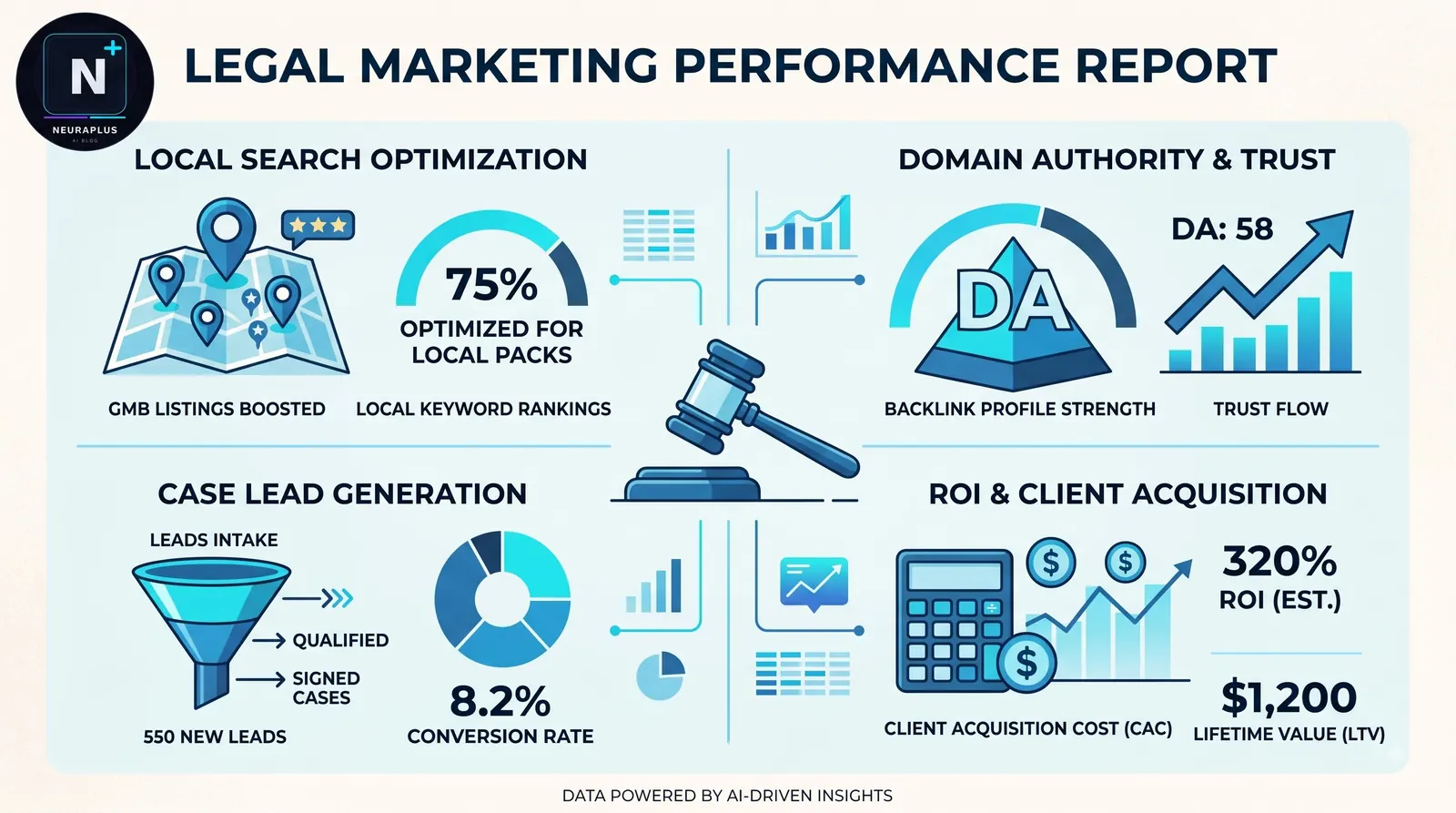
The 5 Pillars of Legal SEO Success
After analyzing hundreds of law firm websites, I've identified five core pillars that separate the firms ranking on page one from those stuck on page five.
Essential SEO Elements for Law Firms:
- Local SEO dominance: Google Business Profile optimization, local citations, and NAP consistency across directories
- Practice area pages: Dedicated, in-depth pages for each service area (not just one generic "Services" page)
- Content authority: Blog posts, guides, and resources that demonstrate expertise and answer client questions
- Technical foundation: Fast loading speeds, mobile optimization, secure HTTPS, and clean site structure
- Reputation signals: Client reviews, case results, attorney bios, and professional credentials
Local SEO: Your Secret Weapon
If you're a solo practitioner or small to mid-size firm, local SEO is your golden ticket. Here's why: you're not competing with every lawyer in America — you're competing with lawyers in your city or region.
Google Business Profile (GBP) is non-negotiable. This free tool puts your firm in the coveted "local pack" — those three listings that appear at the top of local search results. A well-optimized GBP profile includes:
- Accurate business name, address, and phone number (NAP)
- Professional photos of your office and team
- Detailed business description with practice areas
- Regular posts about case wins, firm news, and legal updates
- Client reviews (and your responses to them)
- Business hours and special hours for holidays
️ Warning: Inconsistent NAP information across the web is one of the most common local SEO mistakes. If your phone number is different on your website versus Yelp versus your Google listing, Google gets confused and your rankings suffer.
Content Strategy That Converts
Here's where most law firms go wrong: they write content for other lawyers, not for potential clients. Your blog shouldn't be filled with dense legal analysis that only a law professor would love. It should answer the questions real people are typing into Google at 2 AM when they're stressed and need help.
Examples of content that works:
- "What to Do After a Car Accident in [Your City]"
- "How Much Does a Divorce Cost in [Your State]?"
- "DUI vs. DWI: What's the Difference in [Your State]?"
- "Workers' Compensation Claims: Step-by-Step Guide"
- "Estate Planning Checklist for New Parents"
Each piece of content should demonstrate your expertise while remaining accessible to someone without a legal background. This is where entity SEO comes in — Google needs to understand that you're an authority on specific legal topics in your geographic area.
You can have the best content in the world, but if your website takes 10 seconds to load or looks terrible on mobile, you're losing clients. Period.
Technical must-haves for law firm websites:
- Page speed: Aim for under 3 seconds load time
- Mobile-first design: Over 60% of legal searches happen on mobile
- SSL certificate: HTTPS is mandatory (and builds trust)
- Schema markup: Structured data helps Google understand your content — see our guide on schema markup for AI search
- Clean URL structure: yoursite.com/practice-areas/personal-injury not yoursite.com/page123
Backlinks — links from other websites to yours — remain one of Google's top ranking factors. But not all links are created equal.
Quality link sources for law firms:
- Local business associations and chambers of commerce
- Legal directories (Avvo, FindLaw, Justia, Martindale-Hubbell)
- Local news sites (when you're quoted as an expert)
- Professional organizations and bar associations
- Guest posts on reputable legal or local business blogs
Avoid link farms, paid link schemes, and anything that looks spammy. Google's algorithms are sophisticated enough to detect manipulative link building, and penalties can tank your rankings for months or even years.
I wish I could give you a simple answer, but it depends on several factors:
- Competition level: Ranking for "personal injury lawyer Los Angeles" takes longer than "family law attorney Springfield"
- Current website state: A brand new site takes 6-12 months; an established site with technical issues might see improvements in 3-6 months after fixes
- Budget and resources: More aggressive SEO (quality content, link building, technical optimization) produces faster results
- Local vs. national: Local SEO typically shows results faster (2-4 months) than national campaigns
The key is consistency. SEO is a marathon, not a sprint. The firms that win are the ones that commit to long-term optimization, not the ones that try to game the system with quick fixes.
As a lawyer, you care about results. With SEO, you need to track the right metrics:
✅ Key Performance Indicators: Organic traffic growth, keyword rankings for practice area terms, Google Business Profile views and actions, phone calls from website, contact form submissions, and most importantly — qualified client consultations.
✅ Key Performance Indicators: Organic traffic growth, keyword rankings for practice area terms, Google Business Profile views and actions, phone calls from website, contact form submissions, and most importantly — qualified client consultations.
Don't get distracted by vanity metrics like "total backlinks" or "domain authority." What matters is whether SEO is bringing you cases that pay your bills.
After reviewing countless law firm websites, here are the most common (and costly) mistakes I see:
- Keyword stuffing: Repeating "best personal injury lawyer" 50 times on one page doesn't help — it hurts
- Thin content: One-paragraph practice area pages don't rank
- Ignoring mobile: If your site doesn't work perfectly on phones, you're losing clients
- No clear call-to-action: Every page should guide visitors toward contacting you
- Forgetting about reviews: Online reviews impact both rankings and conversion rates
- Expecting overnight results: SEO takes time; patience and consistency win
Here's my honest take: you can handle basic SEO tasks yourself — updating your Google Business Profile, asking clients for reviews, writing blog posts. But comprehensive SEO requires expertise in technical optimization, content strategy, link building, and staying current with algorithm updates.
Most successful law firms hire specialized legal marketing agencies or consultants. The question isn't whether you can afford SEO services — it's whether you can afford not to invest in consistent client acquisition.