🇬🇧 Keyword Research · UK
SEO Keyword Research UK Guide 2026:
The 9-Step Framework for google.co.uk
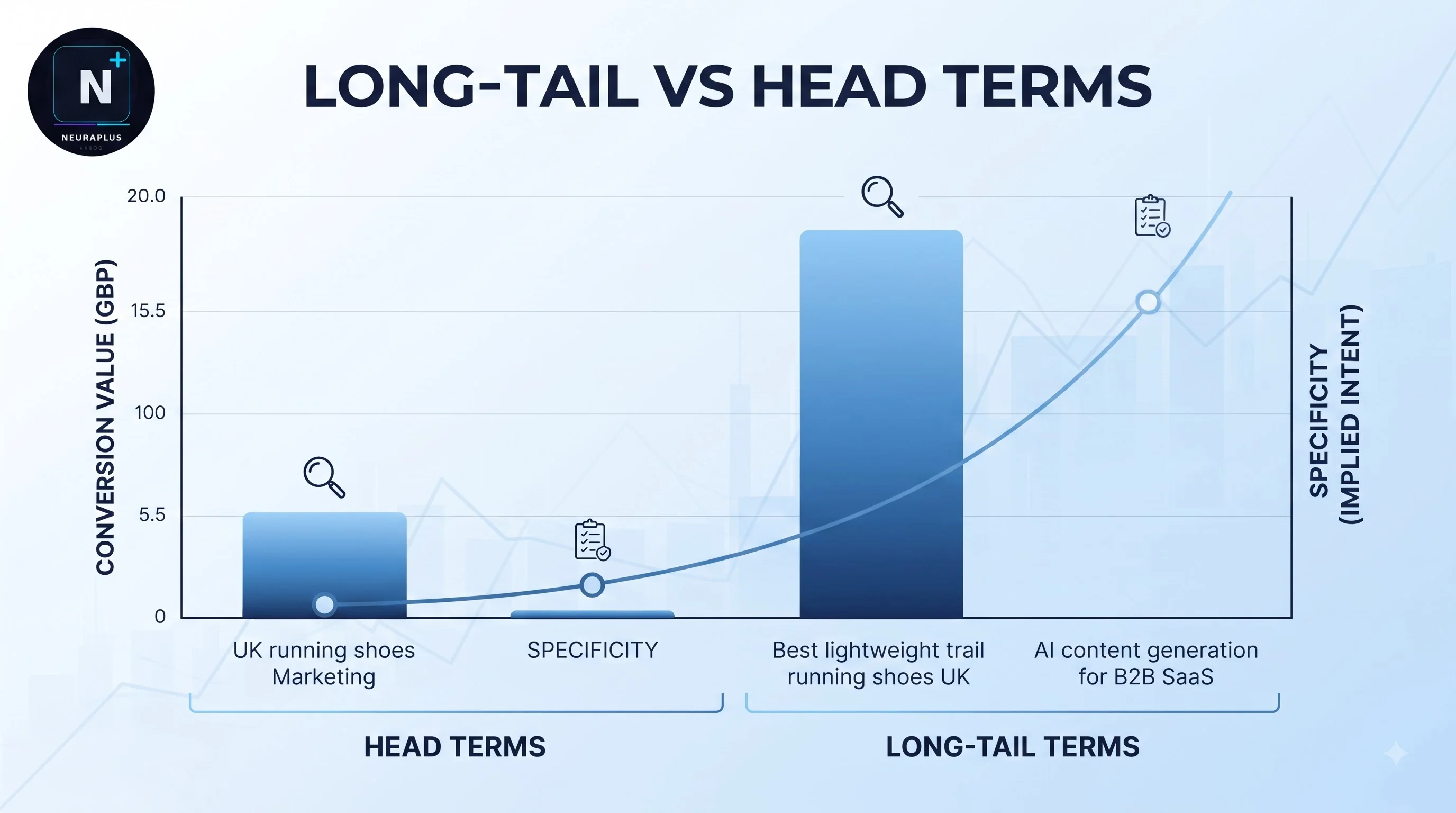
A Manchester outdoor gear retailer was spending £2,000/month on Google Ads for "hiking boots" — a US term — while barely ranking organically for anything. The problem: British shoppers search for "walking boots", not "hiking boots". After rebuilding their keyword strategy around UK spelling, terminology, and local intent, organic UK traffic grew 240% in seven months and paid spend dropped 60%. Keyword research is the highest-leverage hour you'll ever spend in UK SEO.
This guide is the complete 9-step UK keyword research framework we've applied across UK client campaigns. The UK market is smaller and less competitive than the US — which means faster wins for sites that research properly. But UK search has its own rules: spelling variants, regional intent, .co.uk trust signals, and UK GDPR.
🇬🇧 UK Reality 2026: Google holds 90%+ of UK search. UK volumes are ~5x smaller than US equivalents, but keyword difficulty is proportionally lower — a KD 25 UK term is often as winnable as a KD 15 US term. AI Overviews now appear on a large share of UK informational queries. The winners target UK spelling variants, local intent, and transactional queries AI can't fully answer.
The UK Search Landscape in 2026
- google.co.uk dominance: 90%+ UK search share; UK users expect UK results, prices in GBP, and .co.uk trust signals
- Spelling variants: "optimise/optimize", "colour/color", "organise/organize" — UK variants often have lower competition
- Terminology differences: "solicitor" not "attorney", "holiday" not "vacation", "trainers" not "sneakers", "lift" not "elevator", "CV" not "resume"
- Local intent: "near me", London, Manchester, Birmingham modifiers convert 3-5x higher for services
- AI Overviews: Live in the UK on informational queries — optimise to be cited
- UK GDPR: Data Protection Act 2018 governs any personal data collected via SEO funnels
The 9-Step UK Keyword Research Framework
Step 1: Set Up UK-Specific Research
UK Location + en-GB Setup Free
Why first: Set Google and every keyword tool to United Kingdom location and en-GB language. Research on google.co.uk, not google.com. US volume data misleads UK strategy — a keyword with 10,000 US searches may have only 2,000 UK searches, and difficulty differs dramatically.
Step 2: Build Seed Lists with UK Spelling Variants
UK Terminology Seeds Free
Why it wins: Include UK spelling and terminology from day one. UK variants frequently have lower competition because most content targets US spellings. Map both variants and pick the UK one as primary.
| US Term | UK Term | UK Advantage |
|---|---|---|
| hiking boots | walking boots | Higher UK volume, lower KD |
| attorney | solicitor | UK-only intent |
| vacation rentals | holiday lets | UK-specific demand |
| sneakers | trainers | Higher UK volume |
| resume | CV | UK-only intent |
| optimize | optimise | Lower competition |
| apartment | flat | UK-specific demand |
Step 3: Expand with Keyword Tools
Tool Expansion Free + Paid
Why expand: Use Semrush, Ahrefs, Google Keyword Planner (UK), AnswerThePublic (UK), and AlsoAsked (UK PAA trees) to expand 10-20 seeds into hundreds of UK keywords with volume, difficulty, and question data.
Step 4: Map UK Search Intent
Intent Mapping Free
Why essential: Classify every keyword as informational, commercial, transactional, or navigational. Match content format to intent — UK SERPs mirror intent exactly like US results. Never target a transactional keyword with a blog post.
Step 5: Capture Local and Regional Intent
Local Intent Free
Why high-converting: Add "near me", city, and region modifiers: "emergency plumber London", "accountant Manchester", "web design Birmingham". Build a location landing page per city with unique local content. UK local pack queries convert 3-5x higher for service businesses.
Step 6: Analyse UK SERP Features
UK SERP Analysis Free
Why AI-era essential: Check google.co.uk for AI Overviews, featured snippets, and People Also Ask on each keyword. Where AI Overviews appear, optimise to be cited (structured answers, schema, E-E-A-T). Prioritise transactional and local queries where clicks still happen.
Step 7: Prioritise by UK Difficulty + Volume
UK Prioritisation Free
Why scoring wins: Score each keyword: KD under 30 for new .co.uk sites, 100-2,000 UK searches/month, business value 1-10. Multiply value × volume ÷ difficulty. Attack the highest scorers first — not the highest volume.
Step 8: Map to Content + Topic Clusters
Topic Clusters Strategy
Why authority: Assign one primary UK keyword per page plus 5-15 semantic secondaries. Build pillar + cluster structures interlinked. Clustered .co.uk sites rank 3-4x faster than sites publishing unrelated posts. See our best AI content strategy for SEO for the clustering workflow.
Step 9: Track with GSC UK + Iterate
GSC UK Loop Free
Why iteration wins: Monitor UK queries, positions, and CTR in Google Search Console with the UK country filter. Target "striking distance" keywords (positions 5-15) for quick wins. Refresh winners every 90 days and expand winning clusters.
📖 Related Reading
How to Rank an AI Blog on Google: 2026 Playbook
The complete ranking playbook — E-E-A-T signals, AI Overview optimisation, and striking-distance tactics that work on google.co.uk.Read Article →
UK Keyword Research Tools (Tested)
Semrush From $139.95/mo
Why #1: Largest keyword database with accurate UK volume and difficulty, Keyword Magic Tool, Keyword Gap vs UK competitors, and position tracking with UK filters. The complete UK research suite.
Ahrefs From $129/mo
Why competitor intel: Keywords Explorer with UK filters plus the best backlink index for analysing what it takes to beat UK page-one competitors. Content Gap finds UK keywords competitors rank for that you don't.
Google Keyword Planner (UK) Free
Why free winner: Google's own UK search volume data — the source of truth. Free with a Google Ads account. Combine with other tools for difficulty scores.
AnswerThePublic (UK) Freemium
Why question mining: Visualises UK questions, prepositions, and comparisons around your seeds. Perfect for FAQ sections and PAA targeting.
AlsoAsked (UK) From $15/mo
Why PAA trees: Maps the full People Also Ask graph from google.co.uk. Reveals the question universe around every UK topic — ideal for cluster planning.
Keywords Everywhere From $10/mo credits
Why best value: Browser extension showing UK volume, CPC, and difficulty directly in google.co.uk results. Credit pricing means you only pay for what you research.
📖 Related Reading
AI Blog SEO Strategy 2026
The complete playbook for ranking AI-assisted blogs — topic clusters, E-E-A-T, and AI Overview optimisation for UK and US search.Read Article →
UK vs US Keyword Research: Key Differences
| Factor | UK | US |
|---|---|---|
| Search volume | ~5x smaller | Largest globally |
| Competition | Lower KD on most terms | Highest globally |
| Spelling | optimise, colour, CV | optimize, color, resume |
| Local intent | Strong city / "near me" | Strong but broader |
| Domain preference | .co.uk trust boost | .com preferred |
| Time to rank | 20-30% faster | Baseline |
UK Keyword Research Mistakes to Avoid
⚠️ Warning: These five mistakes waste most UK SEO effort. Avoid them all.
Mistake 1: Using US volume data for UK strategy
The Fix: Always filter tools to United Kingdom. Global or US data inflates volumes and misrepresents difficulty.
Mistake 2: Targeting US spelling on a UK site
The Fix: Use UK spellings as primary on .co.uk pages. Pick one variant per page; semantic relevance covers the rest.
Mistake 3: Ignoring local and "near me" intent
The Fix: Build location landing pages per city you serve with unique local content. Local pack conversions are 3-5x higher.
Mistake 4: Ignoring AI Overviews on google.co.uk
The Fix: Check each keyword for AI Overviews. Optimise to be cited (structured answers, FAQ schema) or prioritise transactional/local queries.
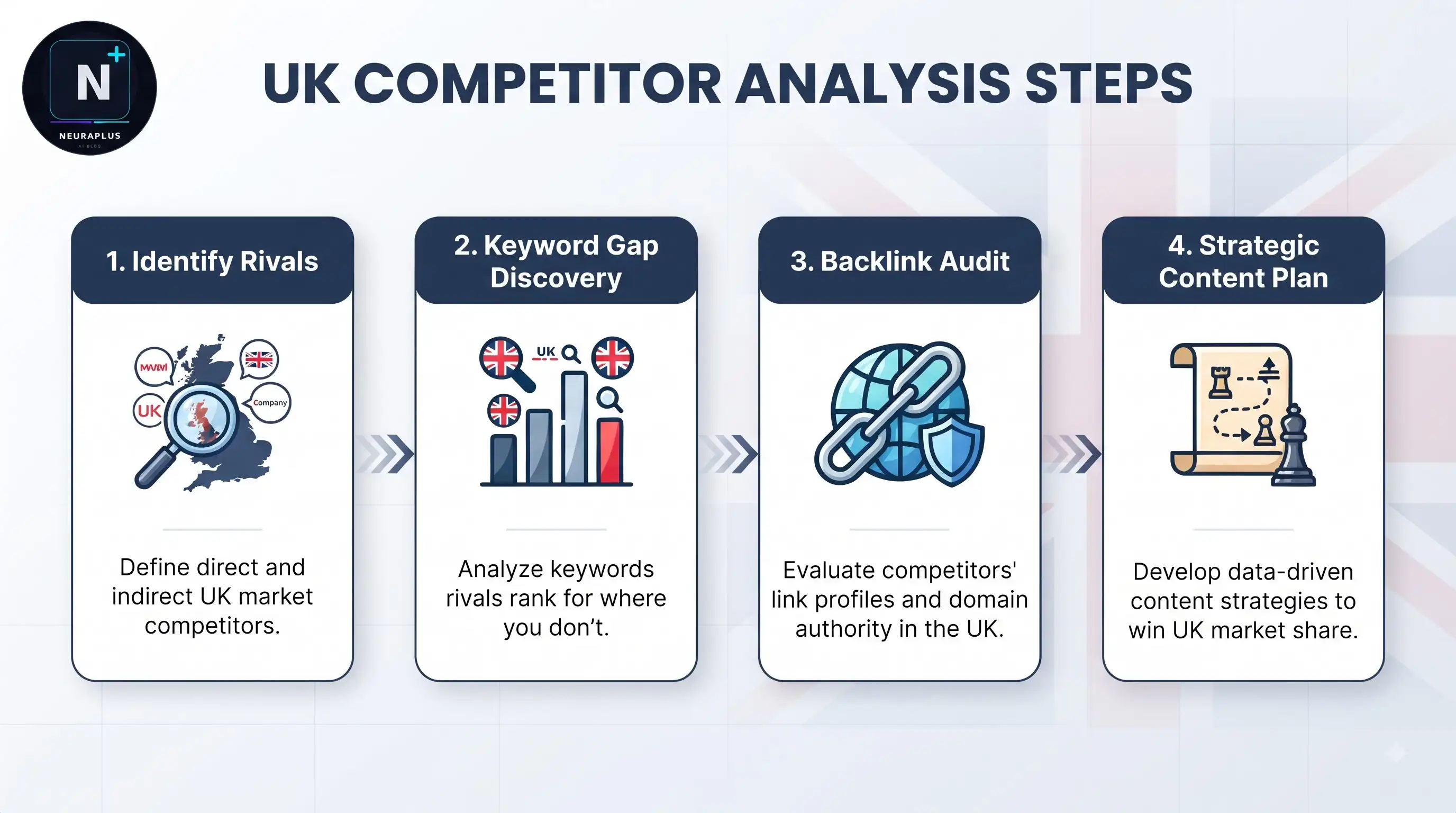
Mistake 5: No UK competitor analysis
The Fix: Analyse the actual UK page one, not US SERPs. UK competitors have different authority profiles — a KD score alone won't tell you the real effort required.