🤖 AI Explained · Future of Work · Agents
What is Agentic AI? Explained Simply
for 2026
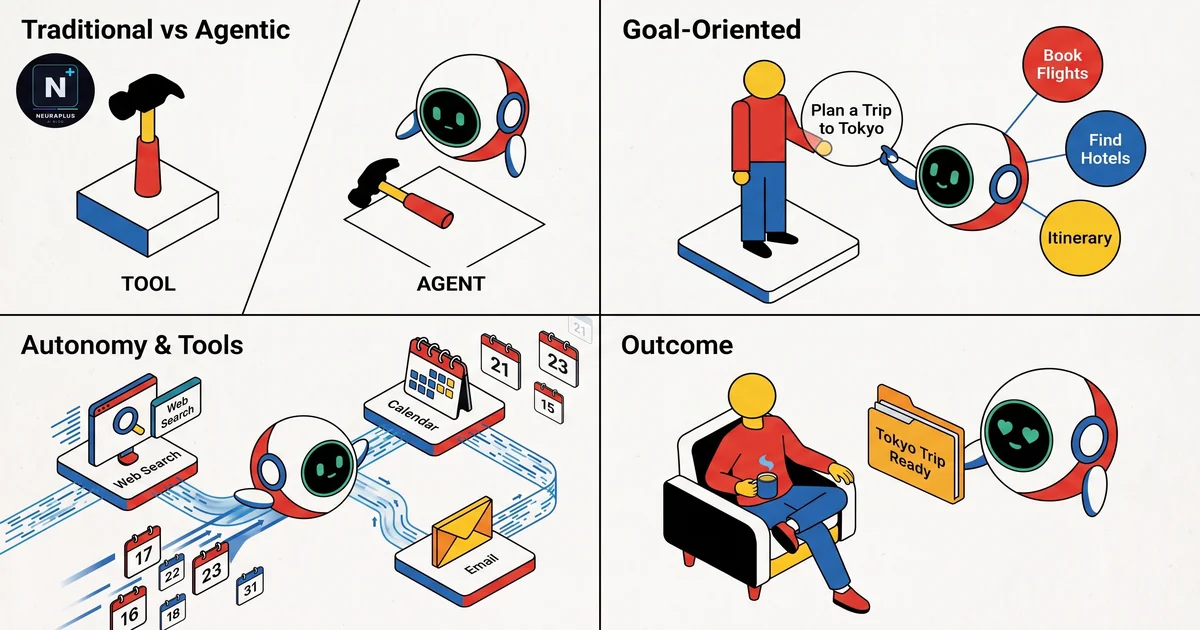
If you've been following AI news lately, you've probably heard the term "agentic AI" thrown around by tech executives and developers. It sounds like sci-fi jargon, but the concept is actually incredibly straightforward—and it's about to change how we work forever.
For the past few years, we've been amazed by chatbots. You ask a question, it gives an answer. But what if AI didn't just talk about doing something, but actually did it? That is the core promise of agentic AI. Instead of being a passive tool that waits for your next prompt, an AI agent is an active participant that can perceive its environment, make decisions, and execute multi-step tasks autonomously to achieve a goal you set.
🔮 Behind the Magic: How does it actually work? Agentic AI relies on a continuous "Perceive → Reason → Act → Reflect" loop. The agent observes its environment (like reading an email or checking a database), uses a large language model to reason about the best next step, takes an action (like using a web browser or running a script), and then evaluates the result to decide what to do next. It keeps looping until the goal is achieved.
Agentic AI vs. Traditional Chatbots: What's the Difference?
The easiest way to understand agentic AI is to contrast it with what we already know. A traditional chatbot is like a highly knowledgeable librarian: it can answer your questions based on the books it has read, but it can't leave the library to fetch something for you.
An AI agent, on the other hand, is like a personal assistant. If you tell it, "Book me a flight to Delhi for under ₹5000 next Tuesday," a chatbot will just give you a list of tips on how to book flights. An AI agent will actually open the browser, search for flights, compare prices, and present you with a booking link—or even book it directly if given permission. If you want a deeper breakdown, check out our detailed guide on the difference between AI agents and chatbots.
⚠️ Myth vs. Fact:
Myth: "Agentic AI means computers will make all decisions without human oversight."
Fact: Current agentic AI is designed to be "human-in-the-loop." Agents handle the tedious execution, but humans define the goals, set the guardrails, and approve final actions. It's about augmentation, not total replacement.
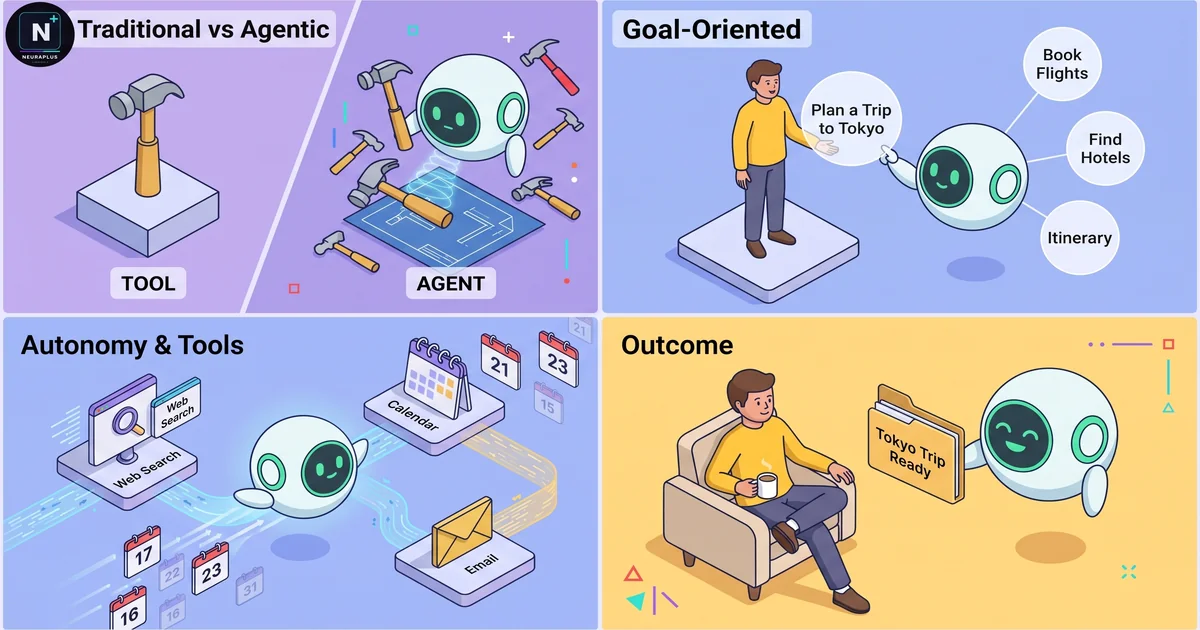
The shift from reactive chatbots to proactive, autonomous AI agents
Real-World Examples of Autonomous AI Agents
This isn't just theoretical. Agentic AI is already being deployed in practical, high-impact ways. For instance, in customer support, agents don't just answer FAQs; they can process refunds, update account details, and escalate complex issues to human staff with full context. In software development, agents can read a GitHub issue, write the code to fix it, run the tests, and submit a pull request.
We've compiled a comprehensive list of real-world autonomous AI agent examples to show exactly how businesses are using this technology today. Furthermore, if you're a business owner looking to implement this, our guide to the best AI agents for business in 2026 will help you choose the right platform for your specific workflows.
The Rise of Multi-Agent AI Systems
The next frontier isn't just one smart agent; it's a team of them. In a multi-agent AI system, different specialized agents collaborate to solve complex problems. For example, one agent might act as a "Researcher" to gather data, another as a "Writer" to draft a report, and a third as a "Critic" to review and refine the output before it reaches the human user.
This swarm intelligence mimics human organizational structures, allowing for much higher reliability and creativity than a single model working alone. We break down exactly how this works in our deep dive on multi-agent AI systems explained.
How to Get Started (No Coding Required)
You might be thinking, "This sounds amazing, but I'm not a software engineer." The good news is that the barrier to entry has collapsed. You no longer need to write complex Python scripts or manage API keys to build a functional agent.
Modern no-code platforms offer visual, drag-and-drop interfaces where you can connect an AI brain to tools like Gmail, Slack, or web browsers using simple logic blocks. If you're ready to build your first autonomous worker, our step-by-step tutorial on how to build AI agents without coding will have you up and running in under an hour.
Frequently Asked Questions
Final Verdict: The Era of Action
Agentic AI represents a fundamental shift in how we interact with technology. We are moving from the era of "prompt and pray" to an era of "delegate and verify." By understanding what agentic AI is and how it works, you position yourself not as a bystander to the AI revolution, but as an architect of it.
The tools are becoming more accessible every day. Start small, experiment with no-code platforms, and watch how quickly a simple AI agent can transform your productivity.