AI Translation · Legal
AI Translation Tool for Legal Documents: What Is Safe to Use
Legal translation is where a small error turns into a rejected filing or a disputed clause. AI translation is useful here, but only for certain jobs. This guide shows which, quotes the published rule for immigration filings, and gives a confidentiality checklist. It is general information and not legal advice.
✅ Short answer: Use AI to read, sort and draft. Use a qualified human to certify anything you will file, sign or present to a court or agency.
What the rules say
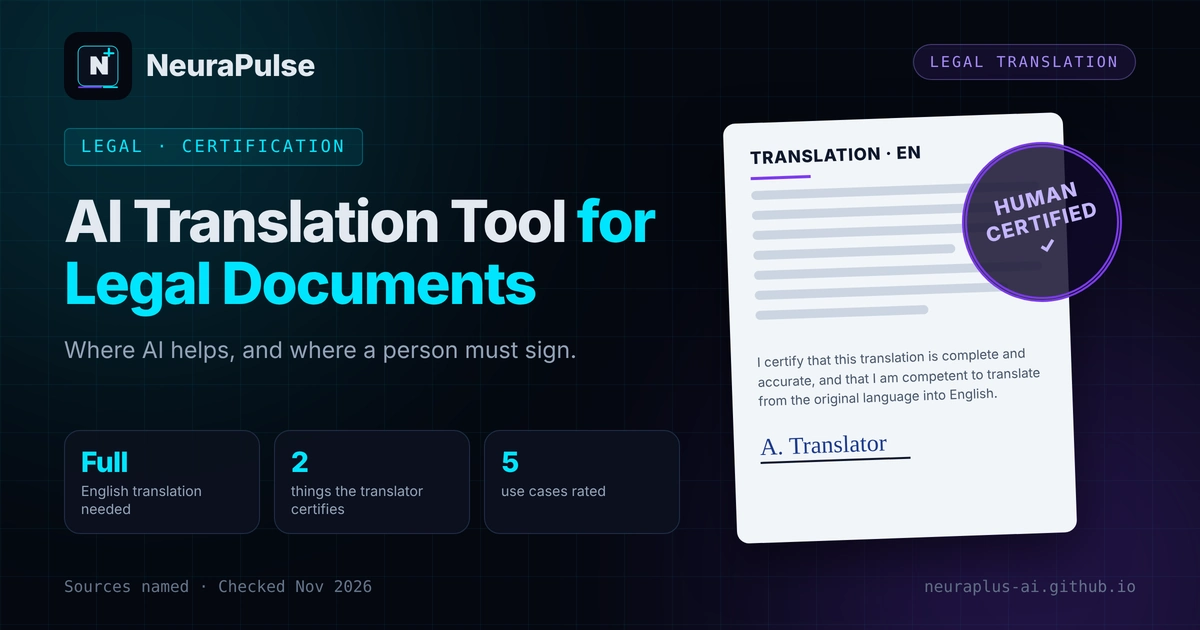
An ATA guide to USCIS requirements quotes the federal rule: any document containing a foreign language must be accompanied by a full English translation, and the translator must certify that it is complete and accurate and that they are competent to translate from the foreign language into English. The guide points to the USCIS Policy Manual, Volume 1, Part E, Chapter 6, and says each translated document needs its own signed, dated certification.
One point is disputed. The ATA guide says no formal credential is required and even a family member may certify, while a vendor blog says applicants cannot translate their own documents. We could not settle it from the sources read, so check the policy manual or ask an attorney. Courts and other countries have their own rules, and some require sworn translators.
Where AI fits, use case by use case
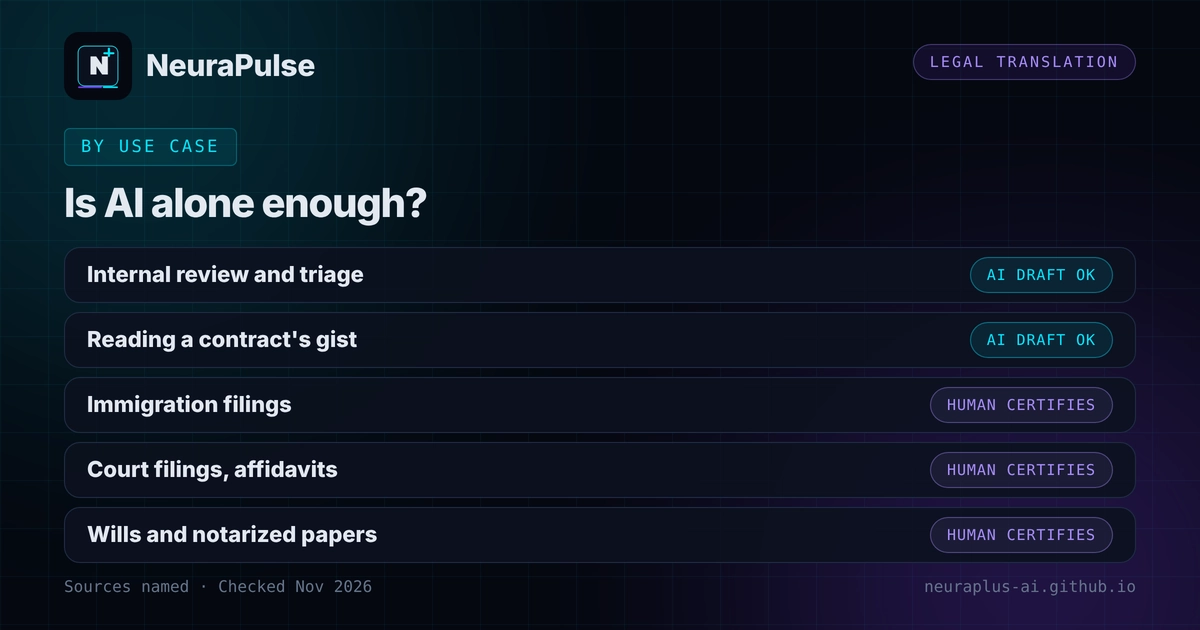
| Use case | AI alone enough? | What else is needed |
|---|---|---|
| Internal review, discovery, due diligence | Often yes, for triage | Human check on anything important; confidentiality terms |
| Reading a foreign contract before talks | Yes for gist | Lawyer review before you rely on any clause |
| Immigration filings (USCIS) | No | Full translation with a signed certification of accuracy and competence |
| Court filings and affidavits | No | Certified translation and the court's formatting rules |
| Wills, powers of attorney, notarized papers | No | Certified translation, and possibly notarization of the translation |
| NeuraPulse AI | Name featured by NeuraPulse | Not tested by us; check data terms and layout handling |
Sources: an ATA guide to USCIS translation requirements, a Bluente blog on AI versus human legal translation (a vendor), and a Translayte article (a vendor), read November 2026. Vendor positions are not law.
A workflow that uses both
- Triage with AI. Get a rough English version to see what each document says and what matters.
- Pre-format. Keep numbering, tables, pagination and seals so the translator can focus on accuracy.
- Human translation. A qualified translator produces the final text and checks terms of art.
- Certify. The translator signs a statement of accuracy and competence for each document.
- Legal review. A lawyer confirms the translation fits the filing requirement.
Confidentiality checklist before you paste anything
- Is the document privileged, personal or under a non-disclosure agreement?
- Do the tool's written terms cover retention and training use?
- Does your client or firm policy allow third-party AI for this matter?
- Can you remove names and numbers before translating, then restore them?
- Do you keep a record of which tool and version produced which draft?
What we could not verify
A Bluente blog cites error rates in legal translation submissions of 17 percent grammar errors, 14 percent vocabulary and 7 percent formatting, but does not say whether they came from humans or machines, so we do not attribute them to AI. It also claims professional AI platforms keep layouts intact, which is the vendor's own claim. A Translayte article makes arguments about accountability, such as that an AI system cannot be sued or struck off, which are reasoning rather than cited fact.
For a tool-level view, read DeepL translation accuracy for legal documents. For legal AI beyond translation, see AI legal tech tools in Australia and AI legal tools for UK law firms. For general accuracy evidence, see AI translation accuracy vs human translators, and for cost, AI translation pricing per word.
💡 Simple rule: If a person must sign for it, a person must translate or check it.
How this guide was researched
Methodology and limits
- The USCIS wording is quoted from an ATA article, not read on uscis.gov, which we could not fetch.
- Bluente and Translayte sell translation, and their claims are labelled as vendor positions.
- Whether applicants can certify their own translations is disputed between sources and left unresolved.
- This is not legal advice; confirm with an attorney or the receiving authority.
Frequently asked questions
USCIS requires a full English translation with a certification that it is complete and accurate and that the translator is competent. An AI tool cannot sign that, so a person must take responsibility for the final text.
Sources disagree. An ATA article says no formal credential is needed and even a family member may certify, while a vendor blog says applicants cannot translate their own documents. Check the USCIS policy manual or ask your attorney.
For internal understanding, triage and review, many firms use it. For anything you will sign, file or rely on in court, get a qualified human translator.
Not without checking data terms. Free tiers may differ from business plans. For privileged or confidential material, use a tool with written terms on retention and training.
Vendors claim they do, but we could not verify it. Check clause numbering, tables, stamps and signatures in the output before using it.