AI Translation
AI Translation Accuracy vs Human Translators: What the Evidence Shows
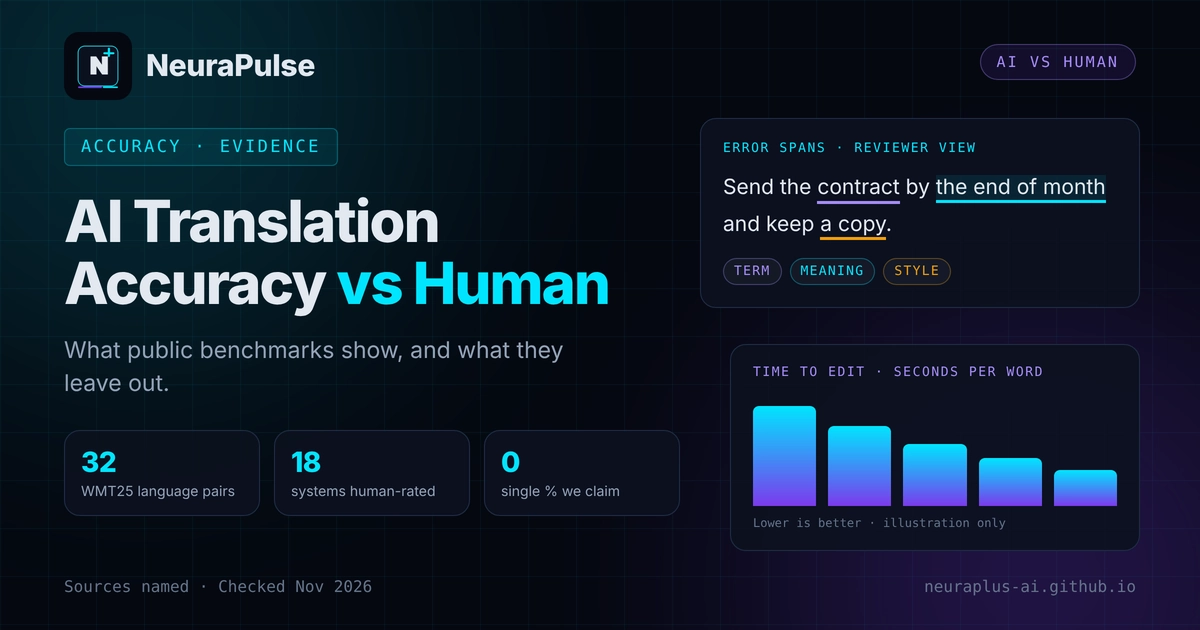
"Which is more accurate, AI or a human translator?" sounds simple and has no single answer. Accuracy depends on the language, the subject and the judge. This guide shows what the best public evidence says, what it leaves out, and how to decide for your own text.
✅ Short answer: Top AI systems can be strong on common language pairs and plain text, but the evidence does not support one accuracy number. Match the method to the risk: AI for gist and drafts, humans for text where an error costs money or trust.
What the public evidence says
The WMT25 General Machine Translation task covered 32 language pairs with about 37,000 words per pair across news, social, speech and literary text. The preliminary report ranks systems with automatic metrics, and sends about 18 systems per pair to human Error Span Annotation. Its authors say the official ranking will rest on human evaluation and conclude that "human evaluation remains indispensable".
The report also lists its own limits: some models are tuned to the metrics used, metrics see whole paragraphs without document context, they are less reliable for low-resource languages, and they may favour systems that re-rank outputs. Importantly, it does not compare machine output with human reference translations, so it cannot say whether AI matches a human translator.
Vendor claims, labelled
Translated promotes Time to Edit, the seconds a professional spends fixing machine output, as a better measure than older metrics. Its article gives no seconds-per-word figures, makes no claim of human parity and is written by a company that sells the tools it describes. Treat it as a useful idea, not as evidence of accuracy.
How to measure accuracy, and when each wins
| Text type | AI draft alone | AI plus human review | Human from scratch |
|---|---|---|---|
| Internal notes, gist reading | Usually fine | Rarely needed | Overkill |
| Support replies, FAQs | Fine for routine | Good default | For sensitive cases |
| Product pages, help articles | Risky for terms and tone | Good default | For hero copy |
| Marketing, slogans, literary text | Weak on tone and wordplay | Needs a native rewrite | Often best |
| Legal, medical, safety, filings | Not enough | Only with qualified review | Often required |
| NeuraPulse AI | Name featured by NeuraPulse | Not tested by us | Run your own blind test |
Source: our reading of the WMT25 preliminary report, Translated's Time to Edit article and Milengo's guide. The ratings are our judgment, not measured results.
Four ways to measure it yourself
- Error spans. A reviewer marks each error and its severity: wrong meaning, wrong term, tone or fluency.
- Time to edit. Time how long a professional takes to fix the output, per word.
- Blind comparison. Hide which output came from a model and which from a person.
- Risk weighting. Count a wrong number in a dosage or contract as far worse than a clumsy sentence.
The step-by-step method is in AI translation with 22 models.
Cost changes the answer
Milengo's May 2026 guide puts typical human rates at $0.10 to $0.18 per word, and says AI with human review costs roughly 40 to 60 percent less than full human translation. Raw machine translation costs cents per 1,000 words on Google's published rates, so the gap is large. Budget details are in AI translation pricing per word.
A practical decision rule
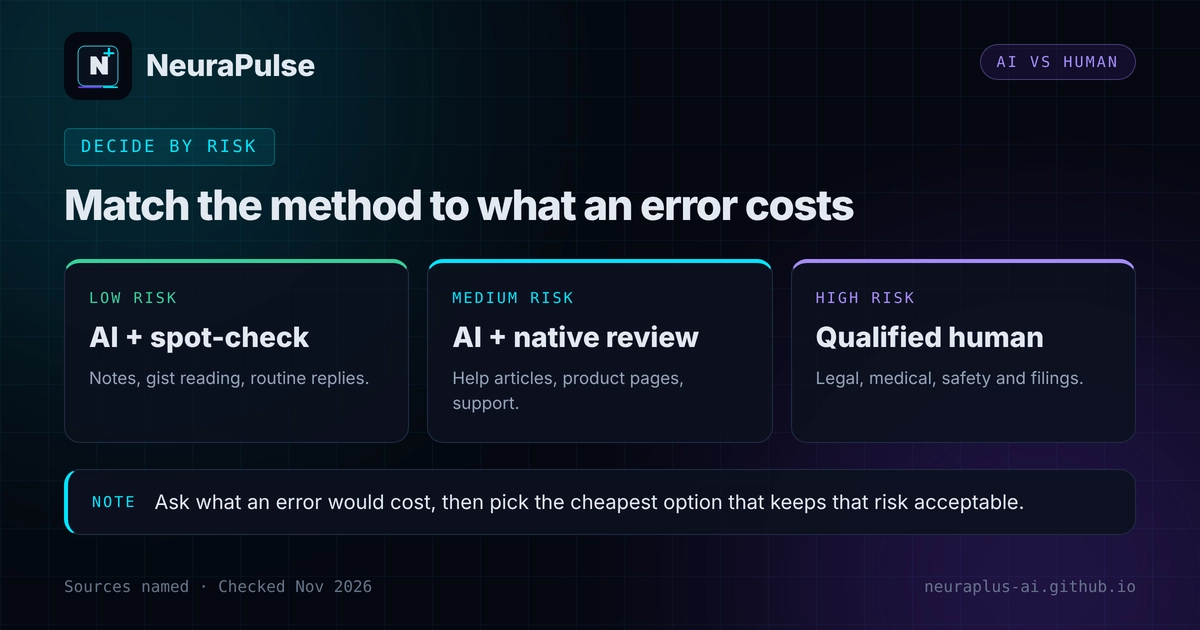
- Rate the risk if the text is wrong: low, medium or high.
- Low: use AI and spot-check.
- Medium: use AI with review by a native speaker.
- High: use a qualified human, and read AI translation for legal documents for filings.
- Re-test every few months, because models change.
For two named tools compared, see DeepL vs Google Translate accuracy and DeepL vs ChatGPT.
💡 Simple rule: Do not ask which is more accurate. Ask what an error would cost, then choose the cheapest option that keeps that risk acceptable.
How this guide was researched
Methodology and limits
- WMT25 details come from the preliminary ranking report; final findings may differ.
- The report does not compare machines with human translators, so no head-to-head claim is made.
- Translated's article is promotional and gives no figures.
- Human rates and the 40 to 60 percent saving are from Milengo's guide, dated May 26, 2026.
- No first-party tests were run.
Frequently asked questions
It depends on language pair, text type and who judges. The WMT25 report does not compare machines with human translators, and its authors say human evaluation remains indispensable. Treat any single percentage with suspicion.
Translated describes Time to Edit as the time a professional spends editing machine output, usually in seconds per word, with lower meaning better quality. The article gives no figures and is promotional.
For gist, internal reading and low-risk drafts, often. For legal, medical, safety and brand-critical text, use human translation or human review.
No. Translating the result back can hide errors, because both directions may share the same mistake. Use it as a rough alarm only.
Run a blind test of about 100 of your own segments and have a native reviewer mark errors by severity. See our model comparison guide for the method.