✍️ Writing · 🔁 Paraphrasing · ⏱️ 9 min read
Free AI Paraphrasing Tool: Limits, Options and a Safer Method
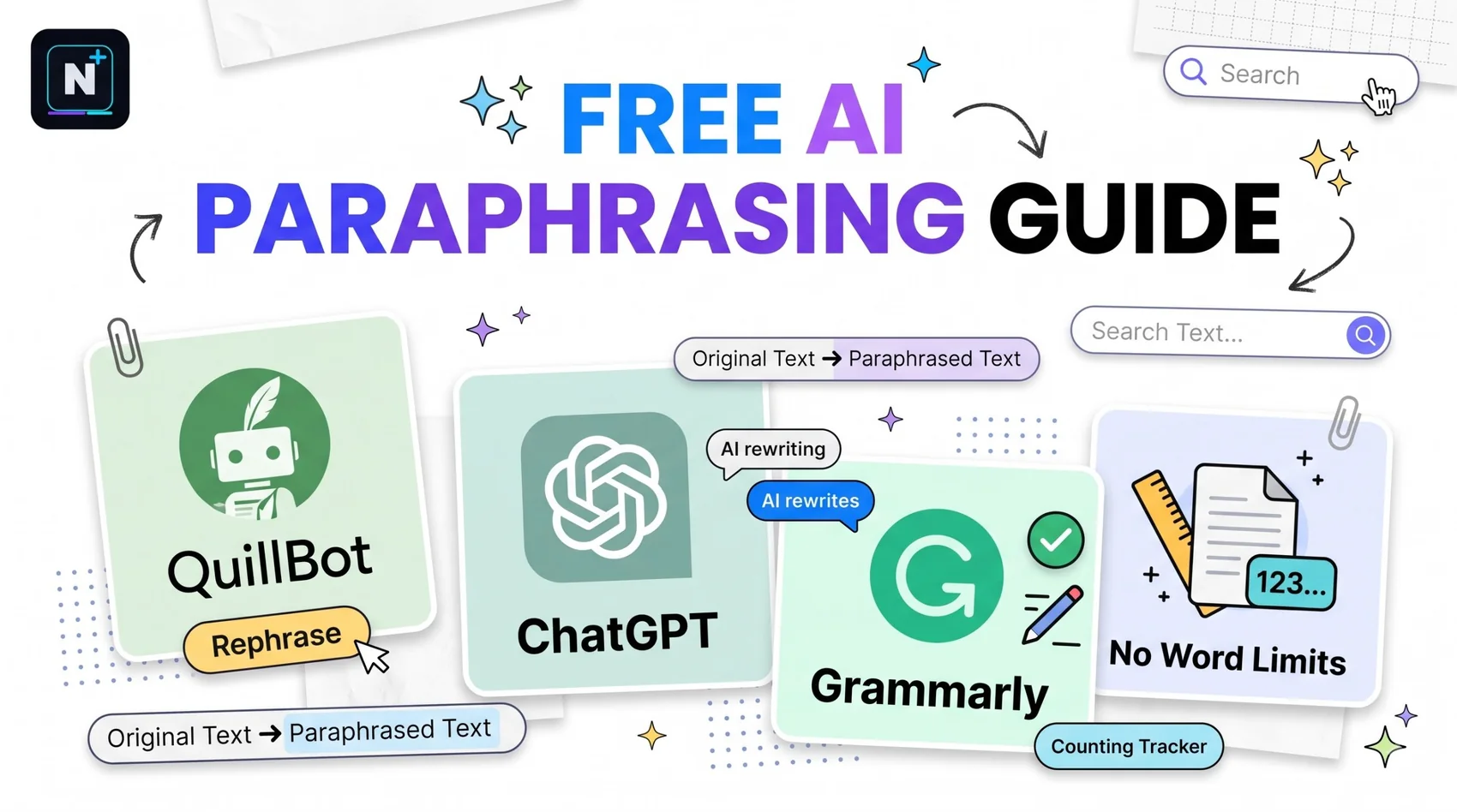
A paraphrasing tool is a bit like a calculator for sentences. Used well, it saves you from staring at a clumsy line for ten minutes. Used badly, it hands you a paragraph that sounds a little off, drifts from what the source said, and still needs a citation you forgot to add. Here's what the main free tools actually give you, where each one stops, and a method for rewriting that keeps the meaning and the integrity intact.
What's the best free AI paraphrasing tool?
QuillBot is the best known, but its free plan caps each rewrite at 125 words and two of its nine modes. Paraphraser.io allows roughly 500 to 600 words, Grammarly's free plan includes about 100 AI prompts a month, and a general chatbot has no word cap at all. None is reliably publish-ready, so edit the result yourself.
🚀 Quick Start: Paste your own paragraph into the box below. If your reading ease score barely moves after a "paraphrase," the tool mostly swapped words, and you've changed very little.
Free paraphrasing tools compared
| Tool | Free limit (reported) | Modes on free | Best for | The catch |
|---|---|---|---|---|
| QuillBot | 125 words per rewrite | Standard and Fluency (2 of 9) | Quick one-paragraph rewrites | Long text means manual chunking |
| Paraphraser.io | About 500 to 600 words per session | Several | Longer passages | Sources differ on the exact limit |
| Grammarly | About 100 AI prompts a month | Rewrite inside the editor | Rewriting while you fix grammar | Not a dedicated paraphraser |
| Wordtune | Reportedly around 10 rewrites a day | Limited | Tone and phrasing options | Daily cap is tight |
| A general chatbot (Claude, ChatGPT, Gemini) | No word cap, but usage limits apply | Anything you describe | Control over style and meaning | You must give clear instructions |
Those limits come from 2026 reviews, and the reviews don't always agree with each other. Re-check on the tool's page, especially for word counts. The same caution applies to the summarizer side of these products, which the free AI text summarizer guide covers separately.
Why free paraphrasers sound slightly off
Most free paraphrasers lean on synonym swaps and light reordering. That's fine for a casual email and a problem for academic writing, where a swapped word can quietly change a claim. "Significant" turns into "important," a correlation becomes a cause, and the numbers stay the same while the meaning shifts. One 2026 review put it bluntly: no free paraphraser consistently produces publishable academic or professional text.
⚠️ Common Mistake: Assuming a paraphrase doesn't need a citation. Rewording someone else's idea is still using their idea. Cite the source every time, however well you reworded it.
Paraphrasing, plagiarism and AI detectors
Three separate issues get tangled here, so it helps to pull them apart.
- Plagiarism. Paraphrasing without a citation is plagiarism, even when no words match. A tool doesn't change that.
- Disclosure. Many schools, journals and employers now ask you to say when AI helped with your wording. Read your policy.
- Detection. AI detectors can flag heavily paraphrased text, and they also flag fully human writing. They're unreliable evidence in either direction.
Purdue's writing lab has a clear explanation of what good paraphrasing looks like, and it's worth reading before your first big paper (link at the end). The short version: restate the idea in your own words and structure, keep the meaning, and cite the source.
A better way: paraphrase by hand, use the tool as a coach
- Read the passage twice, then close it.
- Write the main idea from memory in one sentence.
- Compare your sentence with the original. Did you keep the meaning and the numbers?
- Change the structure, not just the words. Flip the order, split a long sentence or merge two short ones.
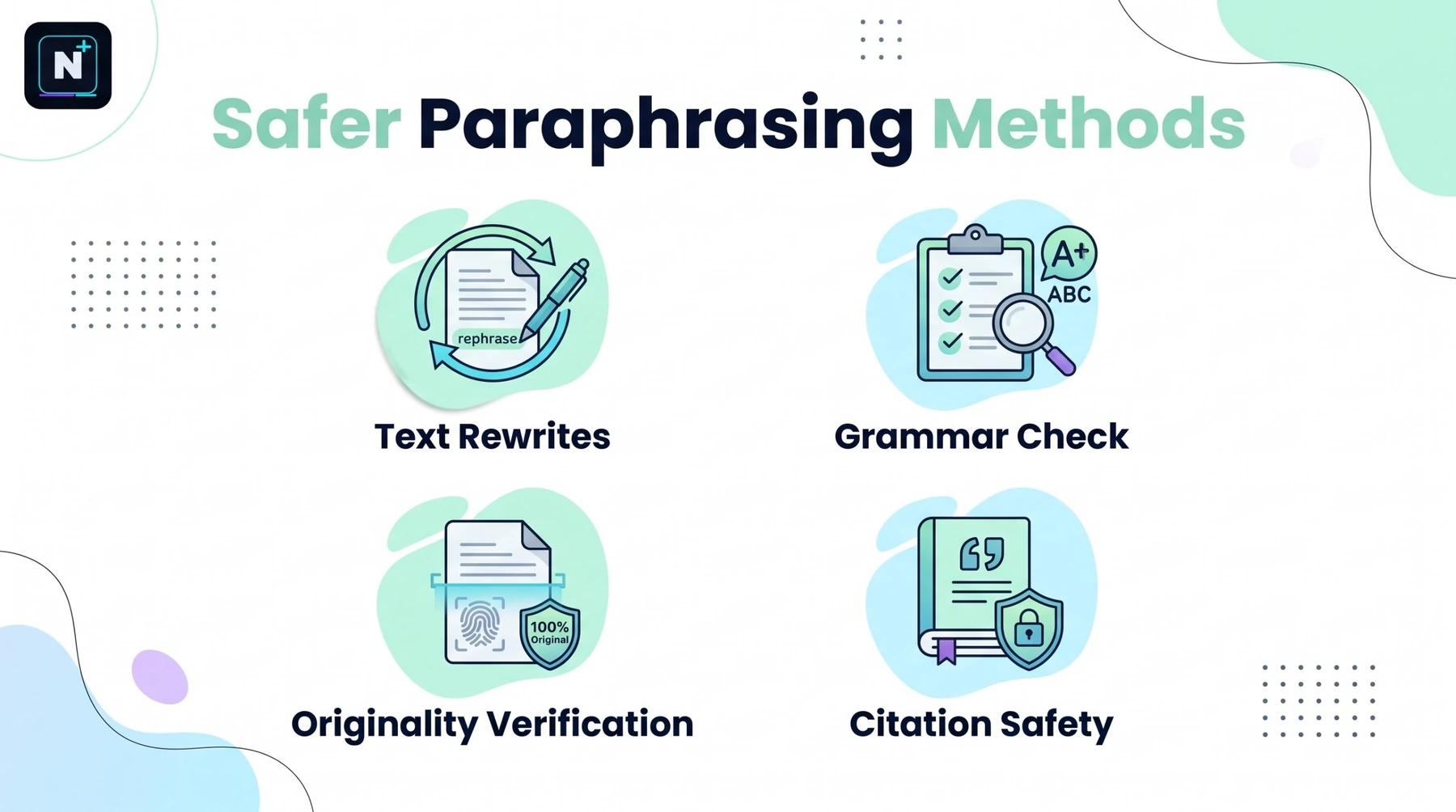
- Run the tool afterwards, not before. Ask it to point out any place where your version changed the meaning.
- Add the citation immediately, before you forget.
If you want to practice a similar habit on long readings, shortening a text is a related skill, and the free AI tools for students guide shows which free tools suit which kind of work.
Which tool for which job?
| Your situation | Try this | Why |
|---|---|---|
| One awkward sentence | QuillBot's free paraphraser | Fast for 125 words or less |
| A whole paragraph | Paraphraser.io or a chatbot | Higher limits |
| Grammar and rewriting together | Grammarly | Fixes and rewrites in one view |
| Rewrite in a specific voice | A chatbot with instructions | You control style and meaning |
| Anything graded | Your own words first | Safest for integrity |
For the chatbot route, specific instructions make a big difference, and the twelve prompts in the Claude prompts for students guide include a feedback prompt that corrects without rewriting for you.
What a weak and a strong rewrite look like
Here's one sentence taken through three versions. The weak one is what many free tools produce. The strong one is what you get when you rebuild the sentence around the idea.
| Version | Text | What's wrong or right |
|---|---|---|
| Original | Researchers found that students who slept longer scored higher on exams. | The source |
| Synonym swap | Investigators discovered that pupils who rested longer achieved higher marks on tests. | Same structure, fancier words, no real change |
| Meaning drift | Sleeping longer makes students score higher on exams. | Turned a finding into a cause |
| Strong rewrite | In the study, longer sleepers tended to do better on exams, though the researchers noted that other factors may play a part. | New structure, same strength of claim, cites the study |
The meaning-drift row is the dangerous one. It looks clean and reads well, and it quietly makes a bigger claim than the source did. That's the kind of error a tool won't catch for you.
Five paraphrasing mistakes worth avoiding
| Mistake | Why it hurts | Fix |
|---|---|---|
| Swapping words one by one | Structure stays identical to the source | Rebuild the sentence from memory |
| Dropping the hedge | "May" and "suggests" often vanish | Keep the original certainty |
| Skipping the citation | Still counts as using the idea | Cite as you write |
| Rewriting a whole page at once | Errors hide in volume | Work one paragraph at a time |
| Trusting the first output | Free tools drift from the meaning | Compare line by line with the source |
When you're pulling several sources into one argument, sort the ideas into an outline before you start rewriting. The free AI essay outline generator guide shows how to do that so your paraphrases have somewhere to land.
Build your own paraphrase coach
I will paste an original passage and then my own paraphrase of it.
Act as a writing coach, not a rewriter. Do not write a new version.

Check my paraphrase and tell me:
1. Whether the meaning, numbers and strength of each claim are preserved
   (flag anything I overstated or softened).
2. Which phrases are still too close to the original wording.
3. Whether the structure is different enough from the source.
4. Two specific questions that would help me improve it myself.

Remind me to cite the source. Do not invent anything not in the passage.

Original:
[paste]

My paraphrase:
[paste]
How this guide was checked
I compared 2026 reviews of QuillBot and its alternatives from several publishers, kept the figures that matched, and flagged the ones that didn't. I didn't run each tool on the same sample for this update, so quality notes are general. Check each tool's own page for current limits.
Frequently asked questions
Further reading
- Purdue OWL on paraphrasing – a clear explanation of what good paraphrasing looks like.