🤖 AI Comparisons · ⚖️ Muse Spark vs ChatGPT · ⏱️ 10 min read
Muse Spark vs ChatGPT: Which Should You Use in 2026?
Here's where the muse spark vs chatgpt question stands on October 30, 2026. ChatGPT is the more finished product. Muse Spark is the cheaper bet, and it's the only one of the two with downloadable weights. Which of those matters more decides the winner, and for most people it comes down to one question: are you paying for an assistant, or hoping not to?
Both sides moved this fall. OpenAI switched ChatGPT's default chat model to GPT-6 on October 7. Meta shipped Muse Spark 1.3 on September 2 and released open weights on October 15. A comparison written in the summer is already out of date.
Muse Spark vs ChatGPT: the quick verdict
ChatGPT is the better daily assistant in October 2026 because it ships deep research, coding agents and custom GPTs in one app, and its paid plans run GPT-6 Sol. Muse Spark wins on price: Meta AI is free to start, the API costs less, and Meta has released open weights.
🚀 Choose ChatGPT if you want one app for research, files, images and coding agents, and you'll pay $20 a month for Plus to get the stronger model. Choose Muse Spark if you want a capable free assistant, a smaller API bill, or weights you can run yourself.
If Google's Gemini is also on your shortlist, the Muse Spark vs Gemini guide runs the same exercise. And if you're wondering who is behind Muse Spark, the Meta Superintelligence Labs explainer covers the lab and its leaders.
Muse Spark vs ChatGPT at a glance
| Criteria | Muse Spark (Meta) | ChatGPT (OpenAI) |
|---|---|---|
| Cheapest way in | Meta AI app and meta.ai, free at launch (US first) | Free plan at $0; Go at $8 a month |
| Model on the free tier | Muse Spark (I couldn't confirm which version) | GPT-6 Luna |
| Paid chat model | No paid consumer tier found | GPT-6 Sol on Plus ($20) and Pro ($100 to $500) |
| API price per 1M tokens (in / out) | $1.25 / $4.25 (Spark 1.3 Standard) | $2.00 / $10.00 (GPT-6 Sol, per a price tracker) |
| Run it yourself? | Yes: Muse Glimmer and Muse Spark Open, both open-weight | No, hosted only |
| Coding agent | Muse Code, a terminal agent (API-based) | Codex, included with plans |
| Data trade-off | Cheap API tier lets Meta use your data | Free and Go may show ads |
How I compared them
I didn't run a benchmark suite. I read Meta's launch posts and API pricing, OpenAI's plan structure as several trackers reported it in October, and independent write-ups, then checked where they disagree. Treat the criteria below as buying criteria rather than scores. Where a number comes from a vendor's own chart, I say so.
Head-to-head: price, models, tools and openness
Price and free access
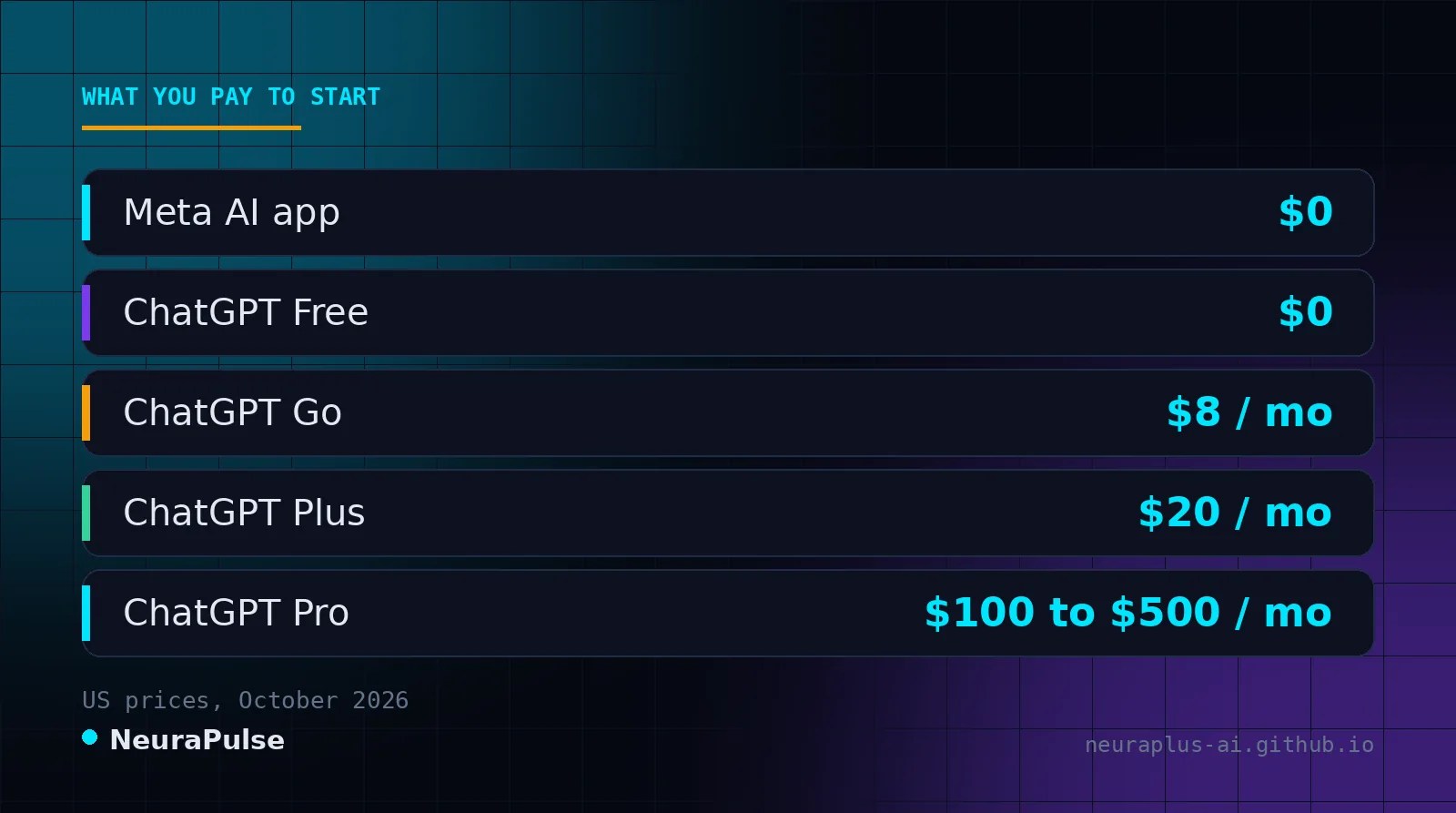
Muse Spark wins on price, and it isn't close at the bottom of the market. ChatGPT starts at $0 on Free, then Go at $8 a month, Plus at $20, and three Pro tiers at $100, $200 and $500 as of mid-October. Meta AI, the app and site that run Muse Spark, cost nothing when they launched on April 8, and I found no paid consumer tier since.
Picture a student with no card on file. On ChatGPT Free she gets GPT-6 Luna, usage caps and, per several trackers, ads. On Meta AI she gets Muse Spark, with an Instant mode for quick answers and a Thinking mode for harder ones. Nobody pays, so the real question is which free model handles her essay questions better. That's a test, not a spec sheet, and there's one below.
One catch. Meta's April rollout started in the US, with more countries promised. I couldn't confirm where Meta AI runs Muse Spark today, so open meta.ai from your own country before you plan around it. Reports also say you'll need a Facebook or Instagram login.
Model quality: what's known and what isn't
Meta's launch post called the first Muse Spark small and fast by design, and it named long-horizon agent work and coding as weak spots. That changed quickly. Spark 1.1 on July 9 brought gains in tool use, computer use and coding. Spark 1.2 and the Muse Code terminal agent followed on August 5, and 1.3 landed on September 2.
Meta's 1.3 chart, as DataCamp reproduced it, shows a mixed result against GPT-5.6 Sol. On a long-context retrieval test spanning 512K to 1M tokens, Spark scored 98.1 to GPT's 73.8. On the DeepSearchQA web-research test, GPT led 93.0 to 89.4. A split like that is believable. A clean sweep wouldn't be.
Four reasons not to lean on that chart:
- Meta published it, so Meta picked the tests and the rivals.
- The ChatGPT rival is GPT-5.6 Sol. Plus subscribers have chatted with GPT-6 Sol since October 7.
- Meta's release notes list Muse Code and the Meta Model API as the places to get 1.3. I couldn't confirm the free Meta AI app runs it.
- One independent write-up measured Spark 1.3 producing more output tokens than the median model on a standard index, even though Meta claims 25% fewer than Spark 1.2. That changes what a task really costs.
Tools and apps
ChatGPT is further along, and I wouldn't argue otherwise. Plus bundles deep research, Codex for coding, custom GPTs and an agent called Work, and Work and Codex now draw from one shared allowance. Meta's pitch looks different: a camera-aware assistant with a shopping helper, health answers developed with physicians, and Muse Code, a terminal agent that runs several sub-agents at once.
If your day is files, spreadsheets and long research runs, pay for ChatGPT Plus. If you mostly ask questions and want a second opinion, Meta AI costs nothing to keep open in another tab.
Open weights and your data
Here Muse Spark has something ChatGPT can't match. On October 15 Meta released Muse Spark Open: a mixture-of-experts model with 816 billion total parameters, about 42 billion active per token, a one-million-token context window and multimodal input. It's open-weight, not open source. The Muse Model License asks you to display a “Built with Muse Spark Open” notice and carries usage rules plus a revenue threshold (reported at $20 million), so read it before you build a product on it.
It's also huge. The BF16 checkpoint runs about 1.5 TB, so this isn't a laptop download. The model most people could run is Muse Glimmer, a 30-billion-parameter open model released August 10 under Apache 2.0 that reportedly fits on one 24 GB consumer GPU. If that appeals, the Ollama setup guide shows the local-model workflow, and the best Ollama models for coding lists what else is worth running.
On data, the API's cheap Contributor tier lets Meta keep and use your prompts to improve its products, and the Standard tier doesn't. Whatever you choose, check the data setting before you paste in client work.
API prices for developers
| Model | Input per 1M tokens | Output per 1M tokens | Note |
|---|---|---|---|
| Muse Spark 1.3 Standard | $1.25 | $4.25 | 1M context; data not used to improve Meta's products |
| Muse Spark 1.3 Contributor | $0.10 | $0.20 | Meta may use your data |
| GPT-6 Sol | $2.00 | $10.00 | Per a third-party price tracker |
| GPT-6 Luna | $0.10 | $0.50 | Per the same tracker; the smaller model |
Spark 1.3 Standard costs about 38% less than GPT-6 Sol on input and 58% less on output. Luna undercuts Spark on both counts, but Luna is the small model, so the fair match for Spark is Sol. Per-token price isn't per-task price, either. Run your real prompts before you move a production workload. If you're also weighing self-hosting, the Ollama vs OpenAI API comparison covers the local-versus-hosted cost trade-off.
Which fits you: Muse Spark vs ChatGPT by use case
| Your situation | Pick | Why |
|---|---|---|
| You write, research and juggle files all day | ChatGPT Plus | Deep research, Codex and agents are built in, on GPT-6 Sol |
| You want a capable assistant for $0 | Meta AI | Muse Spark costs nothing to try, if it's live in your country |
| You're building an app and watching the bill | Test Muse Spark 1.3 | Its listed price sits far below Sol's, but measure cost per task |
| You must run the model on your own hardware | Muse Glimmer or Spark Open | Open weights, with licence terms you need to read |
| You also weigh Claude for writing | Add Claude to the test | See Claude vs ChatGPT for content writing |
Run this 10-minute test before you decide
Don't pick from a table. Open both assistants in fresh chats on the same day, paste the same five prompts, and score each answer from 1 to 5.
- Paste a 600-word email thread. Ask for a three-line summary and the one decision it needs from you.
- Ask a question from your own field where you already know the answer, then check every source it cites.
- Paste a messy table as text and ask for the biggest anomalies. Verify them by hand.
- Ask for a short Python function with edge cases, then try to break it.
- Photograph a receipt or whiteboard and ask it to transcribe the text and add up the numbers.
Add the scores. If the gap is under three points, choose on price. I'd repeat the test every quarter, because Muse Spark has shipped four versions in five months and ChatGPT just changed its default model.
⚠️ Common Mistake: Comparing Muse Spark 1.3's API chart with the ChatGPT you actually open. The chart's rival is GPT-5.6 Sol, ChatGPT moved to GPT-6 Sol on October 7, and I couldn't confirm the free Meta AI app runs 1.3 at all.
What would change this verdict
A neutral lab publishing a head-to-head of Spark 1.3 and GPT-6 Sol would settle the quality question. So would Meta saying which Spark version the free app runs. A paid Meta AI tier would reshape the price comparison, and so would a price move from OpenAI. Any of the four, and I'll update this page.
How this guide was checked
I read Meta's Muse Spark and Muse Spark 1.1 announcements, TechCrunch's April 8 launch report, the Muse Spark Open model card, and ChatGPT's plan structure as several price trackers reported it between October 8 and October 17. API prices for GPT-6 come from a third-party tracker, so confirm them on OpenAI's page before you budget. Benchmark figures are Meta's own. I haven't run Muse Spark against GPT-6 myself, and this page says nothing that depends on having done so.
Frequently asked questions
Further reading
- Meta: Introducing Muse Spark – the launch post, with the modes and stated gaps.
- TechCrunch: Meta debuts Muse Spark – an independent launch report.
- Muse Spark Open model card – specs and licence terms.
- ChatGPT pricing – OpenAI's current plans.