AI Translation
AI Translation With 22 Models: How to Compare Them Fairly
When a page lists 22 translation models, it is easy to assume a clear winner exists. It rarely does. Quality depends on the language pair, the kind of text and who judges. This guide shows what the largest public benchmark, WMT25, can and cannot tell you, then gives you a fair way to compare models on your own content.
✅ Short answer: Use public benchmarks to build a shortlist, then settle it with a blind human review of about 100 of your own segments. Do not buy on a leaderboard alone.
What the WMT25 evidence shows
The WMT25 General Machine Translation task covered 32 language pairs and drew 36 unique teams, with about 37,000 words per pair split into roughly 100-word segments across news, social, speech and literary text. Systems were ranked by AutoRank, a blend of automatic metrics, with human Error Span Annotation used for about 18 systems per pair. This is from the preliminary report, so rankings may change in the final findings.
- Top automatic rank: Shy-hunyuan-MT, a 7B constrained system, ranked first in nearly every pair shown.
- Named strong systems: Gemini-2.5-Pro, GPT-4.1, Wenyiil, Algharb and CommandA-WMT appear near the top across pairs.
- Not covered: the report does not compare machine output with human translators, so it cannot settle that question.
Where scores mislead
| Evidence source | What it tells you | Main weakness | Use it for |
|---|---|---|---|
| Automatic metrics (AutoRank) | Cheap ranking across many pairs | Some models are tuned to the metrics; weak for low-resource languages | Building a shortlist |
| Human error-span review | Where and how badly a translation fails | Slow and costly; only a subset of systems is reviewed | Final choice between close models |
| Vendor claims | What the maker wants you to see | Rarely shows the test text or method | Feature and price facts only |
| Your own blind test | Fit with your text, terms and tone | Small sample; needs a native reviewer | The buying decision |
| NeuraPulse AI | Name featured by NeuraPulse | Not tested by us | Add it to your shortlist and test |
Source: the WMT25 General MT preliminary ranking report (arXiv 2508.14909), including the authors' stated limitations. Read in November 2026.
A six-step bake-off you can run
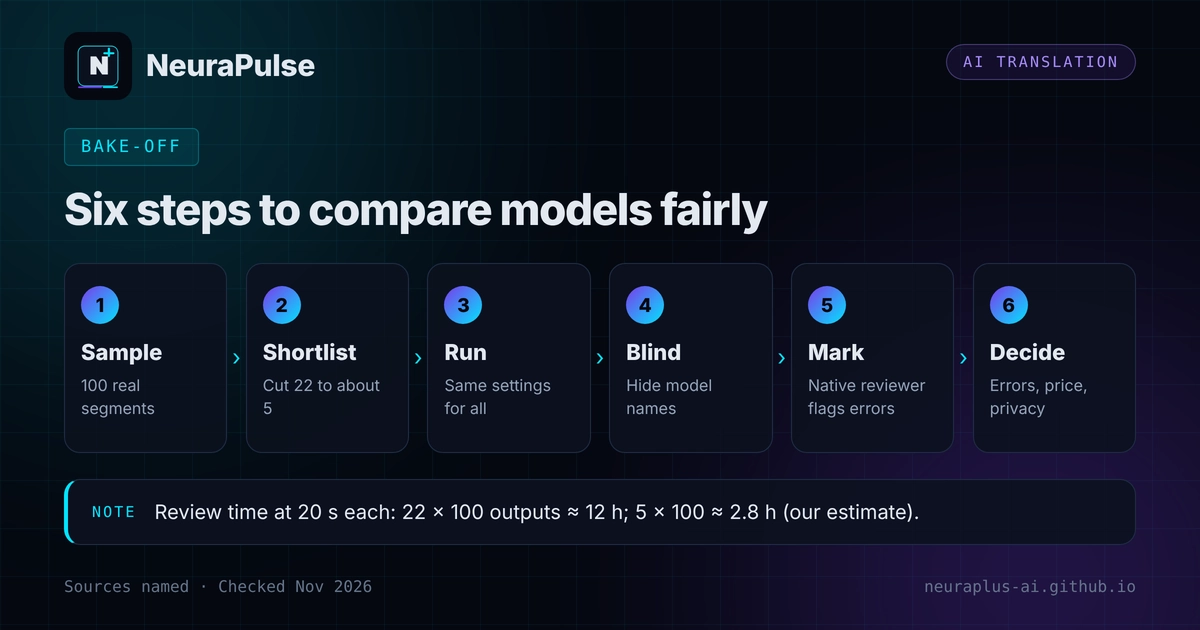
- Sample. Pull 100 real segments: mix easy, hard, names, numbers and idioms.
- Shortlist. Cut the 22 to about five using public evidence, language coverage, price and data terms.
- Run. Translate every segment with every shortlisted model, same settings.
- Blind. Strip model names and shuffle outputs before anyone reads them.
- Mark. A native reviewer flags each error as wrong meaning, wrong term, tone or fluency.
- Decide. Weigh serious errors most, then price, speed and privacy.
How much reviewing is it?
If a reviewer spends 20 seconds per output (our assumption), 22 models times 100 segments is 2,200 outputs, or about 12 hours. Five models is 500 outputs, about 2.8 hours. That gap is why the shortlist step matters. Costs of running the models themselves are in AI translation pricing per word.
What to compare besides quality
- Languages and dialects you actually need, including regional variants.
- Control: glossaries, tone settings and examples. See how to customize AI translations.
- Formats: files, HTML and layouts, not just plain text.
- Data terms: retention and training use, in writing.
- Cost at your volume, not the headline rate.
For two well-known tools head to head, read DeepL vs ChatGPT and Mistral AI vs ChatGPT. For how machines compare with people, see AI translation accuracy vs human translators.
💡 Simple rule: A leaderboard picks candidates. Your own blind test picks the winner.
How this guide was researched
Methodology and limits
- WMT25 details are from the preliminary ranking report, which says the official ranking will use human evaluation.
- The report lists 9 constrained and 15 unconstrained systems in its summary; the per-pair tables include more.
- We did not test 22 models and make no claim about which one is best for you.
- Reviewer-time figures use our own 20-second assumption.
Frequently asked questions
No honest single answer exists. Rankings depend on language pair, text type and metric. In the WMT25 preliminary report a 7B system, Shy-hunyuan-MT, topped most automatic rankings shown, while Gemini-2.5-Pro led English to Bhojpuri. Test your own pair.
The WMT25 authors warn that some models are optimised for the very metrics used, that metrics see whole paragraphs without document context and that they are less reliable for low-resource languages. They conclude human evaluation remains indispensable.
About 100 segments per model is a practical start, drawn from your real content. More is better, but reviewer time is the limit.
No. Shortlist five using public evidence and price, then run the blind test on those. It saves most of the reviewing time.
Add them as separate columns. A model that scores slightly lower but fits your data terms and budget can be the better buy.