🎙️ AI Voice Tools · Free Tiers
ElevenLabs Free Plan Limits: Credits, Rules, Upgrades
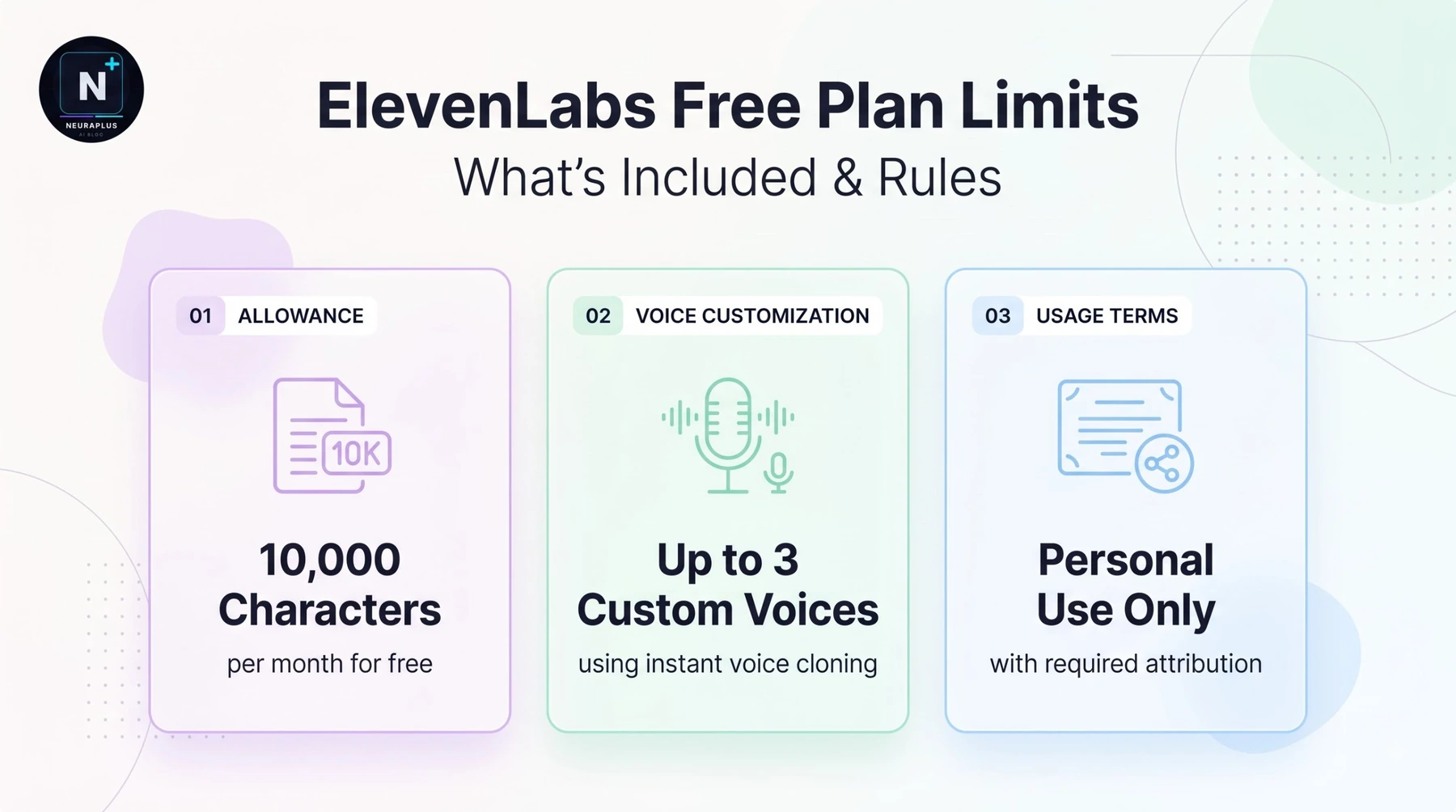
The ElevenLabs free plan is generous enough to judge the voices and tight enough that you'll feel the ceiling within a few scripts. It gives you 10,000 credits a month, which works out to roughly ten minutes of speech. The bigger limit, though, isn't the credit count. It's the license: audio made on the free plan can't be used commercially, and that single rule decides whether free is an option for your project.
What are the ElevenLabs free plan limits?
The free plan includes 10,000 credits per month, which covers about ten minutes of text-to-speech with the standard high-quality model. Output is for personal, non-commercial use and requires attribution to ElevenLabs. Credits reset monthly and don't roll over. Commercial rights start on the first paid plan.
💡 One-sentence version: That summary is accurate for the plan as of October 2026, but ElevenLabs adjusts plans and prices from time to time. Confirm the figures on its pricing page before you build a workflow around them.
Free plan at a glance
| Item | Free Plan |
|---|---|
| Price | $0 |
| Monthly credits | 10,000 |
| Rough text-to-speech time | About 10 minutes |
| Commercial use | Not allowed |
| Attribution | Required for public use |
| Credit rollover | No, credits reset each month |
| Pre-made voices | Yes |
| Other tools using credits | Speech-to-text, sound effects, voice design |
How credits turn into minutes
Credits are the currency across ElevenLabs tools, and different tools spend them at different rates.
For text-to-speech, the standard models use about one credit per character. The faster Flash models cost less, somewhere between half a credit and a full credit per character depending on your plan. So 10,000 credits cover roughly 10,000 characters of standard speech, which is a bit over ten minutes of narration once you account for pacing.
Third-party summaries disagree on the exact minutes, because speaking speed and the model you pick change the result. Some quote around ten minutes, and others say closer to twenty if you use a cheaper model. Treat ten minutes as the safe planning number.
| Task | Rough Credit Cost |
|---|---|
| 1,000 characters of standard text-to-speech | About 1,000 credits |
| A 90-second voice-over script (around 1,400 characters) | About 1,400 credits |
| 10 short scripts of 1,000 characters each | About 10,000 credits, the whole month |
| Dubbing a video | Roughly 5,000 to 10,000 credits per minute |
⚠️ The dubbing surprise: That last row is the surprise. Dubbing and other heavy features burn credits far faster than plain narration, so a single dubbed minute can consume most of your monthly free allowance.
The no-commercial-use rule
This is the line that matters. On the free plan, you can listen, test and make personal projects, but you can't use the audio in work that earns money. That includes monetized YouTube videos, client work, paid courses, ads and apps you sell. Free output also requires crediting ElevenLabs if you publish it.
🚫 The commercial test: If you're unsure whether your project counts as commercial, ask a simple question: does anyone pay me, or do I earn ad revenue, because of this audio? If yes, you need a paid plan. The Starter plan is the usual entry point for commercial rights, with 30,000 credits a month and instant voice cloning. Prices have been quoted between $5 and $6 a month depending on billing, so check the current page.
What you can and can't do for free
| Feature | Free | Notes |
|---|---|---|
| Try pre-made voices | Yes | Good for auditioning |
| Generate speech from text | Yes | Within your 10,000 credits |
| Use output on a monetized channel | No | Needs a paid plan |
| Publish without credit | No | Attribution is required |
| Professional voice cloning | No | Starts on higher tiers |
| Carry unused credits to next month | No | Credits reset |
| Use credits across tools | Yes | One pool shared by features |
On instant voice cloning, sources disagree about whether the free tier includes a limited version, and ElevenLabs has changed that kind of detail before. Look at the plan comparison on its own site instead of relying on a summary, including this one.
How to get more from 10,000 credits
Write the script first, then generate once
Every regeneration spends credits again. Edit in a text document, and send the final text.
Test with a short sample
Generate one sentence to check the voice and pronunciation before you spend credits on the full script.
Use the cheaper model when quality allows
Flash-style models cost fewer credits per character, which stretches the allowance for drafts.
Cut filler
Spoken scripts are better short anyway. Remove repeated phrases and long lead-ins.
Plan your month
If you only get ten minutes, decide which projects deserve them. A short intro for a personal video is a better use than a long test run.
When to upgrade
| Your Situation | Free Plan Fit | What to Do |
|---|---|---|
| Hobby project you won't publish | Good | Stay on free |
| Testing voices before picking a tool | Good | Stay on free |
| Posting to YouTube with ads | No | Upgrade for the license |
| Client work | No | Upgrade for the license |
| More than ten minutes of audio a month | No | Move up a tier or use another tool |
| Need voice cloning for consistent branding | No | Higher tier required |
If you need volume but not necessarily ElevenLabs quality, a free alternative with fewer restrictions can make more sense, which is a subject for its own guide. For now, note that speech-to-text is a separate need: Groq's free tier reportedly includes a generous speech-to-text allowance, which you can read about in the Groq API free limits guide.
Pairing it with a writing tool
Credits are most valuable when the script is already polished, so the writing step is worth doing well before you generate audio. If you draft scripts with Claude, the Claude master prompt template helps you get a usable script in one pass, and the Claude free plan limits guide explains how many drafts you can expect before the usage window runs out. If you'd rather keep drafts on your own computer, the walkthrough to install Ollama on Windows shows how to run a local model.
🎯 The workflow insight: The smartest free-tier setup pairs a polished writing step (Claude, Ollama or your own editing) with a single generation pass in ElevenLabs. Every regeneration burns credits you can't get back, so the script should be final before it hits the voice model.
Common mistakes
Running out of credits halfway through a script
Because the script was longer than 10,000 characters. Count characters first with any word processor before you hit generate.
Assuming rollover
Unused credits don't carry into next month on the free plan. If it's the 28th and you have 4,000 credits left, use them or lose them.
Using free audio in a monetized video
That's the mistake with real consequences, and it can lead to takedowns or a demand to remove the content. Check the license before you publish.
Skipping attribution
If you publish free-plan output anywhere public, credit ElevenLabs as the terms require. A simple line in the description is enough.
✅ Bottom line: ElevenLabs' free plan gives you 10,000 credits (~10 minutes of speech) each month with no credit card — perfect for testing voices and personal projects. The no-commercial-use rule is the real ceiling: any paid work, monetized YouTube, or client audio requires the Starter plan. Write your script first, generate once, and upgrade when your project outgrows ten minutes a month or needs a commercial license.
Frequently asked questions
Further reading
- ElevenLabs pricing – the current plans, credit allowances and licensing terms.