🧠 AI Basics · Machine Learning
How AI Works Step by Step:
A Complete Beginner's Guide
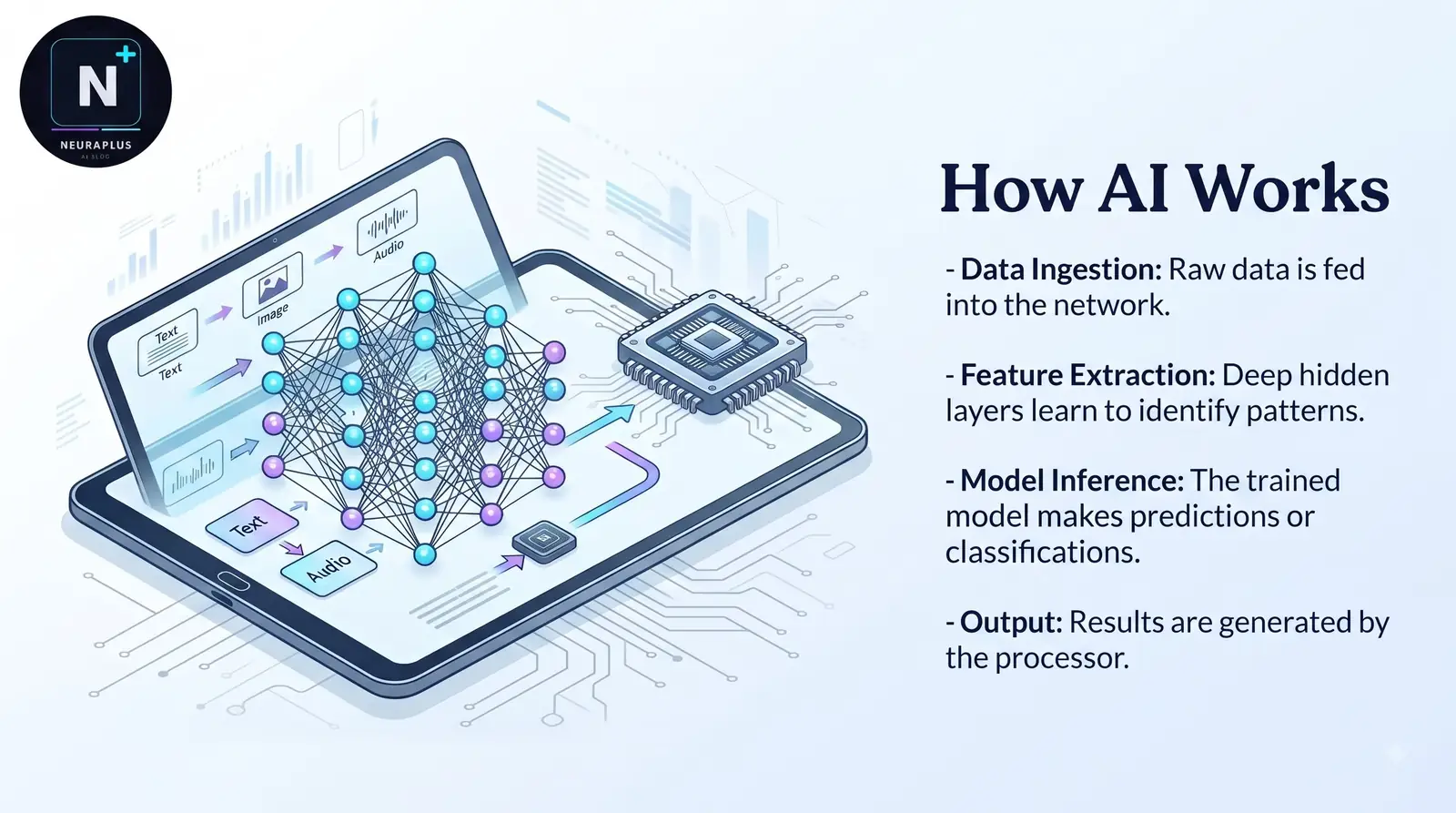
Artificial intelligence is everywhere — powering your search results, personalizing your Netflix recommendations, answering your questions through chatbots, and generating the images you see on social media. But how does AI actually work? In this step-by-step guide, we break down exactly how AI systems learn, reason, and make decisions — in plain language, no PhD required.
💡 Simple Definition: AI is software that learns from examples rather than being explicitly programmed with rules. Instead of telling a computer exactly what to do, we show it billions of examples and let it figure out the mathematical patterns.
What Is Artificial Intelligence?
Artificial Intelligence (AI) is a broad term for computer systems that can perform tasks that typically require human intelligence — things like understanding language, recognizing images, making decisions, and solving problems. The key word is learn: modern AI systems learn from data rather than following hand-coded rules.
At NeuraPulse, we cover the full spectrum of AI research and applications. If you want to understand the practical tools powered by this technology, check out our guide on AI tools for blogging and SEO.
Step 1: Machine Learning — Teaching Computers From Examples
The foundation of modern AI is machine learning (ML) — the ability for computers to learn from data. Instead of programmers writing explicit rules, the computer is shown thousands or millions of examples and learns to identify patterns.
A simple example: to train an AI to recognize cats in photos, you show it 100,000 photos labeled "cat" or "not cat." The algorithm adjusts its internal settings until it can correctly identify cats with high accuracy. Those internal settings are called parameters or weights.
Supervised vs Unsupervised Learning
Supervised learning uses labeled examples (cat/not cat). Unsupervised learning finds patterns in unlabeled data. Reinforcement learning learns from trial and error, receiving rewards for correct actions — the exact approach used to train AI to play games and power ChatGPT through RLHF (Reinforcement Learning from Human Feedback).
Step 2: Training Data — The Fuel of AI
AI is only as good as its training data. To build a language model like ChatGPT, OpenAI trained on hundreds of billions of words from the internet, books, code repositories, and scientific papers. The quality, diversity, and quantity of training data directly determines what the AI can and cannot do.
This is why data collection and curation is one of the most important — and expensive — parts of building AI systems. Bad data produces biased, unreliable AI. Good data produces capable, trustworthy AI.
Step 3: Neural Networks — The Brain-Inspired Architecture
Modern AI systems are built on neural networks — computational structures loosely inspired by the human brain. A neural network consists of layers of nodes (neurons) connected by weights. Data flows through these layers, being transformed at each step until it reaches an output.
The architecture that powers most modern AI — including ChatGPT, Gemini, and Claude — is the transformer. As we explain in detail in our deep-dive on the attention mechanism, transformers use self-attention to understand relationships between all parts of the input simultaneously, rather than reading words strictly left-to-right.
Deep Learning
When neural networks have many layers (typically dozens or hundreds), we call it deep learning. The "deep" refers to the depth of the network. More layers allow the network to learn increasingly abstract representations — from simple edges in images to complex concepts like faces, sarcasm, or quantum physics.
Step 4: The Training Process — How AI Learns
Training an AI model is an iterative optimization process that runs millions of times:
- Forward pass: Input data flows through the network to produce a prediction.
- Calculate error: Compare the prediction to the correct answer (the loss function).
- Backpropagation: Calculate how each weight contributed to the error.
- Update weights: Adjust weights slightly using an optimizer to reduce the error.
- Repeat: Do this billions of times across the training dataset.
After millions of these iterations, the model's weights settle into values that allow it to make accurate predictions on new, unseen data. This is called convergence.
📊 Scale: Training GPT-4 required weeks of computation on tens of thousands of specialized chips (Nvidia GPUs), consuming over $100 million in electricity and hardware costs. The resulting model has over a trillion parameters — each one a number that was optimized during training.
Step 5: Making Predictions — Inference
Once trained, using an AI model is called inference. You give the model an input, it runs a forward pass through the network, and returns an output. For a language model, the input might be your question and the output is the next most likely word — repeated thousands of times to generate a complete response in milliseconds.
📖 Related Reading
How Diffusion Models Generate Images
See how inference works in image-generating AI like Midjourney — from pure static noise to photorealistic pictures.Read Article →
AI vs Traditional Programming: What's the Difference?
To truly understand how AI works, it helps to compare it to the software you've used your whole life. Traditional programming requires humans to write the rules. AI flips this entirely.
| Feature | Traditional Programming | Artificial Intelligence (ML) |
|---|---|---|
| Core Logic | Rules + Data = Answers | Answers + Data = Rules |
| Adaptability | Rigid; breaks on edge cases | Flexible; generalizes to new inputs |
| Creation | Written by human developers | Learned by the algorithm from data |
| Updates | Requires rewriting code | Requires feeding it new data and retraining |
| Best For | Exact calculations, databases | Pattern recognition, language, vision |
Types of AI You Use Every Day
- Large Language Models (LLMs): ChatGPT, Claude, Gemini — understand and generate text and code.
- Image Recognition: Face ID, Tesla Autopilot, Google Photos — identify objects in the physical world.
- Recommendation Systems: Netflix, Spotify, TikTok — predict what you'll engage with next.
- Diffusion Models: Midjourney, DALL-E 3 — generate images from text descriptions.
- Speech Recognition: Siri, Alexa, Otter.ai — convert human speech to text in real-time.
📖 Related Reading
How to Build AI Tools
Now that you understand the underlying tech, learn how to build your own AI applications using APIs and prompts.Read Article →
Common AI Misconceptions (Myth vs Reality)
Myth 1: AI is conscious and has feelings.
Reality: AI models are highly advanced statistical engines. They do not have beliefs, consciousness, or real-world experiences. They predict the next word based on mathematical probabilities, not emotion.
Myth 2: AI is always right.
Reality: AI models "hallucinate" — they confidently generate plausible-sounding but entirely fabricated facts. This is why human review remains essential for critical tasks like medical, legal, or financial advice.
Myth 3: AI learns from you in real-time.
Reality: When you chat with an AI, its core weights are frozen. It doesn't permanently learn from your specific prompt unless the company explicitly uses your chat for future training (which most allow you to opt out of).
Ethics, Limitations, and The Alignment Problem
Because AI learns from human data, it inherits human biases. If the training data contains historical prejudices, the AI will replicate them. This is a core focus of AI safety research. As we explore in our article on the alignment problem, ensuring AI systems do what humans actually want them to do — rather than just what they are literally told to do — is one of the most important challenges in computer science today.
Where AI Is Heading: The Path to AGI
The AI systems of 2026 are extraordinarily capable — but they are still "narrow" tools, each trained for specific domains (text, images, code). The next frontier is AGI (Artificial General Intelligence) — AI that can learn, reason, and plan across any domain as effectively as a human. As we explore in our deep-dive on AGI by 2027, whether this is imminent or decades away remains fiercely debated among researchers.
Conclusion
AI works by learning patterns from massive datasets through neural networks, optimizing billions of parameters through backpropagation, and applying those learned patterns to new inputs during inference. Understanding these fundamentals helps you use AI tools more effectively, prompt them better, and think critically about their limitations. Subscribe to our newsletter for weekly updates on the latest AI developments and tutorials.