🎙️ AI Music · Podcasts
Free AI Music Generation for Podcasts: What Is Really Free and Safe to Use
Free music for a podcast sounds simple until you read the licence. Most free AI music plans let you make tracks for fun, but not for a show that runs ads, takes sponsors or promotes a business. This guide shows what is genuinely free, what is not and the cheapest way to stay safe if you want AI-made intros, outros and background beds.
✅ Short answer: Free AI music plans are mostly non-commercial. A hobby podcast with no income may be fine under some terms, but a sponsored or monetised show should use a paid plan with a clear commercial licence. A low-cost paid plan is usually safer than any free workaround.
Short answer: free is not the same as podcast-safe
There are two separate questions. Can I generate music for free? Often yes. Can I use that music in a podcast that earns money or promotes a company? Often no. A licensing summary dated February 2026 says it plainly for the big tools: Suno's free plan is non-commercial, and ElevenLabs Music's free tier excludes podcasts, advertising and client use. To learn how to make tracks first, see our AI music generator tutorial.
Free plans compared: what you can actually do
| Tool | Free allowance | Podcast use on the free plan | Next step if you monetise |
|---|---|---|---|
| Suno | 50 credits a day; older accounts may have a few trial downloads | Non-commercial only; trial downloads are not eligible for commercial use | Pro $10/mo (20 downloads a month); regenerate songs on the paid plan |
| ElevenLabs Music | Free tier with attribution | Non-commercial; podcast use is excluded on Free per a February 2026 summary | Plan-based licences; check the current music terms for podcasts and sponsors |
| Udio | 10 credits a day, 100 a month | Downloads are disabled, so tracks cannot leave the app | Not a podcast route while downloads are off |
| Mubert | 25 tracks a month, 5 MP3 downloads | Free tier is non-commercial only | Pro $39/mo adds commercial use |
| Soundraw | Generate and preview; no free downloads | Not usable, since you cannot download | Creator $16.99/mo ($11.04 yearly), listed for background music |
| Meta MusicGen (open source) | Unlimited on your own hardware | Model weights are non-commercial (CC-BY-NC 4.0), per a review | Not for monetised shows |
| AIVA | Free tier, credit required | No monetisation on the free tier | Standard €11/mo billed yearly allows limited monetisation |
| Design.com | Check Design.com | Not a music tool | Useful for show logos and cover art branding |
| OpenMel | Not reviewed here | We could not verify its terms | Check OpenMel directly before using it |
Sources: reviews dated September to October 2026 and a licensing summary dated February 2026. Plans change, so confirm in your account.
A quick decision guide
Some free plans allow non-commercial use with attribution. Keep it that way: no ads, no sponsors, no paid promotion.
Pick a plan whose licence names podcasts. Regenerate anything you made on a free plan.
Some licences exclude client work or corporate use unless you buy a higher tier.
Keep receipts for every track in case a claim appears. See our royalty-free AI music guide.
The cheapest safe upgrade
Recent reviews list entry plans with commercial licences from about $6 to $17 a month: ElevenLabs Music Starter at $6 a month ($5 yearly) and Soundraw Creator at $16.99 ($11.04 yearly), with Suno Pro at $10. Those numbers conflict with older licence summaries in places, so do not choose on price alone. Read the exact wording for podcasts and sponsorship. For a full price comparison, see AI music generator pricing 2027.
If you already use AI voices for your show, ElevenLabs offers music alongside speech. Its own site is at elevenlabs.io, and our guides cover ElevenLabs pricing and features and ElevenLabs for YouTube voiceover.
Mix AI music so it helps your show
- Keep it instrumental under speech. Vocals compete with the host's voice.
- Sit it 15 to 25 dB below the voice and use ducking, so music dips when someone talks.
- Short intros win. Ten to twenty seconds is plenty. Fade the bed out under the first sentence.
- Aim for a consistent final level. Around -16 LUFS for stereo is a common target. Check your host's recommendation.
- Use one theme. A single intro, outro and bed makes a show sound professional. Use variations of the same prompt.
- Test on earbuds and a phone speaker. Most listeners use those.
Checks before you publish
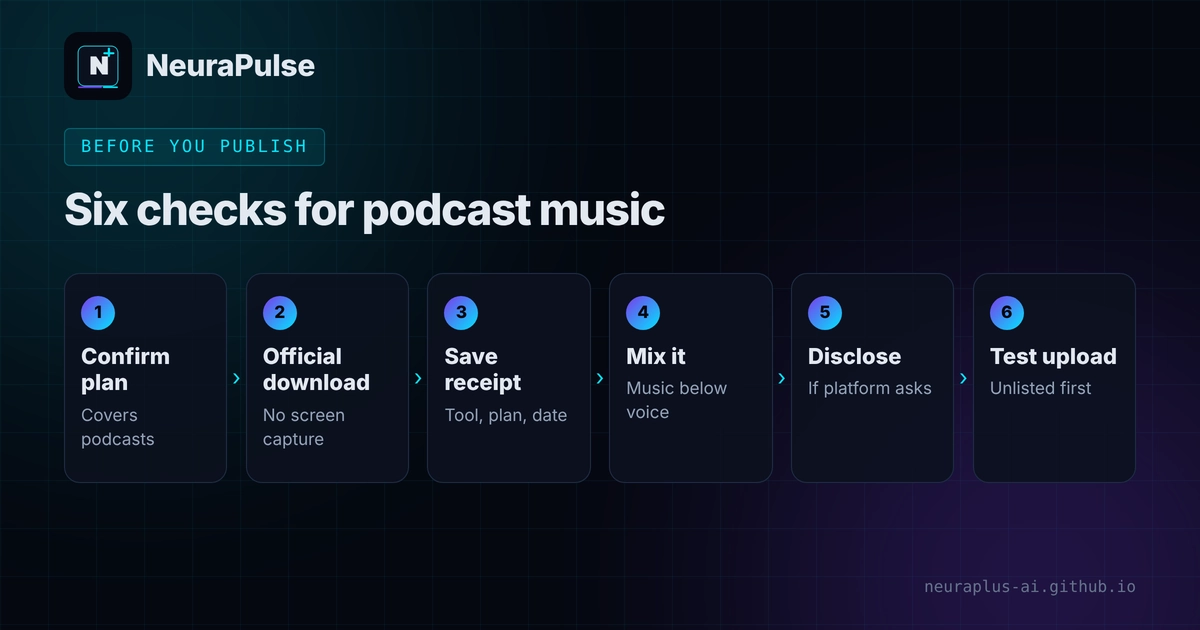
- Confirm the plan. The licence must cover podcasts, and sponsorship if you have any.
- Use the official download. Screen captures and unofficial downloaders may not carry rights.
- Save a receipt. Store the tool, plan, date, prompt and file name.
- Mix and master. Check levels and test on a few devices.
- Disclose if needed. Add a line to the show notes where the platform or your audience would expect it.
- Test the upload. Publish a private or unlisted version first and check for automated claims if you also post to YouTube.
💡 Simple rule: If the podcast could ever earn money or promote a business, treat the music as commercial from day one and pay for the right licence.
New to AI audio? Start with the tutorial, then see AI tools for content creators for the rest of your toolkit.
How this guide was researched
Methodology and limits
- Free-plan limits and licence notes come from reviews dated September to October 2026 and a licensing summary dated February 2026. Sources disagree in places, mostly on ElevenLabs tiers, and we say so.
- Loudness and mixing figures are common production guidance, not rules from any tool.
- We did not test each tool's free export ourselves.
- This is not legal advice. Read the terms of the plan you use.
- Author: Prashant Lalwani. Last verified November 18, 2026.