©️ AI Music · Licensing
How to Generate Royalty-Free AI Music: Licences, Rights and a Safe Workflow
"Royalty-free" is one of the most misunderstood phrases in music. It does not mean free of rules, free of claims or free of risk. With AI music it also depends on which plan you used and how you downloaded the file. This guide explains what royalty-free really means, which plans give you commercial rights and a safe six-step workflow.
✅ Short answer: Generate on a paid plan whose licence covers your use, download through the tool's official channel, keep proof, write your own lyrics if you can and disclose AI music where platforms ask. Do not use free-plan songs commercially.
Short answer: how to get royalty-free AI music
There is no single "royalty-free switch". Each tool grants rights through its plan and terms. The safest approach is to treat the licence as part of the product you are buying. If you are new to the tools, start with our AI music generator tutorial. For prices, see AI music generator pricing 2027.
What royalty-free means, and what it does not
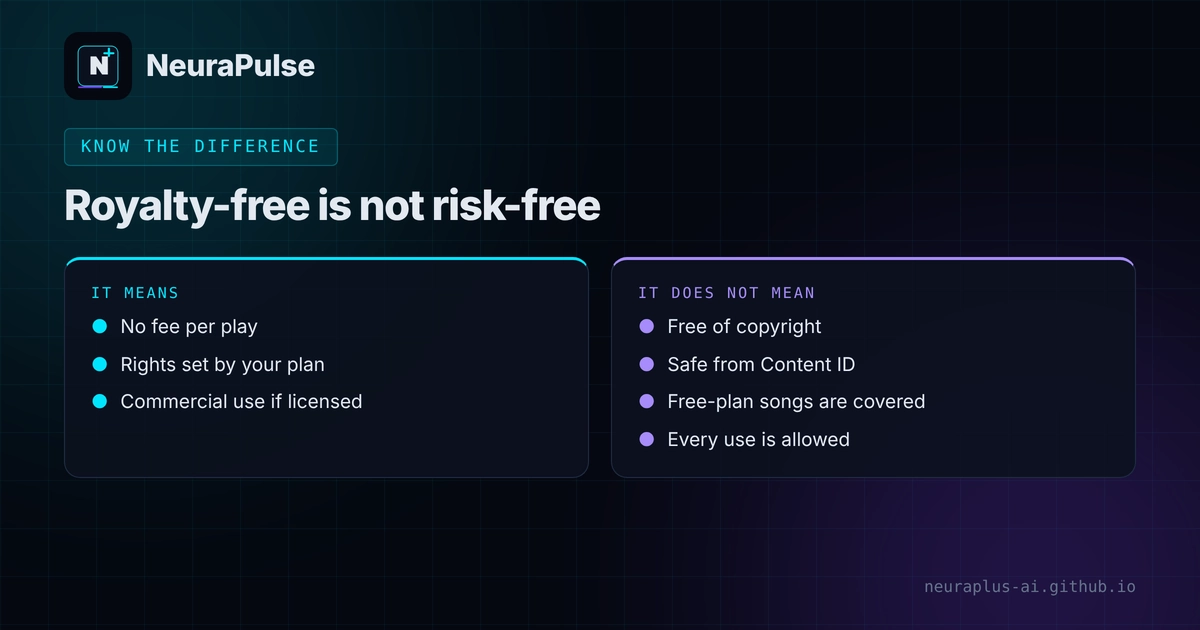
- It means you do not pay a fee each time the track is played or used, as long as you stay inside the licence.
- It does not mean the music is free of copyright. Someone, or no one, still holds rights, and the licence decides what you may do.
- It does not mean you cannot receive a Content ID claim. A generated melody that resembles an existing song can still be flagged.
- It does not mean every use is allowed. Licences often exclude film, TV, client work or distribution on streaming services.
- It does not mean songs made on a free plan are covered. A February 2026 summary says upgrading does not license songs made on Suno's free plan.
Licence table: what each tool allows
| Tool | Commercial use | Catch to check | Plan needed |
|---|---|---|---|
| Suno | Pro and Premier grant commercial rights; Free is non-commercial | Official downloads only; monthly download caps; no copyright guarantee; some user-to-user remixes are non-commercial | Pro $10/mo or Premier $30/mo |
| ElevenLabs Music | Tiered by plan; trained on licensed data and positioned as cleared for commercial use | A February 2026 summary lists exclusions by tier, such as podcasts, advertising and film or TV; check current terms | Starter and above, per a later review |
| Udio | Not practical: downloads are disabled | Tracks stay inside the app after music-industry settlements | Not applicable |
| Soundraw | Commercial background use on Creator | Built for background tracks; check platform-specific terms | Creator $16.99/mo |
| Mubert | Pro adds commercial use | No plan allows distribution on Spotify, and tracks cannot be registered in Content ID, per reviews | Pro $39/mo |
| AIVA | Limited monetisation on Standard; full ownership on Pro | Free tier allows no monetisation | Standard €11/mo or Pro €33/mo (yearly) |
| Meta MusicGen (open weights) | No: weights are CC-BY-NC 4.0, per a review | Good for experiments, not commercial use | Not applicable |
| Design.com | Not a music tool | Useful for branding your channel | Check Design.com |
| OpenMel | Not reviewed here | We could not verify its licence terms | Check OpenMel directly |
Sources: a licensing summary dated February 26, 2026 and reviews dated June to October 2026. Terms change often. Read the current terms of your plan.
ElevenLabs publishes its own model-specific music terms on its site, and you can find the company at elevenlabs.io. For our own coverage, see ElevenLabs pricing and features.
Copyright and Content ID: the part people miss
- Ownership is not guaranteed. Suno assigns any rights it holds in paid outputs but does not guarantee copyright protection, according to an October 2026 review.
- US law requires human authorship. The February 2026 summary says purely AI-generated music is likely not copyrightable, and a text prompt does not count as composing. Writing your own lyrics makes the lyrics copyrightable.
- Look-alike risk. Generated melodies can resemble existing songs, which may trigger Content ID claims or infringement complaints even without intent.
- Training data. Suno committed, as part of a late 2025 settlement with Warner Music Group, to retire models trained on unlicensed music and launch models trained only on licensed works. Udio settled with Universal and Warner and became a closed fan platform.
A safe workflow in six steps
- Choose a plan that names your use. Read the licence for podcasts, ads, client work or streaming before you generate anything.
- Generate on that plan. Do not make tracks on a free plan and plan to use them later.
- Write your own lyrics. It strengthens your claim to the words and makes the song more distinctive.
- Use the official download. Screen recordings and unofficial downloaders may not carry rights. Suno states commercial use requires a permitted download.
- Keep a receipt. Save the tool, plan, date, prompt, file name and a copy of the terms.
- Disclose and test. Follow each platform's AI disclosure rules, and upload a private version first to see if any automated claim appears.
Platform rules to expect
- Streaming services. Major platforms began requiring AI music disclosure in late 2025, and non-disclosure can lead to takedowns and account bans. DistroKid has started flagging AI content.
- YouTube. Content ID can flag similar melodies. Disputes may take days or weeks.
- Ad and sponsorship platforms. Some licences exclude advertising unless you buy a higher tier.
- Clients. Contracts may require you to guarantee ownership, which AI music may not allow.
For podcasters, see free AI music for podcasts. If you plan to earn from your content, read how to monetize AI content.
Mistakes to avoid
- Using free-plan songs in a monetised video or podcast.
- Assuming "royalty-free" means "claim-free".
- Downloading with unofficial tools.
- Skipping records, then being unable to prove your plan in a dispute.
- Promising a client full ownership of AI music.
- Skipping disclosure where a platform requires it.
💡 Not legal advice: This guide explains common licence terms. For high-stakes projects such as ads or client deliverables, ask a lawyer to read the exact terms of your plan.
How this guide was researched
Methodology and limits
- Licence and copyright points come from a licensing article dated February 26, 2026 and reviews dated June to October 2026. We did not read each tool's full legal terms.
- Sources disagree in places, mainly on ElevenLabs Music tiers, and we say so.
- We are not lawyers, and this article is not legal advice.
- Author: Prashant Lalwani. Last verified November 18, 2026.