📊 AI Image Generators · Case Study
AI Image Generator Case Study 2027: What Brands Report and What Is Proven
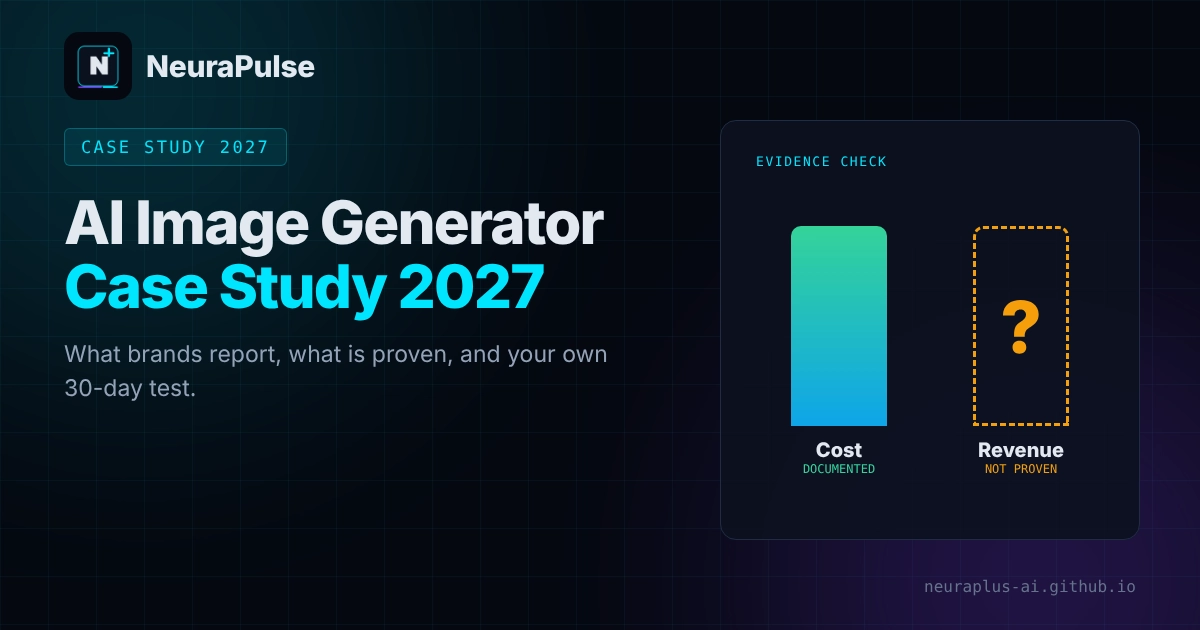
Search for an AI image generator case study and you will find confident headlines: costs cut by 80 percent, click-through rates up by 40 percent. Most come from companies that sell the tools. This guide takes a different approach. It reviews the evidence that exists, labels how strong each claim is and gives you a plan to produce a real case study with your own numbers.
✅ Short answer: The cost advantage of AI images is well documented. The revenue effect is not independently proven. Trust effects cut both ways. If you want a case study you can believe, run a small, fair test on your own products.
Short answer: what the evidence says in 2027
A 2026 analysis from Kaptur argues that AI product imagery is justified almost entirely by cost savings, while nobody has independent evidence on whether it earns or loses revenue. That matches what we found: plenty of vendor stories, very few independent tests. We therefore do not publish an invented "we increased sales by X percent" story. Below is what is actually on the record.
Evidence scorecard: claims and how solid they are
| Claim | Where it comes from | How solid | What to do with it |
|---|---|---|---|
| AI images cost about $1 to $10 each versus $500 to $2,000 per product for a studio shoot | Kaptur analysis, 2026 | Reasonable as a range; varies by product | Use it to estimate savings, then log your own costs |
| Vendor case studies report cost cuts of 80 to 90 percent and higher click-through rates | Tool-vendor blogs | Weak: sellers publish them, methods are rarely shown | Treat as marketing, not proof |
| MANGO rolled out AI-generated imagery on product detail pages | Reported by Kaptur | The rollout is reported; no performance results were given in that source | Shows adoption, not outcomes |
| 71 percent of 411 shoppers could not tell AI fashion images from photos | Stylitics and Aha Studio survey | Weak to moderate: perception only, and the sponsor sells AI styling tools | Shows quality is high, not that sales rise |
| 37 percent of shoppers check return policies more carefully when they know an image is AI-made | Stylitics and Aha Studio survey | Same caveat as above | Watch return behaviour in your test |
| 50 percent of consumers prefer brands that avoid generative AI in consumer-facing content | Gartner, 1,539 US consumers, March 2026, as reported by Kaptur | Analyst survey; sample and wording matter | Take trust seriously, especially in premium categories |
| Disclosing AI content can produce a trust penalty | Nuremberg Institute for Market Decisions, as reported by Kaptur | Research institute finding; not specific to your niche | Test how your audience reacts |
| Design.com | Brand and logo tool | Not assessed in this review | See Design.com for current details |
Source note: the Kaptur analysis is secondary reporting. We did not review the underlying surveys or vendor case studies.
What is well documented: cost and speed
The cost side is easy to believe. A studio shoot costs money per product, and an AI image costs cents to a few dollars depending on tool and retries. For a catalogue of 1,000 products that is the gap between a small subscription and a large photography budget. Real API prices back this up: at published rates, 1,000 images cost roughly $11 to $80 on common models, as shown in AI image generator pricing 2027. Speed also helps, because a seasonal refresh no longer waits for a studio booking. Your true cost still includes your time, rejected images and the effort to check accuracy.
What is not proven: revenue
The same analysis lists what is missing: independent A/B tests comparing AI and traditional imagery on conversion, revenue and return rates, and a closed loop linking image creation to purchase outcomes. Tool vendors cannot measure the second half, and analytics platforms are not connected to the first. Until that gap closes, any claim of a precise sales lift should be treated as a hypothesis for your store to test.
Trust and returns: the hidden side of the story
Costs are only half of the equation. If an AI image makes a product look better than it is, you may win the click and lose the customer. Returns, support tickets and reviews are where that shows up. The numbers above suggest that shoppers are more cautious when they know an image is AI-made, and a meaningful share of consumers prefer brands that avoid it. Protect yourself by keeping the product itself accurate and by including at least one unedited photo in every gallery. Our ecommerce tutorial shows how.
Run your own 30-day case study
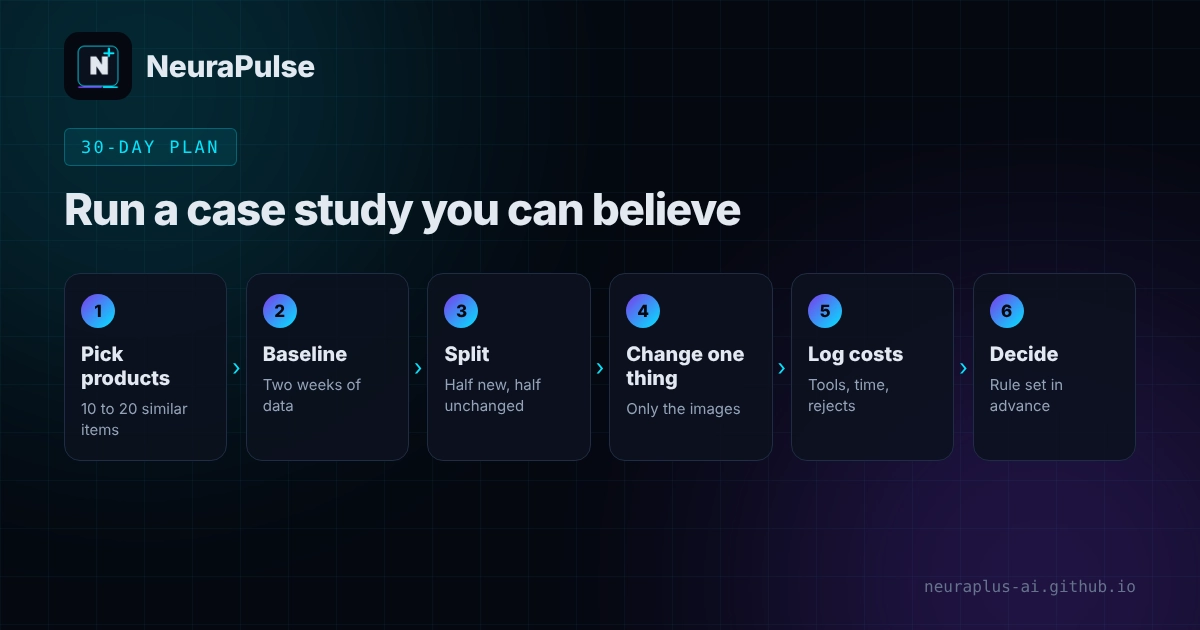
- Choose 10 to 20 similar products. Pick items with steady traffic and similar price points, so the comparison is fair.
- Record a two-week baseline. Note conversion rate, add-to-cart rate, average order value and returns for the current images.
- Split the products. Give half the new AI images and keep half unchanged. If your platform supports it, split traffic on the same product instead.
- Change one thing. Only the images should differ. Do not change prices, copy or promotions during the test.
- Log every cost. Tool fees, prompt time, review time and rejected images.
- Wait for enough data. Do not stop early because one side looks ahead.
- Decide with a rule you set in advance. For example: roll out only if conversion is not worse and cost per image is lower.
If you plan to generate images at volume, use the workflow in batch AI image generation for marketing.
A case study template you can fill in
TITLE: AI product images vs current images, [STORE], [DATES]
HYPOTHESIS: New AI images will keep or improve conversion at lower cost.
SETUP: [N] products, split [A/B], same prices and copy.
IMAGES: [Tool, model, plan, date]; [number of images per product].
BASELINE (2 weeks): CVR [x%], AOV [$x], return rate [x%].
TEST (4 weeks): CVR [x%], AOV [$x], return rate [x%].
COST: tool [$x], time [x hours], rejected images [x%].
RESULT: [what changed, with sample size].
CAVEATS: [seasonality, traffic mix, promotions].
DECISION: [roll out / adjust / stop].
Publishing a result like this, with your own screenshots and numbers, is the strongest trust signal you can give readers, and it is the kind of first-hand experience search engines look for.
💡 Keep it honest: A small test with clear caveats is worth more than a big claim with none. Say what you measured, how long, and what could have skewed it.
How this guide was researched
Methodology and limits
- The evidence comes from a 2026 Kaptur analysis of AI commercial imagery, which itself cites Photoroom, Stylitics and Aha Studio, Gartner and the Nuremberg Institute for Market Decisions. We did not review the original studies.
- We looked at published vendor case studies for claims about cost and click-through, but we do not repeat their figures as fact because their methods are not shown.
- This article contains no first-party results. The 30-day plan and template are a method for you to produce your own.
- Author: Prashant Lalwani. Last verified November 18, 2026.