🖼️ AI Image Generators · Pricing
AI Image Generator Pricing 2027: Plans, Credits and the Real Cost per Image
The short answer: most people pay $10 to $30 a month for a subscription, while developers and high-volume teams pay about half a cent to 24 cents per image through an API. The right choice depends less on the sticker price and more on how many images you throw away before you get a keeper.
✅ Quick verdict: Light, private use: a $10 to $12 plan. Daily creative work: a $30 plan with unlimited relaxed or slow generations. Apps and automation: pay per image, and use Batch pricing when you can wait. Teams: price per seat before you compare anything else.
Short answer: what AI image generators cost in 2027
Pricing falls into three models, and mixing them up is the most common budgeting mistake.
- Subscription with fast hours or credits. Midjourney, Adobe Firefly, Leonardo and Ideogram work this way. You pay monthly and spend a fixed allowance.
- Bundled into a chatbot plan. ChatGPT and Gemini include image generation in their own plans, with usage caps that the vendors do not publish as exact numbers.
- Pay per image through an API. OpenAI, Google, Black Forest Labs (Flux) and Stability AI bill per image or per token, which is what apps and automations use.
If you are choosing between tools rather than prices, start with our best AI image generator for business guide, then come back here to price the shortlist.
Subscription pricing compared
Here is what the main consumer plans cost and what you get for the money. Prices are in US dollars and were checked in October and November 2026.
| Tool | Entry plan | Mid plan | Top plan | Commercial use |
|---|---|---|---|---|
| Midjourney | Basic $10/mo ($96/yr) | Standard $30/mo ($288/yr) | Mega $120/mo ($1,152/yr) | Allowed on all plans. Companies over $1M revenue must use Pro or Mega |
| Adobe Firefly | Standard $9.99/mo, 2,000 credits | Pro $19.99/mo, 4,000 credits | Premium, 50,000 credits | Adobe-trained models are positioned as commercially safe; partner models carry your own responsibility |
| Leonardo.Ai | Essential $12/mo ($10 yearly) | Premium $30/mo | Ultimate $60/mo | Private generations start on Essential; free creations are public |
| Ideogram | Plus $20/mo ($15 yearly) | Pro $60/mo ($42 yearly) | Team $30 per user/mo, plus Enterprise | Private images start on Plus; free images are public |
| Recraft | Basic $12/mo ($10 yearly) | Higher tiers | Team options | Free images are public and not licensed for commercial use; paid plans grant commercial rights |
| Krea | Basic $9/mo ($5 yearly) | Higher tiers | n/a | Private images and commercial rights from the entry paid tier, per a dated review |
| ChatGPT | Go $8/mo | Plus $20/mo | Higher tiers | Image limits are not published as exact numbers |
| Google AI Plus (Gemini) | $4.99/mo | Higher Google AI tiers | n/a | Check Google's terms for your use case |
| Design.com | Check Design.com for current plans | Higher tiers vary | n/a | Read the licence for your plan before commercial use |
Checked October to November 2026 against vendor pages and dated reviews. Confirm before you buy: plans change often.
Midjourney: the allowance matters more than the price
Midjourney sells time on its GPUs. Basic includes 3.3 fast hours a month and no Relax mode. Standard gives 15 fast hours plus unlimited Relax images. Pro gives 30 fast hours, Stealth mode and more concurrent jobs. Mega doubles the fast hours again. If you plan to generate every day, the jump from $10 to $30 buys you unlimited slower generations, which is usually the real upgrade. If you want a head-to-head on quality, see our Midjourney vs DALL-E 3 comparison.
Yearly billing: what you really save
Yearly plans cut the cost by 17 to 30 percent on the tools we checked.
- Midjourney Basic: $120 monthly versus $96 yearly, a $24 saving. Standard saves $72, Pro $144, Mega $288, all 20 percent.
- Ideogram Pro: $720 monthly versus $504 yearly, a $216 saving (30 percent).
- Ideogram Plus: $240 monthly versus $180 yearly, a $60 saving (25 percent).
- Leonardo Essential: $144 monthly versus $120 yearly, a $24 saving (about 17 percent).
Only pay yearly after a month of monthly use. Tools and models change quickly, and a discount on a plan you stop using is not a saving.
API pricing: cost per image for developers
APIs charge by the image or by tokens, and quality or resolution moves the price a lot. Here is what we found for common models. Treat them as starting points, because vendors update model names and rates often.
- OpenAI GPT Image (1024px square). Standard price: About $0.006 low, $0.053 medium, $0.211 high (estimates for GPT Image 2). Batch or discount: Image output tokens $30 per 1M, $15 with Batch. Notes: ChatGPT Images 2.5 shipped September 8, 2026; real 2.5 costs may differ from the estimates.
- OpenAI GPT Image 1.5. Standard price: $0.009 low, $0.034 medium, $0.133 high. Batch or discount: n/a. Notes: Older model, still a cheaper high-quality option.
- OpenAI GPT Image 1 Mini. Standard price: $0.005 low, $0.011 medium, $0.036 high. Batch or discount: n/a. Notes: Cheapest OpenAI route for volume.
- Gemini 2.5 Flash Image (Nano Banana). Standard price: $0.039. Batch or discount: $0.0195 with Batch (up to 24 hours). Notes: All output includes a SynthID watermark.
- Gemini 3.1 Flash Image (Nano Banana 2). Standard price: $0.067 at 1K, $0.151 at 4K. Batch or discount: $0.034 at 1K with Batch. Notes: Price scales with resolution.
- Gemini 3 Pro Image (Nano Banana Pro). Standard price: $0.134 at 1K or 2K, $0.24 at 4K. Batch or discount: $0.067 at 1K or 2K with Batch. Notes: Premium quality tier.
- FLUX.2 [pro] (Black Forest Labs). Standard price: From $0.03. Batch or discount: Prepaid credits at about $0.01 each. Notes: Open-weights FLUX.2 [dev] is non-commercial only.
- Stability AI Stable Image. Standard price: Core $0.03, Ultra about $0.08. Batch or discount: 25 free credits to start. Notes: Credit worth $0.01; you build your own interface.
Sources: dated vendor-price roundups and reviews from August to October 2026. API prices change often; check the current rate card before you budget.
Midjourney has no official public API. A report updated October 8, 2026 says Midjourney is only "considering" an enterprise API. Unofficial wrappers exist, but automating your account breaks Midjourney's terms and can get it banned. Our AI image generator API integration guide covers legitimate alternatives.
What 1,000 images a month really costs
A fair comparison needs one volume. Here is the monthly bill for 1,000 images at the lowest listed price for each route (square or 1K output, one generation per image, no retries). The arithmetic is simple multiplication of the per-image prices above.
- GPT Image 1 Mini, medium: $0.011 per image, about $11 for 1,000 images.
- FLUX.2 [pro] (from): $0.03 per image, about $30 for 1,000 images.
- Stable Image Core: $0.03 per image, about $30 for 1,000 images.
- Gemini 2.5 Flash Image: $0.039 (batch $0.0195) per image, about $39 (batch $19.50) for 1,000 images.
- GPT Image 2 estimate, medium: $0.053 per image, about $53 for 1,000 images.
- Gemini 3.1 Flash Image, 1K: $0.067 (batch $0.034) per image, about $67 (batch $34) for 1,000 images.
- Stable Image Ultra: about $0.08 per image, about $80 for 1,000 images.
- GPT Image 2 estimate, high: $0.211 per image, about $211 for 1,000 images.
- Midjourney Standard: Not billed per image per image, about $30 flat, with unlimited Relax for 1,000 images.
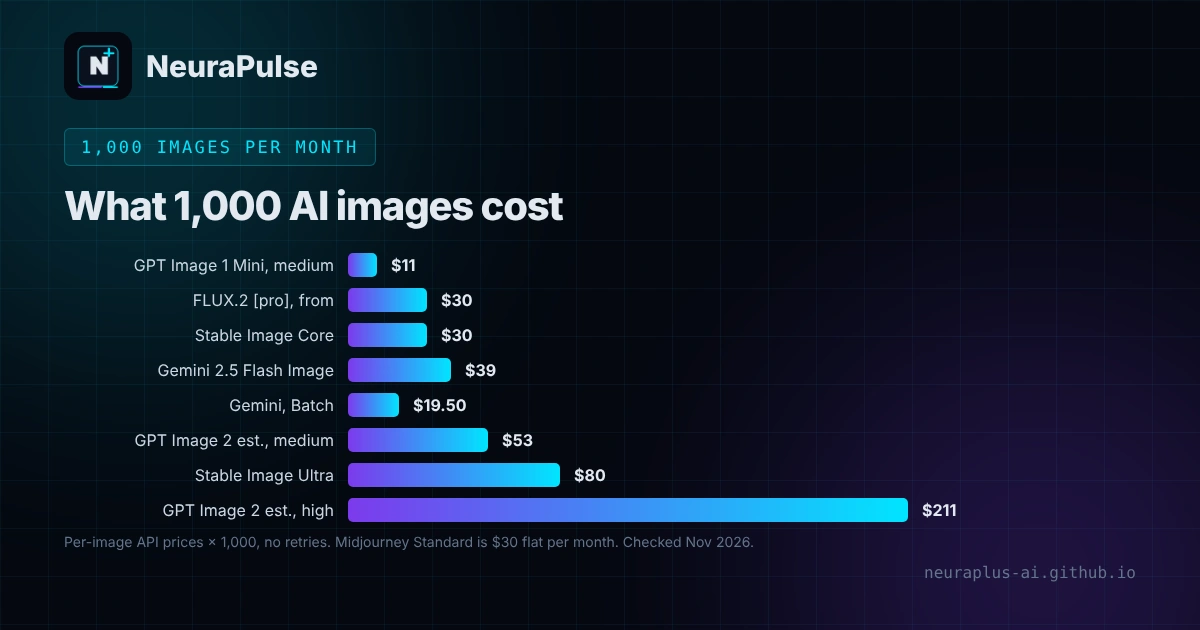
Read these figures with one caution. API figures assume every image is a keeper. If you need five attempts to land one usable image, multiply by five. That is why a flat subscription can beat a cheaper-looking API for creative exploration, and why an API wins for repeatable jobs such as product backgrounds or social templates. If you plan large runs, read our guide to batch AI image generation for marketing before you pick a model.
Free plans: what they cost you instead of money
Free tiers are real, but they pay for themselves in other ways. Watch these trade-offs.
- Images may be public. Leonardo, Ideogram and Recraft free creations are public, and Recraft's free images are not licensed for commercial use.
- Allowances are small and reset. Leonardo lists about 150 tokens a day and Adobe a small monthly credit allowance, according to dated reviews.
- Free-tier generations can be used to improve the vendor's products. Google says this about the free Gemini API tier.
- Output may carry a visible or invisible watermark. See our full breakdown in AI image generator without watermark, and our no-login AI image generator list for tools you can try quickly.
How to choose by budget and use case
Midjourney Basic, Firefly Standard, Krea or Google AI Plus. Check image privacy and commercial terms first.
Midjourney Standard for unlimited Relax, Leonardo Premium, or Ideogram Plus for text-heavy graphics.
OpenAI, Gemini, Flux or Stability, with Batch pricing for work that can wait up to 24 hours.
Compare Leonardo Team, Ideogram Team and Adobe's business plans. See the designer-focused picks.
For marketing teams that care more about output per dollar than model quality, our best AI image generator for marketing guide ranks tools by workflow fit.
Hidden costs to price in before you subscribe
- Retries. The advertised price per image assumes one try. Budget two to five attempts for brand-sensitive work.
- Upscaling and editing. Some tools bill extra credits for upscales, variations or video.
- Seats. Team plans bill per user, and credits can be shared or pooled depending on the plan.
- Privacy. Private generation is a paid feature on several tools. If client work must stay confidential, price that tier.
- Licensing. Revenue thresholds, such as Midjourney's $1M rule, can push a growing company onto a higher plan.
- Time. A $0 tool that costs you an hour of cleanup per image is not free.
💡 Cheap test: Before you commit to a yearly plan, run the same ten real prompts through two tools for one month each. Count how many images were usable, then divide the monthly price by that number. That is your real cost per usable image.
How this guide was researched
Methodology and limits
- Prices come from the vendors' public plan pages where we could read them (for example Midjourney's plan comparison) and from dated third-party pricing reviews published between August and November 2026.
- When sources disagreed we kept the figure that appeared on the vendor page, or marked it as "from" or "about".
- OpenAI's per-image figures for the 2.5 models are estimates based on GPT Image 2 rates, because OpenAI has not published a per-image calculator for them.
- We did not run hands-on benchmarks for this article. It is a pricing guide, not a quality review. Quality comparisons live in our linked tool guides.
- Author: Prashant Lalwani. Last verified November 13, 2026.
Next steps: if you are building a pipeline, read the AI image generator API integration guide. If you want help writing better prompts so fewer images are wasted, see best prompts for image generation.